Not the Austrian painter — this Klimt is a one-man shoegaze project from the Polish coastal town of Sopot, and there is, as far as we can find, no dedicated English-language writeup about the band anywhere online. That's a genuine gap, not a marketing line: every substantial piece of writing about Klimt exists only in Polish, on record-label pages and music blogs most English speakers will never stumble across.
Klimt is the solo project of Antoni Budziński, guitarist for the Sopot band Saluminesja, and across three albums between 2008 and 2015 he built a genuinely distinctive body of shoegaze, post-rock, and ambient work — one that a Polish reviewer once said "hadn't existed in Poland for a very long time." He's played real festival stages, been mastered and produced by people with serious international credits, and still remains almost entirely unknown outside Poland.
This is an introduction for anyone who likes Slowdive, Bark Psychosis, or Labradford and has never had a reason to look toward Poland for more of that sound — because there's a genuinely rewarding discography here waiting to be heard.
Who Is Klimt?
Klimt began as a side project for Antoni Budziński, who plays guitar in the Sopot band Saluminesja, a coastal town on the Baltic just north of Gdańsk known more for its pier, its beaches, and its summer tourist crowds than for spawning hazy, introspective guitar music. He first surfaced publicly in 2007, contributing the track "Ennui" to the compilation Sleep Well III — a quiet, low-key debut that gave little indication of the sustained project it would become.
That first taste of the project's sound led directly into a full album the following year, and rather than a one-off side project, Budziński kept building on it for the better part of a decade, releasing three full-length records under the Klimt name while continuing to play in Saluminesja alongside it. Sopot itself turns out to be a fitting backdrop for this kind of music — a seaside resort town that empties out and turns grey and quiet for most of the year, which lines up unusually well with the wintry, half-lit atmosphere that runs through everything he's released as Klimt.
That a working guitarist in an established band would also carve out the time and space for a much quieter, more introspective solo project says something about how much this material meant to him — Klimt was never a quick side hustle, but a genuinely separate creative identity he kept developing for years alongside his main band.
Jesienne Odcienie Melancholii: The Debut That Started It All
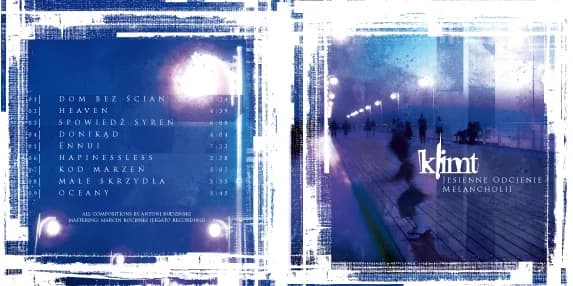
Album artwork courtesy of Requiem Records — the label behind Klimt's debut.
The debut album, Jesienne Odcienie Melancholii ("Autumn Shades of Melancholy"), arrived in 2008 through Requiem Records, mastered by Marcin Bociński. Its nine tracks — including "Dom bez ścian," "Heaven," "Spowiedź syren," "Donikąd," the earlier "Ennui," "Hapinessless," "Kod marzeń," "Małe skrzydła," and "Oceany" — run through a sound the label itself described as "spacious guitars and quiet vocals engaging in dialogue with ambient-oriented electronics and raw rhythm from a drum machine."
Polish music site Nowa Muzyka reviewed the record on its release and drew comparisons to Bark Psychosis, Labradford, and the Icelandic act Slowblow — all artists working in the blurrier, more ambient end of post-rock rather than straightforward shoegaze. The reviewer's description of the listening experience has stuck with anyone who's covered the album since: hearing the music, they wrote, felt like "hearing music through a wet window." That reviewer also noted, pointedly, that this kind of hazy, intuitive production "hadn't existed in Poland for a very long time" — a genuine claim about a gap in the country's music scene that Klimt was quietly filling.
The album didn't go unnoticed domestically, either. It appeared in several year-end roundups of Polish releases, including a mention in the culture magazine Przekrój — modest recognition, but real recognition, for a debut this understated.
Track titles alone hint at the record's emotional register without needing a lyric sheet: "Dom bez ścian" translates to "House Without Walls," and "Spowiedź syren" to "Confession of Mermaids" or "Sirens' Confession" — imagery that leans toward the dissolving, the unguarded, and the half-real, which lines up neatly with a sound built around reverb, whispered vocals, and blurred edges rather than sharp definition. Even the handful of English titles scattered through the tracklist — "Heaven," "Hapinessless" — read like fragments rather than complete thoughts, which suits an album more interested in atmosphere than narrative.
The cover art draws on that same imagery directly — a blurred nighttime shot of a pier, rather than the abandoned factories or industrial decay so often used to signal melancholy in this kind of music. The Nowa Muzyka review actually flagged this as a small missed opportunity, noting the artwork could have leaned into a more distinctly Polish visual identity rather than a generic seaside scene, while still conceding that a pier is a genuinely fitting image for a band based in Sopot, a town built around exactly that kind of structure.
It's a minor critique, but a telling one: even a favorable review was already thinking about how this project could present itself more distinctly to a wider audience, years before that audience had any real chance of encountering it.
The Sound: Shoegaze, Ambient, and a Sopot Seaside Melancholy
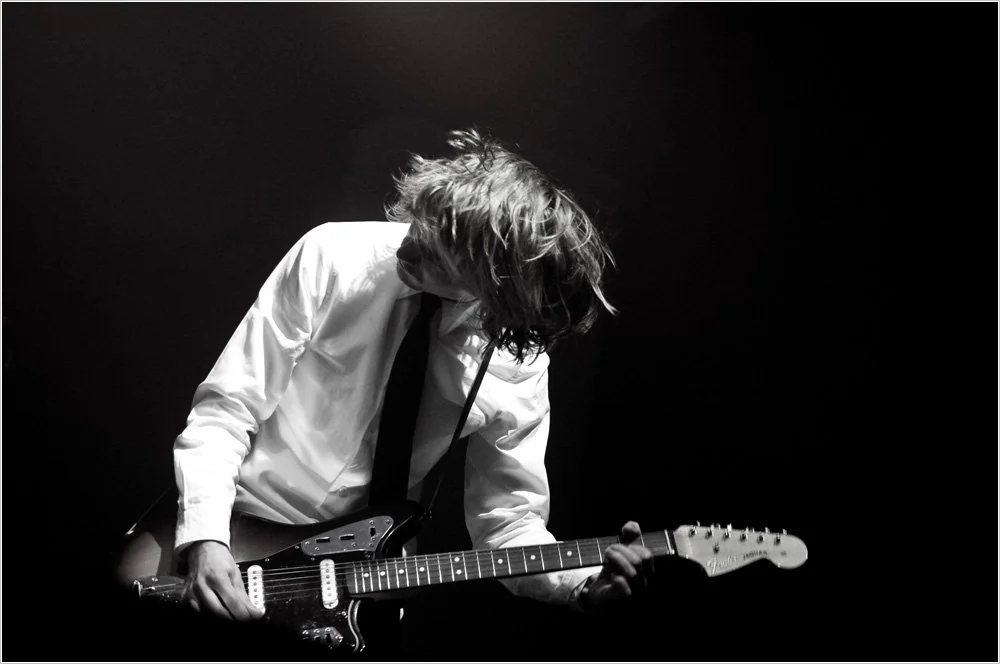
Photo of Antoni Budziński (Klimt) courtesy of Requiem Records.
This project's sound sits closer to the ambient, ego-dissolving end of shoegaze than the guitar-pedal-worship end most newcomers to the genre expect. Rather than walls of distortion, the emphasis is on space — reverb-soaked guitar lines, near-whispered vocals mixed low, and a drum machine standing in for a full rhythm section, giving the whole thing a hazier, more electronic-leaning texture than the genre's shoegaze forebears.
That approach translated to a real stage presence, too. Budziński brought the project to the Festival of Polish Song in Opole in June 2008, and to two of Poland's biggest festival stages for alternative and indie acts, Open'er Festival and the 2010 edition of Seven Festival — a genuine indicator that this wasn't a bedroom project that stayed in the bedroom.
For Fans Of: Where This Project Fits
If you already know Slowdive, Bark Psychosis, or Labradford, the reference points reviewers reached for when this record came out, you have a genuinely good sense of what to expect — hazy, reverb-drenched guitar lines, vocals mixed low enough to function almost as another instrument, and a general refusal to resolve into anything as direct as a hook or a chorus.
Where the project pulls away from those touchstones is the drum machine. Rather than a live rhythm section pushing the songs forward the way it might on a classic early-90s shoegaze record, mechanical, understated beats sit underneath the guitar haze, giving the whole thing a colder, more electronic-adjacent edge — closer to the ambient and post-rock artists the Nowa Muzyka review invoked than to the genre's noisier, more distortion-heavy end. It's a small production choice, but it's the one detail that makes this catalog feel like its own thing rather than a straightforward Slowdive tribute.
AGAPE and Genesa: A Career That Kept Evolving
Klimt didn't stop after one album. A second record, AGAPE, followed in February 2011, and a third, Genesa, arrived on 13 February 2015 — eight compositions the label described as sitting at "the intersection of shoegaze, ambient, and post-rock."
Genesa is also where the project picked up its most internationally notable production credit: the album was produced by Tom Meyer at Hamburg's Master & Servant studio, an engineer who has worked with Brian Eno, Nick Cave, and David Gray. The record's concept drew on Budziński's own dream world, with the title referencing what the label described as "the primordial essence of our self, which often becomes obscured in today's world" — a fittingly abstract, interior theme for a project built around blurred edges and half-lit atmosphere from the start.
Three albums across seven years, real festival stages, and a producer with genuine international pedigree — on paper, that's the resume of a band that should have crossed over. It just never got the English-language write-up to make that crossover happen, until now.
That the Master & Servant connection happened at all is worth sitting with for a second. Getting an engineer who has worked with Brian Eno, Nick Cave, and David Gray to produce a record isn't the kind of thing that happens for a project nobody in the industry rates — it's a genuine vote of confidence from someone with plenty of higher-profile options, and a sign that the quality of this catalog was recognized by people well outside Poland's own music press, even if that recognition never translated into wider English-language coverage.
Why Klimt Never Broke Through Internationally
The honest answer is mostly timing and language, not quality. The band's early years — 2007 to 2011 — predate the current era of algorithmic music discovery, when a Bandcamp tag or a Spotify playlist placement can hand an obscure band an international audience almost by accident. Back then, discovery depended heavily on English-language music blogs and magazines actually writing about a release, and none ever did for Klimt.
Everything of substance written about the band — reviews, festival write-ups, label copy — exists only in Polish, on sites like Nowa Muzyka, Polskie Radio, and Requiem Records itself. A shoegaze fan browsing English-language blogs in 2008 simply had no path to ever hearing about this record, no matter how well it might have fit their taste. That's less a statement about the music and more a statement about which country's music press an international audience happens to read.
It's also worth saying plainly that Poland's underground guitar-music scene has rarely gotten the international press attention its metal and extreme-music scenes have — Polish death metal and black metal acts have built real international followings for decades, while quieter, more atmospheric guitar music from the same country has stayed almost entirely domestic by comparison. A record this understated was always going to have a harder time getting noticed abroad than a genre with a louder, more established export pipeline already built for it.
Where to Listen
The clearest way in is Requiem Records' own page for the debut album, linked above, which is also where the label sells the record directly. Both the debut and AGAPE are streaming on Spotify, and the full catalog is up on Apple Music as well, so a full listen is one tap away on whichever service you already use. Klimt's track "Uciekanie" is also available through the Bandcamp compilation Post-rock PL, a reasonable starting point if you want to sample the sound before committing to a full album. On Rate Your Music, the band's discography sits under the tag "Eastern European Shoegaze" — a small, quiet corner of the genre that deserves a lot more listeners than it currently has.
If Klimt's hazy, melancholic sound appeals to you, our deep dive on Zdzisław Beksiński's art covers another corner of Polish culture built on a similarly unsettling, dreamlike atmosphere — different medium, same instinct for turning melancholy into something genuinely beautiful.
Frequently Asked Questions
Who is Klimt (the band)? The solo shoegaze, post-rock, and ambient project of Antoni Budziński, guitarist of the Sopot band Saluminesja — not to be confused with the Austrian painter Gustav Klimt.
What genre is Klimt? Shoegaze blended with post-rock and ambient electronics, built around spacious reverb-heavy guitars, quiet vocals, and drum-machine rhythms rather than traditional rock structures.
What was Klimt's first release? The track "Ennui," which appeared on the compilation Sleep Well III in 2007, followed by the full debut album Jesienne Odcienie Melancholii in 2008.
How many albums has Klimt released? Three: Jesienne Odcienie Melancholii (2008), AGAPE (2011), and Genesa (2015).
Who produced Klimt's album Genesa? Tom Meyer, at Hamburg's Master & Servant studio, an engineer who has also worked with Brian Eno, Nick Cave, and David Gray.
Has Klimt played any notable festivals? Yes — the Festival of Polish Song in Opole (2008), Open'er Festival, and the 2010 edition of Seven Festival.
Where can I listen to Klimt? Klimt's albums are streaming on both Spotify and Apple Music, Requiem Records sells the debut album directly, and the track "Uciekanie" is available on Bandcamp via the Post-rock PL compilation.
Why hasn't Klimt gotten more international recognition? Mostly timing and language — the band's most active years predate today's algorithmic music discovery, and every substantial review or writeup about the project has only ever been published in Polish.
What language are Klimt's song titles in? Mostly Polish, with a handful of English titles mixed in, such as "Heaven" and "Hapinessless" alongside Polish ones like "Dom bez ścian" ("House Without Walls") and "Spowiedź syren" ("Confession of Mermaids").
Klimt is exactly the kind of band a genre fan discovers by accident and then wonders why nobody told them sooner. If Slowdive, Bark Psychosis, or Labradford are already in your rotation, Antoni Budziński's decade of quiet, foggy Polish shoegaze deserves a place next to them.