Polish tongue twisters have a reputation that isn't exaggerated — the country's most famous one is genuinely difficult enough that native Polish speakers stumble over it too, and Poles love handing it to foreign learners specifically to watch them try. If you've ever wondered why a small town in eastern Poland has a bronze statue of a beetle playing violin in a top hat, the answer is a Polish tongue twister so beloved it became a tourist attraction.
Understanding Polish tongue twisters matters for more than party tricks. They pack an unusual concentration of the exact sounds that make Polish pronunciation hard for learners in the first place — consonant clusters, nasal vowels, and the notoriously confusing sz/ś/ż/ź/cz/ć family of sounds — into short, memorable phrases that are actually fun to practice out loud.
This guide covers Poland's most famous Polish tongue twister and the town that built a monument to it, several more to add to your practice list, and a breakdown of exactly which sounds make them so difficult in the first place.
The Most Famous One: The Szczebrzeszyn Beetle
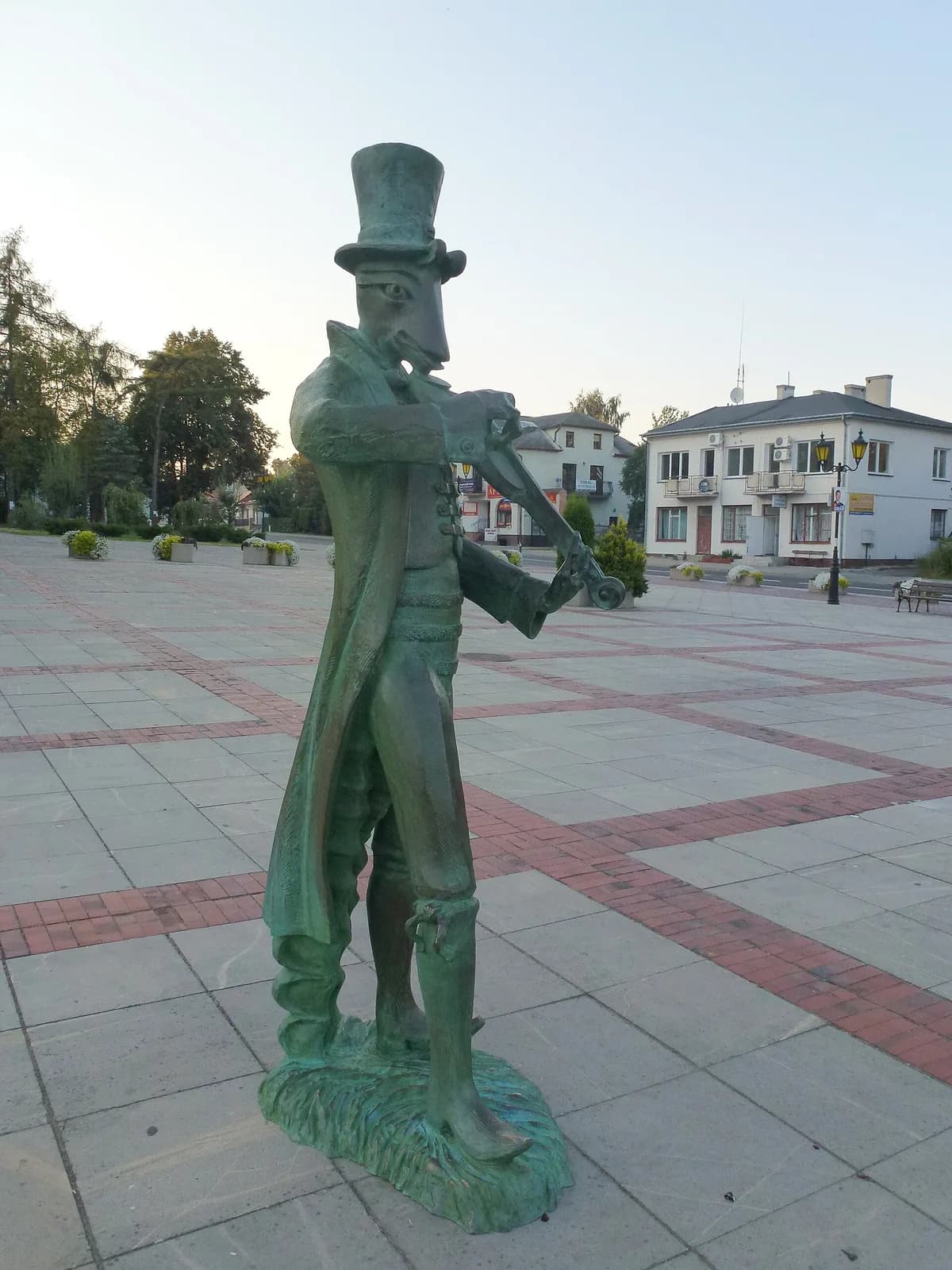
Photo: Lysy, CC BY-SA 3.0, via Wikimedia Commons.
"W Szczebrzeszynie chrząszcz brzmi w trzcinie, i Szczebrzeszyn z tego słynie" — "In Szczebrzeszyn a beetle buzzes in the reed, and Szczebrzeszyn is famous for that" — is the single most recognized entry in the entire canon of Polish tongue twisters. It comes from a poem called Chrząszcz ("Beetle") by the beloved children's author Jan Brzechwa, though the opening line itself is older, dating to at least the 19th century, according to Wikipedia's overview of the poem.
The line packs an almost cruel concentration of difficulty into a few words: chrząszcz alone is a single syllable containing five consonants in a row before you even reach the vowel, and the sentence repeats several of Polish's hardest sound pairs back to back. Among Polish tongue twisters, it's considered one of the toughest short phrases in the entire language — tough enough that it can trip up adult native speakers reciting it quickly.
The town of Szczebrzeszyn embraced the connection rather than resenting it. A wooden beetle monument went up first, then a permanent bronze version was unveiled in the market square on 23 July 2011 — a two-meter-tall beetle in a top hat and tails, mid-performance on a fiddle, exactly as whimsical as the poem that inspired it. The town has held an annual sculpture festival tied to the connection ever since, and English translator Walter Whipple, when adapting the poem, retitled it Cricket rather than attempting a literal translation — partly because the Polish word for cricket, świerszcz, is nearly as punishing to pronounce as the original.
Few pieces of wordplay anywhere earn a physical monument, which says something about how deeply this particular line has embedded itself in Polish popular culture. Ask almost any Polish adult to recite a Polish tongue twister on the spot, and this is overwhelmingly the one they reach for first — it functions less like an obscure linguistic curiosity and more like a shared cultural reflex, something everyone learned in childhood and never quite forgot.
Why Polish Tongue Twisters Are So Hard
Polish tongue twisters aren't hard by accident — they're built from exactly the features that make the language's phonology unusual in the first place, concentrated on purpose. Four core features do most of the damage:
Consonant clusters. Polish routinely allows three, four, or even five consonants in a row at the start of a word or syllable, with no vowel to break them up — chrząszcz, pchła (flea), and wstrząs (shock) are all real, ordinary Polish words built this way, not edge cases invented for twisters. A good Polish tongue twister usually stacks several of these words back to back, so the difficulty compounds rather than resetting between words.
The sz/ż/cz family vs. ś/ź/ć. Polish has two nearly-parallel sets of "sh," "zh," and "ch"-type sounds — one pronounced with the tongue further back (sz, ż, cz), one with it further forward and softer (ś, ź, ć) — and tongue twisters routinely force both sets into the same short phrase, daring you to keep them distinct. This single distinction is probably the most common reason a foreign learner's attempt at a Polish tongue twister sounds subtly "off" even when every individual word is technically correct.
Nasal vowels. The letters ą and ę represent nasalized vowel sounds with no real English equivalent, and they show up constantly in exactly the kind of words Polish tongue twisters love.
The trilled r. Polish r is a light alveolar trill, closer to a Spanish or Italian r than an English one, and it shows up paired with other consonants in ways that demand real tongue control.
Put those four features together in a single sentence, repeat a couple of them twice for good measure, and you've got the basic recipe behind nearly every entry on this list — which is exactly why Polish tongue twisters make such efficient pronunciation practice. You're not just memorizing a party trick; you're drilling the precise sound contrasts that determine whether the rest of your spoken Polish sounds natural or slightly foreign.
More Polish Tongue Twisters to Try
Once you've survived the beetle, a handful of other classic Polish tongue twisters are worth adding to your practice rotation — each one leans on a slightly different combination of the sounds above, and native speakers will recognize most of these on sight the same way English speakers know "she sells seashells."
| Polish | Rough meaning | What it drills |
|---|---|---|
| Król Karol kupił królowej Karolinie korale koloru koralowego | King Karol bought Queen Karolina coral-colored beads | Repeated "k" and rolled "r" in quick succession |
| Stół z powyłamywanymi nogami | A table with legs broken off in several places | A single long, heavily-inflected word as its own twister |
| Szedł Sasza suchą szosą i suszył sobie spodnie | Sasza walked along a dry road and dried his trousers | Repeated "sz" and "s" forcing you to keep both sounds distinct |
| Szły pchły koło wody, pchła pchłę pchła do wody | Some fleas walked by the water, one flea pushed another in | The "pchł" cluster repeated four times in one breath |
The "Stół z powyłamywanymi nogami" entry is a genuinely good beginner's gauge on its own — it's a single sentence, but powyłamywanymi is a nine-syllable word that forces you through nearly every tricky vowel ending Polish grammar can throw at a single adjective. If you can say that one smoothly, the shorter Polish tongue twisters on this list get noticeably easier.
The "King Karol" entry deserves a special mention too, since it's arguably the second-most-recognized item on any list of Polish tongue twisters after the beetle itself — Poles often reach for it specifically because, unlike the beetle poem, it doesn't require knowing an obscure small town to appreciate the joke, just a king with an alliteration problem.
A Practical Guide to the Trickiest Sounds
The sz/ś and cz/ć distinctions are worth isolating on their own, since they're the single biggest source of confusion for learners and the main engine behind most of the twisters above.
| Letters | Sound | Tongue twister example |
|---|---|---|
| sz | "sh," tongue pulled back | szosa (road), Szczebrzeszyn |
| ś / si | soft "sh," tongue forward | pchłę uśmiechnięta ("smiling flea," in longer variants) |
| cz | hard "ch," tongue back | Sasza, koloru koralowego |
| ć / ci | soft "ch," tongue forward | ćma (moth) — a common comparison word for practice |
| ż / rz | "zh," tongue back | trzcinie (in the reed), Karolinie |
| ź / zi | soft "zh," tongue forward | źle (badly) — a common comparison word |
If you want the fuller phonetic breakdown behind these sound pairs, our guide to mastering Polish pronunciation covers the underlying rules in more depth than a list of Polish tongue twisters can. For structured practice with the sound system generally, this lesson is also a solid starting point:
Polish Phonetics
How to Actually Practice These
Reading a list of Polish tongue twisters silently does almost nothing — the entire point is forcing your mouth through the motions out loud, slowly at first, and only picking up speed once the individual sounds are accurate. Trying to go fast from the start just means practicing your mistakes faster.
A workable routine looks like this: pick one Polish tongue twister, say it slowly enough that every consonant is deliberate, and don't move on to the next line until you can do that cleanly three times in a row. Only then start speeding up. Recording yourself while practicing a Polish tongue twister and comparing it to a native speaker's pronunciation — plenty of the sources linked throughout this guide include audio — will catch sz/ś and cz/ć mix-ups your own ear tends to miss while you're focused on just getting through the sentence.
Five minutes a day with one or two Polish tongue twisters, repeated slowly and deliberately, will do more for your pronunciation than an occasional half-hour session where you rush through the whole list once and move on.
Visiting Szczebrzeszyn
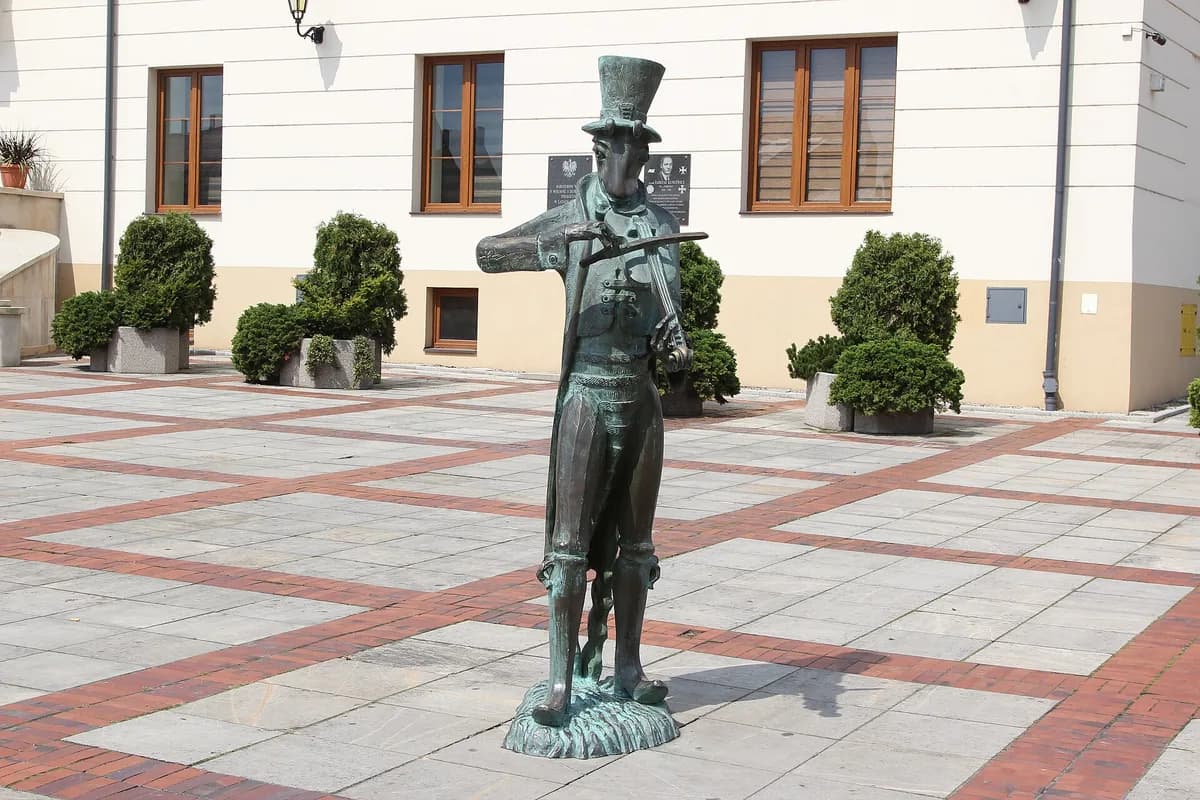
Photo: Fallaner, CC BY-SA 4.0, via Wikimedia Commons.
Szczebrzeszyn is a small town in the Lublin region of eastern Poland, and the beetle monument sits right in its market square — an easy, quick stop if you're passing through the region rather than a dedicated day trip. The town leans into its unlikely fame rather than downplaying it, and the annual sculpture festival tied to the connection has become a modest point of local pride.
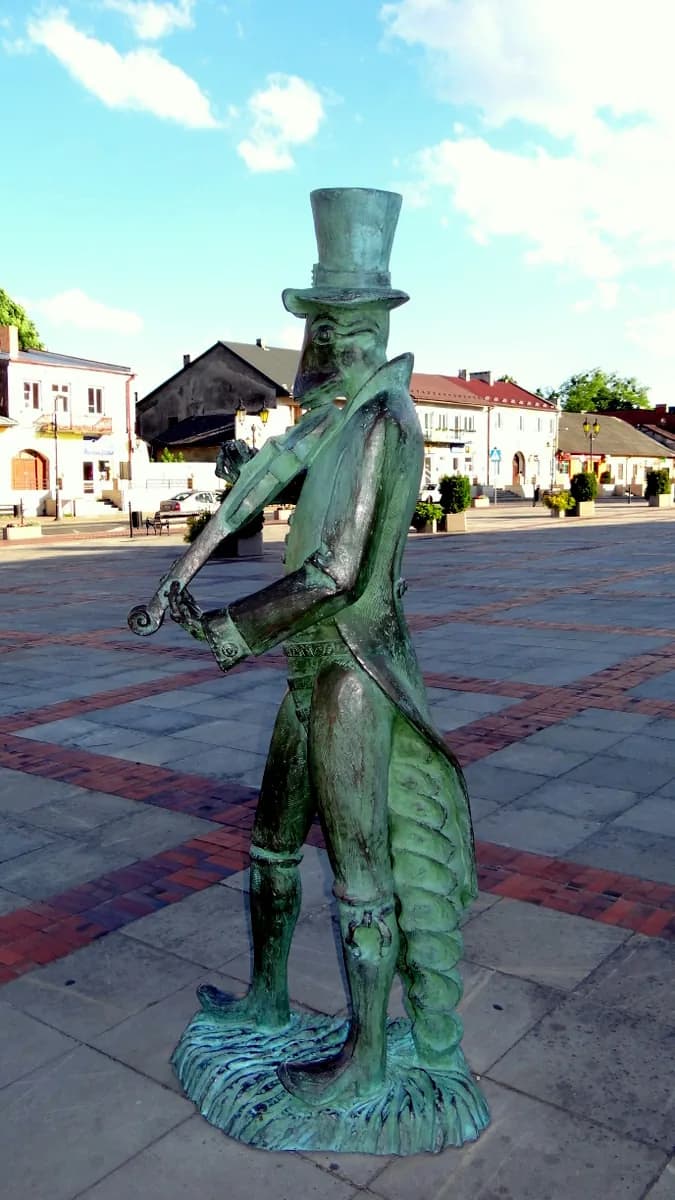
Photo: Gorofil, CC BY-SA 4.0, via Wikimedia Commons.
It's a small, specific example of something that shows up elsewhere in Polish culture too: a piece of wordplay becoming so beloved that it outgrows the page entirely and turns into a physical landmark. Few, if any, other countries have built a monument to a tongue twister, which makes Szczebrzeszyn's beetle a genuinely unique stop rather than just another small-town curiosity. If you enjoy that kind of "this became a whole cultural thing" story, our guide to what Żabka is covers a very different but similarly unlikely piece of everyday Polish pop culture.
Frequently Asked Questions
What is the most famous Polish tongue twister overall? "W Szczebrzeszynie chrząszcz brzmi w trzcinie" — "In Szczebrzeszyn a beetle buzzes in the reed" — from Jan Brzechwa's poem Chrząszcz.
Is Szczebrzeszyn a real place? Yes, a small town in the Lublin region of eastern Poland, which has a bronze beetle monument in its market square specifically because of the Polish tongue twister it inspired.
Why are Polish tongue twisters so hard? They concentrate consonant clusters, nasal vowels, a trilled r, and the easily-confused sz/ś, cz/ć, and ż/ź sound pairs into very short phrases on purpose.
Do native Polish speakers actually struggle with these? Yes — the Szczebrzeszyn Polish tongue twister in particular is difficult enough that native speakers can stumble reciting it quickly, which is part of why it's so well-loved.
What does "chrząszcz" mean? It means "beetle" or "chafer," and it's frequently cited as one of the hardest single words to pronounce in the Polish language.
Is there an English translation of the beetle poem? Yes — translator Walter Whipple rendered it as Cricket rather than translating literally, since the Polish word for cricket (świerszcz) is nearly as difficult to say as the original word for beetle.
What's a good beginner Polish tongue twister to start with? "Stół z powyłamywanymi nogami" is a single sentence built around one long word, making it a manageable first step before tackling longer, multi-clause Polish tongue twisters.
Are tongue twisters actually useful for learning Polish, or just a party trick? Both — Polish tongue twisters are genuinely useful for isolating and practicing the language's hardest sound distinctions, which is exactly why they exist as a category in the first place.
How should I practice Polish tongue twisters as a beginner? Slowly at first, prioritizing accuracy over speed — say each one deliberately until you can repeat it cleanly three times before trying to speed up.
Do Polish children learn these Polish tongue twisters in school? Many grow up with them informally, since Jan Brzechwa's poems (including Chrząszcz) are a staple of Polish children's literature, which is part of why the beetle-themed Polish tongue twister is so universally recognized.
Can I find more Polish tongue twisters beyond this list? Yes — Polish tongue twisters exist in the dozens once you look beyond the handful of famous ones covered here, ranging from short single-word challenges to longer poems built the same way as the Szczebrzeszyn beetle.
Are there tongue twisters in other Slavic languages too? Yes, most Slavic languages have their own tradition of tongue twisters built around similarly heavy consonant clusters, though the specific words and cultural fame of any single one — like Poland's beetle — vary widely from country to country, and none carry quite the same universal, monument-worthy recognition that Polish tongue twisters enjoy within Poland itself.
Polish tongue twisters are a genuinely good shortcut into the language's toughest sounds, wrapped in phrases memorable enough that you'll actually want to practice them. Start with the beetle, work through the rest of the list, and you'll come away with a noticeably better feel for exactly the sounds that trip up most learners.
And if a native speaker ever hands you one of these Polish tongue twisters at a party, take it as a compliment rather than a challenge — it means they've decided you're far enough along to appreciate the joke, not just far enough along to be tested.