Krzysztof Kieslowski: Poland's Most Influential Film Director
Krzysztof Kieslowski is the kind of filmmaker other filmmakers argue is untouchable, even though most casual moviegoers have never heard his name. Stanley Kubrick — a director not exactly known for handing out compliments — once wrote that Kieślowski's ten-part television series Dekalog was the only masterpiece he could name from his own lifetime. That's an enormous claim from an enormously private man, about a Polish director who spent the first half of his career making documentaries the communist censors kept cutting apart.
By the time Kieślowski died in 1996, at fifty-four, he'd gone from banned Polish TV work to Cannes, Venice, and Oscar nominations, and the British Film Institute's Sight & Sound poll had already ranked him among the two greatest directors of modern cinema. Understanding why takes more than a highlight reel — it takes seeing how a filmmaker who started out documenting factory workers under a regime that censored his footage ended up making some of the most morally serious cinema of the 20th century.
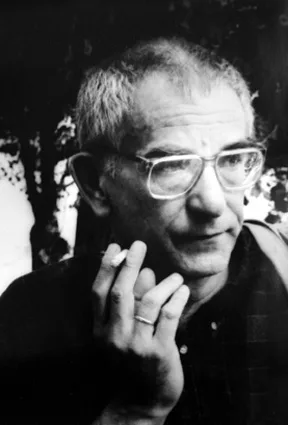
Photo: Alberto Terrile, CC BY-SA 3.0, via Wikimedia Commons.
Who Was Krzysztof Kieslowski?
Krzysztof Kieślowski was born on June 27, 1941, in Warsaw, and spent his childhood moving between towns as his family chased treatment for his father's tuberculosis. He entered the Łódź Film School in 1964 — the same institution that trained Roman Polański and Andrzej Wajda before him — after two rejected applications, and graduated in 1969 into a Polish film industry that was, at the time, one of the more artistically serious in the Soviet bloc.
He originally believed documentary was filmmaking's highest calling, not a stepping stone to fiction. That belief didn't survive contact with Polish censorship for very long.
From Documentaries to Fiction: Filming Under Communist Censorship
Kieślowski's early documentaries followed ordinary Polish life — factory workers, soldiers, city dwellers — with an honesty that kept putting him at odds with the state. His 1971 documentary Workers '71 was censored so heavily that Kieślowski later said the experience made him doubt whether truth could even be told literally under an authoritarian government. A separate incident, during the filming of Station (1981), nearly saw his footage subpoenaed as evidence in a criminal case — the moment he later cited as the real end of his documentary career.
Camera Buff (1979) turned that experience directly into fiction: a factory worker buys a home movie camera, only to watch his own footage run through exactly the kind of censorship Kieślowski knew firsthand. Blind Chance (1981) went further still, following a medical student down three diverging life paths depending on whether he catches a train — and it was banned outright, not released in Poland until 1987, six years after Kieślowski finished it.
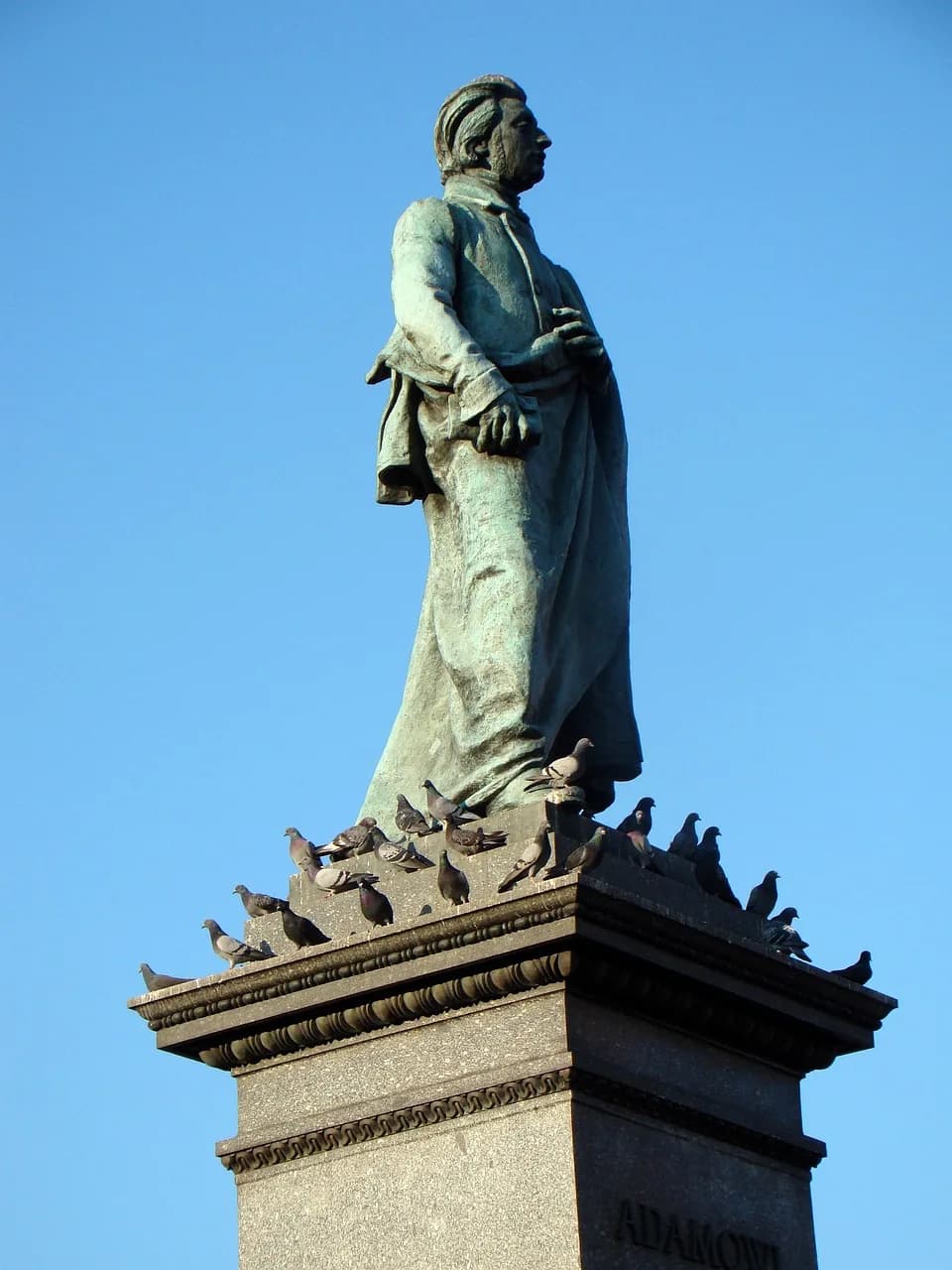
Kieślowski wasn't the first Polish artist to find his medium doubling as an act of resistance under foreign or authoritarian control — Adam Mickiewicz turned poetry into a way of keeping Polish identity alive under a different occupier more than a century earlier. Kieślowski's version of that same instinct just happened to run through a 16mm camera instead of a pen.
Cinema of Moral Concern: The Movement Kieślowski Belonged To
Film historians usually group Camera Buff and Blind Chance under a specific label: Cinema of Moral Concern (kino moralnego niepokoju), a loose movement of late-1970s Polish filmmakers — Kieślowski, Agnieszka Holland, Krzysztof Zanussi, and others — making socially conscious dramas about the small, everyday compromises ordinary people made to survive under communism. It's not the same thing as the earlier, more internationally famous Polish Film School of the 1950s (Andrzej Wajda, Andrzej Munk), which dealt mostly with wartime trauma; Cinema of Moral Concern was about the quieter, grinding moral cost of life under a still-functioning authoritarian state, a full generation later.
That distinction matters because it explains why Kieślowski's early work reads so differently from Dekalog and the Three Colors trilogy — he spent roughly a decade making films specifically about compromise and censorship before ever making the more universal, less overtly political work he's remembered for internationally.
Dekalog: The Ten-Film Masterpiece Stanley Kubrick Called Unmatched
Kieślowski's reputation rests, more than anything, on Dekalog (1988) — ten hour-long films, each loosely built around one of the Ten Commandments, all set in and around a single grim Warsaw housing estate. It was made for Polish television with West German co-financing, on a budget that would barely cover craft services on most prestige productions today, and it's now regularly cited among the greatest achievements in the history of film.
Kubrick's praise, written as the foreword to the published Dekalog screenplays in 1991, is the single most-quoted line about Kieślowski's work: he called it the only masterpiece he could think of made during his own lifetime, and said Kieślowski and his co-writer Krzysztof Piesiewicz "have the very rare ability to dramatise their ideas rather than just talking about them... you never see the ideas coming, and don't realise until later how profoundly they have reached your heart."
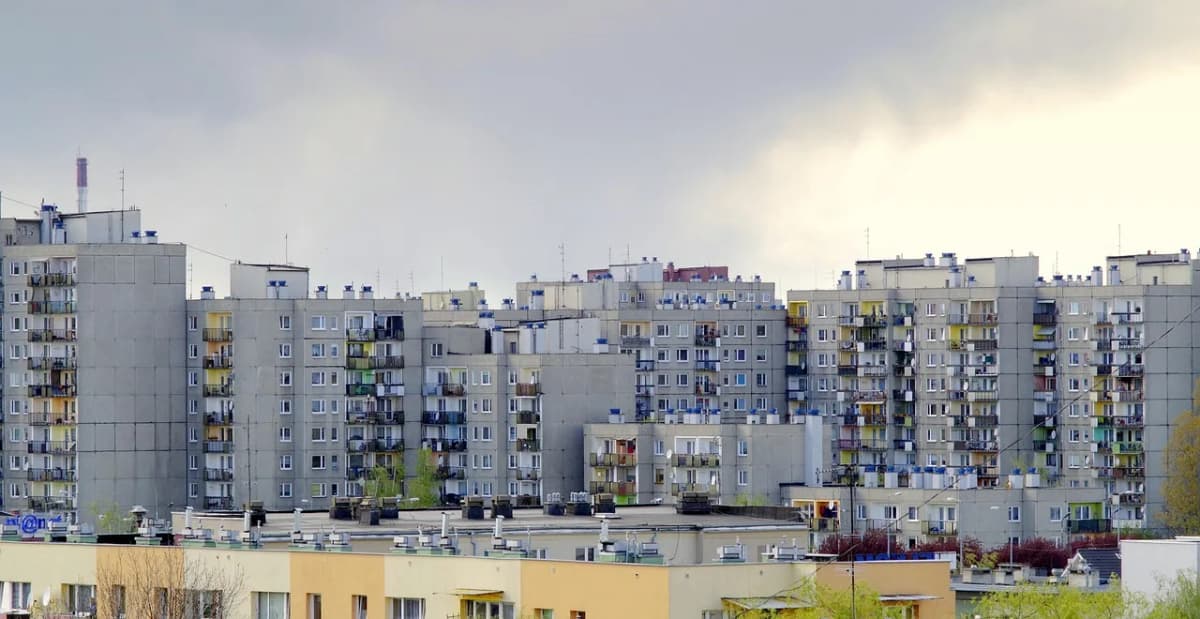
Two episodes — A Short Film About Killing and A Short Film About Love — were expanded into standalone theatrical features, and both won major prizes on their own, including a Cannes Jury Prize. That single housing estate, filmed with a rotating cast of directors of photography to give each episode a distinct visual identity, became one of the most studied locations in film history.
The Double Life of Veronique: Kieślowski's Turn Toward the Metaphysical
The Double Life of Véronique (1991) marked Kieślowski's pivot away from the political and toward something more mysterious: Irène Jacob plays two women, one Polish and one French, who share an unexplained, intuitive connection despite never meeting. It won Jacob the Best Actress prize at Cannes and confirmed what Dekalog had already suggested internationally — that Kieślowski's real subject was never really politics, but the unprovable, half-glimpsed connections between people's inner lives.
It's also the film that opened the door to the international, France-backed production that would define the rest of his career.
The Three Colors Trilogy: Liberty, Equality, Fraternity
Kieślowski closed out his filmography with the Three Colors trilogy (1993–1994) — Blue, White, and Red — each one built around a color of the French flag and the value it represents: liberty, equality, fraternity. Blue follows a widow disentangling herself from grief and obligation; White, the trilogy's dark-comic outlier, follows a humiliated husband's slow-burn revenge; Red follows a chance friendship between a model and a retired, embittered judge who spends his days illegally wiretapping his neighbors.
The trilogy swept festival honors: Blue won the Golden Lion at Venice in 1993, White won Kieślowski the Silver Bear for Best Director at Berlin in 1994, and Red was nominated for three Academy Awards, including Best Director and Best Original Screenplay — a rare feat for a subtitled European film in the mid-1990s.

Why Kieślowski Retired — and Died Two Years Later
After Red premiered in 1994, Kieślowski announced he was retiring from filmmaking entirely. He said, more or less, that he was simply tired — three intensely demanding features in three years, arriving right after the marathon of shooting Dekalog's ten episodes back to back, had worn him out. He turned down further offers, including reported interest from Hollywood, and stepped away while still at the height of his critical standing.
He didn't get much retirement. Kieślowski was a lifelong heavy smoker, and on March 14, 1996 — less than two years after announcing he was done — he died in a Warsaw hospital during open-heart surgery following a heart attack. He was fifty-four. He's buried at Warsaw's Powązki Cemetery beneath a striking granite monument by sculptor Krzysztof M. Bednarski, depicting a pair of hands appearing to shape or release something above the headstone.
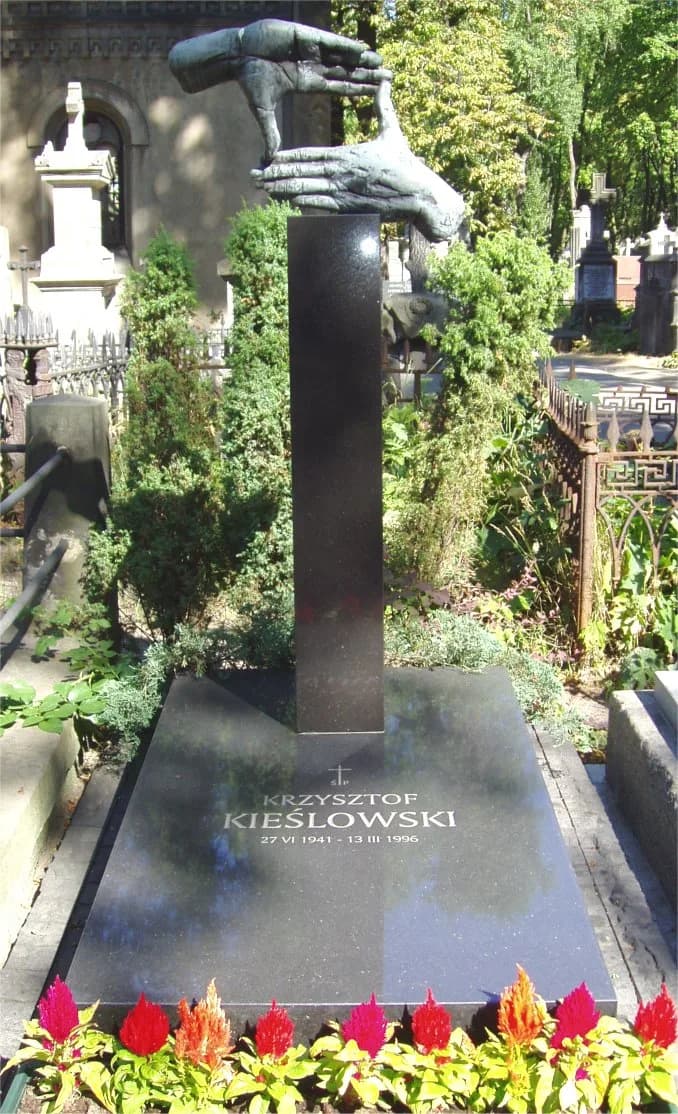
Photo: Zuska, CC BY-SA 3.0, via Wikimedia Commons.
Kieślowski's Influence on Modern Filmmakers
In 2002, the British Film Institute's Sight & Sound poll — widely considered cinema's most authoritative critics' survey — ranked Kieślowski second among the greatest film directors of modern times, an extraordinary placement for a director with a filmography this compact and this recently completed. His name is pronounced kyesh-LOF-skee, a soft-sh-then-hard-ch combination that trips up English speakers for the same reasons covered in our guide to famous Polish people and their names.
His influence shows up less in direct homage than in a whole strand of festival cinema built on interconnected lives, moral ambiguity, and restrained visual style — the kind of "prestige arthouse" filmmaking that owes Dekalog and the Three Colors trilogy a debt whether or not any given director says so out loud.
Kieślowski also worked with the same two collaborators through nearly his entire late career, which is part of why his films feel so tonally consistent despite covering wildly different stories. Composer Zbigniew Preisner scored every Kieślowski film from No End (1985) onward, including an entirely fictional "Van den Budenmayer" composer credit the two of them invented as a running private joke. Lawyer-turned-screenwriter Krzysztof Piesiewicz co-wrote every script from No End through Red, bringing a courtroom's eye for moral gray areas to material that could easily have tipped into melodrama in less careful hands.
Where to Start Watching Kieślowski
The British Film Institute's own viewing guide recommends starting with Dekalog itself, since Kieślowski scholarship tends to split his career into "pre-Dekalog" and "post-Dekalog" periods anyway. From there, The Double Life of Véronique and the Three Colors trilogy are the natural next steps — all four are widely available with strong subtitled releases. Save the earlier, bleaker No End (1985) for later; even the BFI's own guide warns it's a rough place to start.
If ten hour-long episodes feels like too much of a commitment for a first watch, the two feature-length Dekalog spinoffs — A Short Film About Killing and A Short Film About Love — work well as a smaller-scale introduction to the same moral seriousness, each running under 90 minutes. Both stand entirely on their own without any knowledge of the other eight episodes, which makes them a reasonable test of whether Kieślowski's slower, more contemplative style is actually for you before committing to the full series.
Key Facts About Krzysztof Kieślowski
| Fact | Detail |
|---|---|
| Born | June 27, 1941, Warsaw |
| Died | March 14, 1996, Warsaw, during heart surgery |
| Training | Łódź Film School, graduated 1969 |
| Signature work | Dekalog (1988), ten films built around the Ten Commandments |
| Final work | Three Colors trilogy — Blue, White, Red (1993–1994) |
| Major honors | Venice Golden Lion (1993), Berlin Silver Bear (1994), 3 Oscar nominations for Red |
| Critical ranking | #2, BFI Sight & Sound poll of greatest directors of modern times (2002) |
| Burial site | Powązki Cemetery, Warsaw |
Common Misconceptions About Kieślowski
"He was primarily a political filmmaker." Early censorship battles shaped his career, but Kieślowski himself said his real interest was never politics — it was the moral and emotional lives of individuals, which is exactly why he moved away from documentary and toward the more universal, metaphysical territory of Dekalog and the Three Colors trilogy.
"Dekalog is a religious film series." Each episode loosely echoes one of the Ten Commandments, but Kieślowski used the structure as a moral framework, not a religious lesson — the films are ambiguous, secular in tone, and far more interested in difficult ethical gray areas than in doctrine.
"He quit because of poor health." His retirement announcement came before his fatal heart attack, and by most accounts was driven by creative exhaustion after an unusually intense stretch of filmmaking, not a pre-existing diagnosis — his death two years later was a separate, later event.
Frequently Asked Questions
What is Krzysztof Kieślowski best known for? Dekalog (1988), his ten-part television series built around the Ten Commandments, and the Three Colors trilogy (Blue, White, Red, 1993–1994) are his two most acclaimed and widely watched works.
Did Stanley Kubrick really praise Krzysztof Kieślowski? Yes — Kubrick wrote the foreword to the published Dekalog screenplays in 1991, calling it the only masterpiece he could think of from his own lifetime and praising Kieślowski's ability to dramatize ideas rather than simply state them.
Why did Krzysztof Kieślowski retire from filmmaking? He said he was exhausted after making Dekalog's ten episodes and the Three Colors trilogy in rapid succession, and announced his retirement after Three Colors: Red premiered in 1994 — roughly two years before his death.
How did Krzysztof Kieślowski die? He died on March 14, 1996, in a Warsaw hospital during open-heart surgery following a heart attack, at age fifty-four. He was a lifelong heavy smoker.
Is Dekalog connected to the Bible? Loosely — each of the ten episodes takes inspiration from one of the Ten Commandments, but the films are secular moral dramas rather than religious teaching, set entirely among residents of one Warsaw apartment block.
What order should I watch the Three Colors trilogy in? Release order works well: Blue (1993), White (1994), then Red (1994) — the films share minor character crossovers that land best watched in sequence, though each also works as a standalone story.
Was Krzysztof Kieślowski ever nominated for an Oscar? Yes — Three Colors: Red received three Academy Award nominations in 1995, including Best Director and Best Original Screenplay, both rare nominations for a foreign-language film at the time.
Kieślowski's career is really two careers stitched together: a Polish documentarian who kept running into the limits of what he was allowed to film honestly, and an international auteur who spent his final, most celebrated decade asking quiet, unresolvable questions about fate, morality, and connection. It's a strange arc for a director this influential to also be this under-discussed outside serious film circles — a pattern this site keeps running into across the Arts category, since Poland's Nobel-winning writers faced remarkably similar headwinds, just with a pen instead of a camera.