Polish folk motifs show up in more famous paintings than most visitors ever notice — a rooster stitched into a peasant blouse, a wreath of rue floating on a river, a paper-cut flower pattern echoed in the border of a canvas. Long before "Polish art" meant gallery walls in Warsaw or Kraków, it meant embroidery, paper cutting, and carved wooden trim passed down through village households. Painters didn't invent these Polish folk motifs — they borrowed them, and if you know what to look for, you can read a 19th-century Symbolist painting almost like folklore left in plain sight.
This matters for more than art history. The same motifs that inspired painters are still alive today, sewn into festival costumes and cut from colored paper in villages across the Łowicz and Kurpie regions. Learning to recognize Polish folk motifs turns a museum visit — or a scroll through famous Polish painters — into something you can actually feel, not just admire from a polite distance.
Once you know the visual vocabulary, you start seeing it everywhere: in a museum gift shop's paper cutouts, on a grandmother's holiday tablecloth, in the trim of a folk dancer's skirt at a summer festival. Polish folk motifs aren't a closed chapter of art history — they're a living design language that painters happened to notice first.
Polish Folk Motifs in Jacek Malczewski's Symbolism
If one painter proves the point, it's Jacek Malczewski. Among the painters who shaped the national imagination, Malczewski stands out for how openly he raided folk culture for his imagery — fauns, water spirits, and peasant ghosts wander through his canvases as naturally as saints wander through a church fresco.
His early Ondines series (1887–1888) draws directly on Slavic water-spirit folklore — stories villagers told about drowned girls who became river maidens, luring the unwary. By the time he painted his Tales series (1902–1903), Malczewski was folding that same folk repertoire into full allegories about the Polish national condition: a poisoned well standing in for a nation's thwarted hopes, a wanderer standing in for exile itself (Culture.pl's biography of Malczewski traces this shift in detail).
None of it reads as decoration. Malczewski treated Polish folk motifs the way a linguist treats an old dialect — not quaint, but structurally load-bearing. Strip the folk symbolism out of his paintings and half the meaning goes with it.
Why Painters Turned to the Countryside at All
Poland spent 123 years erased from the map, partitioned between three empires. Its painters couldn't paint a flag or a parliament, so many of them painted the village instead — the one place where a distinctly Polish identity had survived intact, in costume, custom, and craft, even when the state hadn't. Folk motifs weren't just visually interesting. They were the safest available symbol of a nation that officially didn't exist, which is exactly why so many Polish folk motifs cluster around the partition-era decades.
Leon Wyczółkowski and Józef Chełmoński: Two Different Routes to the Same Village
Not every painter borrowed folk motifs the way Malczewski did. Leon Wyczółkowski painted peasant life almost documentarily — threshing, sowing, women at a well — recording rural craft and costume with the eye of someone cataloguing a vanishing world rather than mythologizing it. Józef Chełmoński went a third way: his famous Storks (1900) uses a single bird, not an embroidered pattern, to carry the same message Wyczółkowski spent whole canvases building — that the rhythm of the countryside continues regardless of what happens in the capitals.
Three painters, three techniques, one shared source material. That's the real argument for treating Polish folk motifs as a coherent visual language rather than a scattering of quaint details: different artists reached for the same well and came back with different water.
Wycinanki: Poland's Paper-Cutting Art Tradition
Long before it showed up in a gallery, this same visual language existed as wycinanki — Poland's tradition of hand-cut paper decorations, snipped freehand with sheep shears or scissors and pasted onto whitewashed cottage walls. The craft is genuinely old: it began with shepherds cutting patterns from leather and birch bark during long, idle winters, and only shifted to colored paper once paper became cheap enough for village households in the mid-1800s.
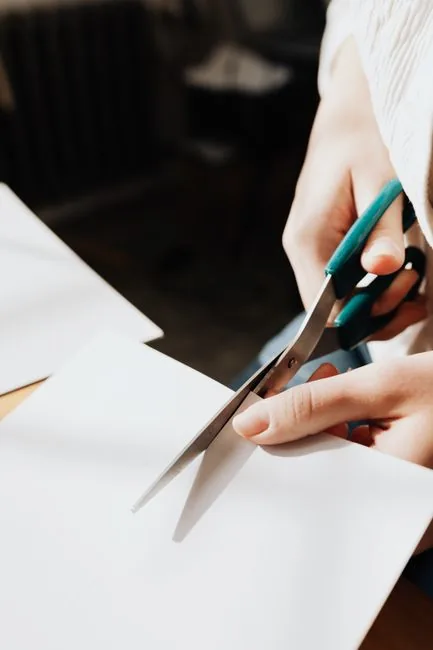
Regional style varies more than most outsiders expect. Łowicz wycinanki are riotously multicolored, built from layered paper in a technique called nalepianki. Kurpie wycinanki, by contrast, are cut from a single color, prized for the precision of the silhouette rather than the palette (Culture.pl's regional guide to Polish paper cutouts walks through the regional differences in more depth). Recurring subjects include peacocks, roosters, star-shaped medallions called gwiazdy, and dense floral borders — the very same Polish folk motifs that later turn up stitched into costume and painted into canvas.
The craft's staying power is remarkable. In 2017, UNESCO added Polish wycinanki to its Representative List of the Intangible Cultural Heritage of Humanity — official recognition that a folk-art form invented by bored shepherds still matters enough to protect, and still shapes how contemporary Polish designers think about pattern.
How Wycinanki Patterns Ended Up on Canvas
Painters working in the late 19th and early 20th centuries would have encountered wycinanki constantly — pinned to cottage walls, sold at markets, tucked into letters as a small gift. The symmetry, the density, the preference for a strong central motif ringed by a busy border: all of it seeped into how Polish artists composed a painting, whether or not they ever consciously "borrowed" from a specific paper cutout.
Łowicz Folk Costume: Where Painters Found Their Palette
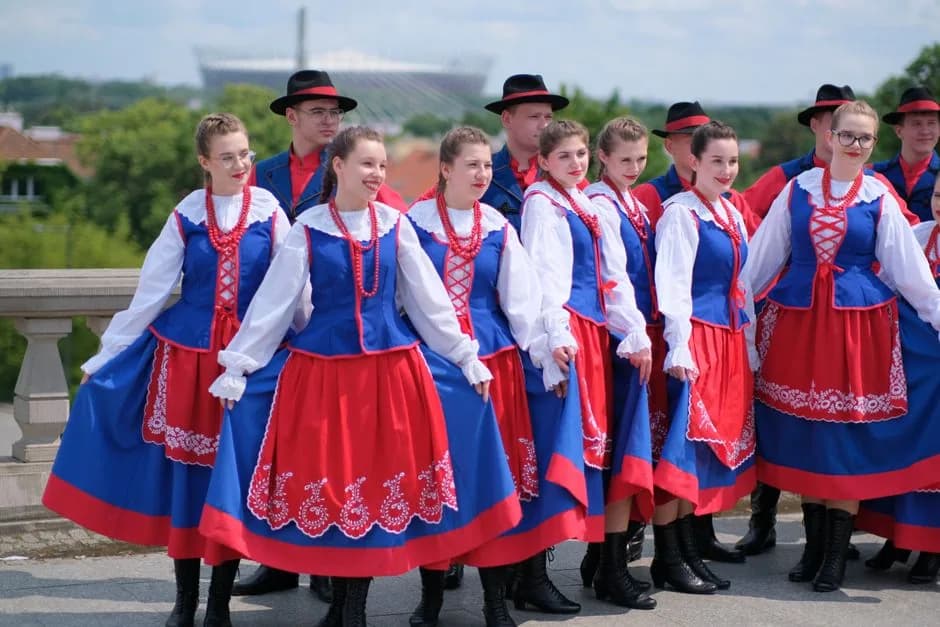
Nowhere is the connection between folk craft and fine art clearer than in Łowicz folk costume. The Łowicz region, about an hour west of Warsaw, produces some of the most visually intense folk dress in Poland — vertical rainbow-striped wool skirts (paski łowickie), heavily embroidered vests, and floral headpieces that look almost too vivid to be traditional rather than theatrical.
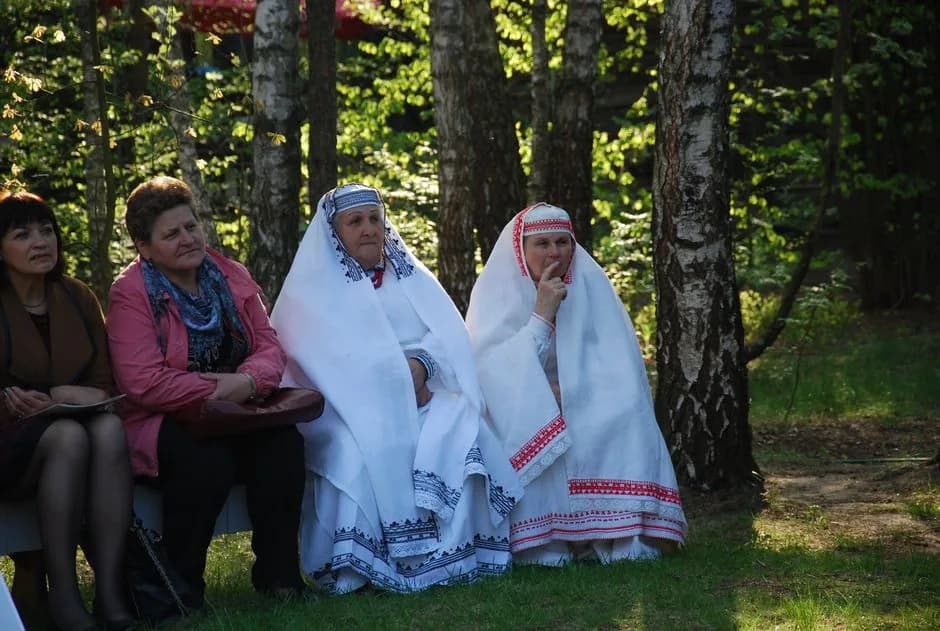
That saturated palette isn't accidental, and it isn't recent. It's the same color logic — bold primary contrasts, dense floral repetition, symmetrical borders — that shows up in Symbolist and folk-realist painting throughout the late 19th century. Painters working in this period had grown up seeing this exact color grammar on market day. When they reached for red, blue, and white in tight geometric rhythm, they were painting what a Polish eye already recognized as "festival," long before it was "art."
Other regions carry their own version of the same idea. Kurpie costume favors white linen with restrained black-and-red embroidery instead of Łowicz's riot of color — a quieter dialect of the same folk visual language, and a reminder that "Polish folk costume" is really a family of regional styles, not one fixed look.
The Symbols Painters Borrowed From the Countryside
A handful of Polish folk motifs recur so often across embroidery, wycinanki, and painting that they function almost like a shared alphabet:
The rooster and other birds
A near-universal wycinanki subject, the rooster symbolizes the household and the turning of the agricultural year. Painters depicting rural scenes — including Józef Chełmoński's storks, a close cousin of the same bird-as-continuity symbolism — leaned on the same association: a bird overhead means the cycle of rural life is intact.
The wreath
Woven from wildflowers and rue, the wreath shows up in both folk ritual (floated on rivers during Midsummer celebrations) and painting, where it typically signals youth, fertility, or a girl at a turning point in her life — courtship, mourning, or both at once.
The geometric border
Wycinanki and embroidery both favor a dense, symmetrical border framing a central motif. Painters absorbed this instinct as composition, not just costume detail — many folk-influenced canvases echo it in how figures or symbols are arranged around a central image.
The star medallion (gwiazda)
A radiating, star-shaped cutout common in wycinanki, the gwiazda rarely appears literally in paintings, but its logic — a strong center with everything else arranged symmetrically around it — shows up constantly in how folk-influenced portraits and allegories are composed.
The cross-stitch flower
Embroidered blouses across nearly every Polish region favor a repeated cross-stitch flower — poppies, cornflowers, and roses appear most often, worked in the same red-and-black palette that dominates folk textile work more broadly. When painters wanted to signal "this is a village woman, not a city one" without saying it outright, dressing a figure in this exact stitch pattern did the job instantly for anyone who'd grown up around it.
Taken together, these recurring Polish folk motifs form less of a checklist and more of a shared grammar — one that a 19th-century Polish viewer would have read fluently, and that a modern visitor can learn to read too, one symbol at a time.
How to Recognize Folk Motifs When You Visit
You don't need an art history degree to spot Polish folk motifs once you know the vocabulary. A few practical pointers for gallery visits:
- Look at borders and hems first, not just faces. Painters who were quoting folk costume usually put the detail in the clothing, not the composition.
- Birds are rarely just birds. A rooster, stork, or dove in a Polish 19th-century painting is doing symbolic work, not just filling space.
- Visit an ethnographic museum alongside an art museum. The State Ethnographic Museum in Warsaw and the Ethnographic Museum in Kraków both display real wycinanki and folk costume — seeing the source material first makes the paintings click differently.
- Notice repetition before you notice meaning. A motif that shows up three or four times in one painting — a bird, a flower, a border pattern — is almost never accidental repetition; it's the artist pointing at something folk-coded.
If you're planning a museum trip to see any of this in person, our guide on how to pronounce Polish cities is worth a look before you go, so you're not stumbling over Kraków, Łowicz, or Warszawa at the ticket counter.
Where the Tradition Is Still Alive Today
Folk motifs didn't stop when the painters put down their brushes. Wycinanki workshops still run in Łowicz schools every spring. Regional folk costume gets a full airing every summer at festivals across Poland, where the same rainbow stripes and floral embroidery that once inspired Symbolist painters get worn, danced in, and photographed by a new generation. Contemporary Polish designers regularly quote wycinanki patterns in textiles, ceramics, and even branding — proof that this "folk art" label undersells how current the design language actually is.
That continuity is exactly why Polish folk motifs reward a slower look. A painting from 1902 and a paper cutout sold at a craft fair last summer are drawing from the same well — not a coincidence, but a design tradition still very much in use.
Where to See These Motifs in Person: Museums Worth the Detour
Warsaw and Kraków get most of the attention in any "where to see Polish art" conversation, and both deserve it — the National Museum in Warsaw holds Malczewski's major Symbolist canvases, and the National Museum in Kraków has one of the country's strongest 19th-century Polish painting collections overall. But if you're tracing Polish folk motifs specifically, don't skip Poznań.
The National Museum in Poznań holds Chełmoński's Summer Evening (1875), a quieter rural scene than his famous Storks but drawn from the same well of countryside symbolism. Poznań is often skipped in favor of Warsaw and Kraków, which makes it one of the few places where you can study a genuine Chełmoński without the crowds — and in 2025, Poznań co-hosted a major Chełmoński retrospective alongside the Warsaw and Kraków national museums, a sign that the city's collection is taken seriously at the national level, even if it rarely makes the tourist itinerary.
Seeing folk-influenced painting in three different cities also makes the regional-motif argument concrete. A Łowicz-style border in a Warsaw painting, a Kurpie-style silhouette echoed in a Poznań landscape, a peasant scene in Kraków — the same underlying folk vocabulary, filtered through wherever the painter actually grew up or travelled.
Frequently Asked Questions
Is wycinanki still practiced today, or is it purely historical? Very much alive. It's taught in schools in the Łowicz and Kurpie regions, sold at craft fairs and folk festivals, and was reconfirmed as UNESCO-protected heritage in 2017 — not a museum-only tradition.
Which Polish painter is most associated with folk motifs? Jacek Malczewski is the clearest case, though Józef Chełmoński and Leon Wyczółkowski both drew heavily on rural and folk subject matter in different ways — Chełmoński through landscape and animal symbolism, Wyczółkowski through direct depictions of peasant life and craft.
What's the difference between wycinanki and other paper-cutting traditions? Wycinanki is the Polish (and broader West Slavic) branch of a wider papercutting family found across Europe and Asia. What sets it apart is regional specificity — Łowicz's multicolor layering versus Kurpie's single-color silhouettes are distinct enough that a trained eye can identify a piece's home region on sight.
Where can I see real wycinanki and folk costume in person, not just in paintings? The State Ethnographic Museum in Warsaw and the Ethnographic Museum in Kraków both hold permanent folk-art collections, and regional museums in Łowicz and the Kurpie area show the original source material the painters were working from.
Do Polish folk motifs vary a lot by region, or is there one "national" style? There's no single national style — that's part of what makes Polish folk motifs interesting. Łowicz's multicolor layering, Kurpie's single-color silhouettes, and the more restrained embroidery traditions further south are all distinct dialects of the same visual language, and painters tended to draw on whichever regional style they'd grown up around.
If gallery paintings gave you a reason to notice these Polish folk motifs, learning a little vocabulary for gender and pattern in Polish nouns — things like haft (embroidery) and wycinanka (paper cutout) — makes the next museum visit even richer.
Polish Noun Gender: Masculine, Feminine, Neuter