Poland's Enigma codebreakers cracked Nazi Germany's most sophisticated cipher machine years before Britain's Bletchley Park team even started trying — and for decades, almost nobody outside Poland knew it. Three young mathematicians, working in near-total secrecy out of a nondescript building in Warsaw, reconstructed the wiring of the Enigma machine using pure mathematics, built the first machine ever designed to break it, and then, five weeks before Germany invaded their own country, handed the entire secret to Britain and France for free.
Alan Turing gets the movie, the statue, and the £50 note. Marian Rejewski, Jerzy Różycki, and Henryk Zygalski get a plaque in a forest outside Warsaw that most tourists never find. This is the story Hollywood left out: how three Poznań University graduates in their twenties beat the world's best cryptographers to the most consequential secret of the Second World War, and why almost nobody was allowed to know about it until most of them were already dead.
Who Were Poland's Enigma Codebreakers?
In September 1932, Poland's Cipher Bureau (Biuro Szyfrów) hired three recent mathematics graduates from Poznań University: Marian Rejewski, then 27, along with Henryk Zygalski and Jerzy Różycki. Poznań had been chosen deliberately — the region had been under German rule until 1918, so its university graduates tended to speak fluent German, a rare and useful skill for anyone trying to read the German military's mail.
None of the three had any special background in cryptography. What they had was a solid grounding in permutation theory, a fairly obscure branch of pure mathematics that happened to be exactly what the Enigma machine's rotor-based scrambling could be described with. Poland had good reason to care about German ciphers specifically: wedged between Germany and the Soviet Union, with a border redrawn in living memory, Polish military intelligence treated German signals traffic as an existential priority long before most of Europe took Hitler seriously.
The Cipher Bureau also ran a deliberate pipeline for finding people like them: in the late 1920s, it quietly offered a cryptology course to top mathematics students at Poznań, specifically in the German-speaking borderlands, then hand-picked the strongest performers before they'd even graduated. Rejewski, Różycki, and Zygalski were the three who made the cut — which means Poland's Enigma codebreakers weren't a lucky accident so much as the product of a recruiting program built years in advance, aimed squarely at a threat most of Europe wasn't yet taking seriously.
Marian Rejewski: Who Broke the Enigma Code First
At the end of December 1932, Marian Rejewski deciphered the first message sent using the German military's Enigma machine — without ever having seen one operate. He had help: a French intelligence agent named Gustave Bertrand supplied Polish intelligence with material obtained from Hans-Thilo Schmidt, a German cipher clerk selling secrets to France, including genuine daily key settings for September and October 1932.
That was a leg up, but it wasn't a solution. Rejewski still had to reverse-engineer the internal wiring of the machine's rotors using only the mathematical structure of intercepted traffic and a known flaw in German procedure — operators repeated a three-letter message key twice at the start of every transmission. Rejewski used group theory to exploit that repetition, deducing the rotor wiring through equations rather than physical inspection. It's still regarded as one of the most elegant achievements in the history of cryptanalysis: a machine's internal secrets, derived entirely on paper.
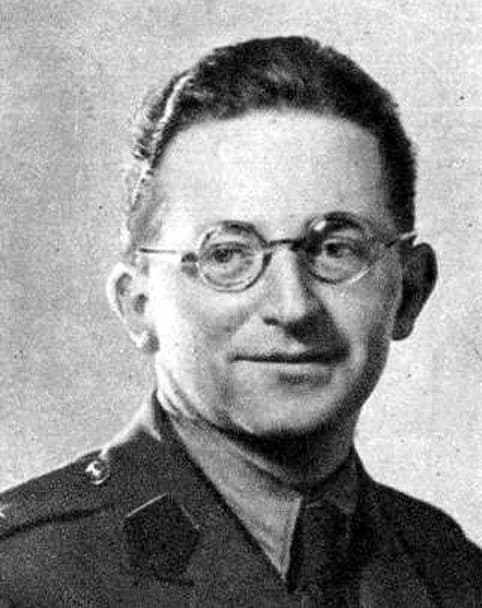
Photo: public domain, taken circa 1943–44 while Rejewski served with Polish signals forces in Britain.
By 1933, working with Różycki and Zygalski, Rejewski's team was reading German Enigma traffic on a regular basis — a feat Britain and France hadn't come close to and, at that point, weren't seriously attempting. For the rest of the decade, Poland's Enigma codebreakers quietly held a lead that no other country in Europe even knew existed, let alone tried to match.
The Bomba Kryptologiczna: Poland's Codebreaking Machine
Breaking one day's key by hand was one thing; doing it fast enough to matter operationally was another. Working with engineers from the AVA Radio Manufacturing Company, the Polish team built the bomba kryptologiczna ("cryptological bomb") — widely credited as the first electromechanical device purpose-built to attack a cipher machine. Zygalski separately devised a system of hand-perforated sheets that let analysts find valid rotor settings by physically overlaying punched cards and looking for the light that shone through every layer at once.
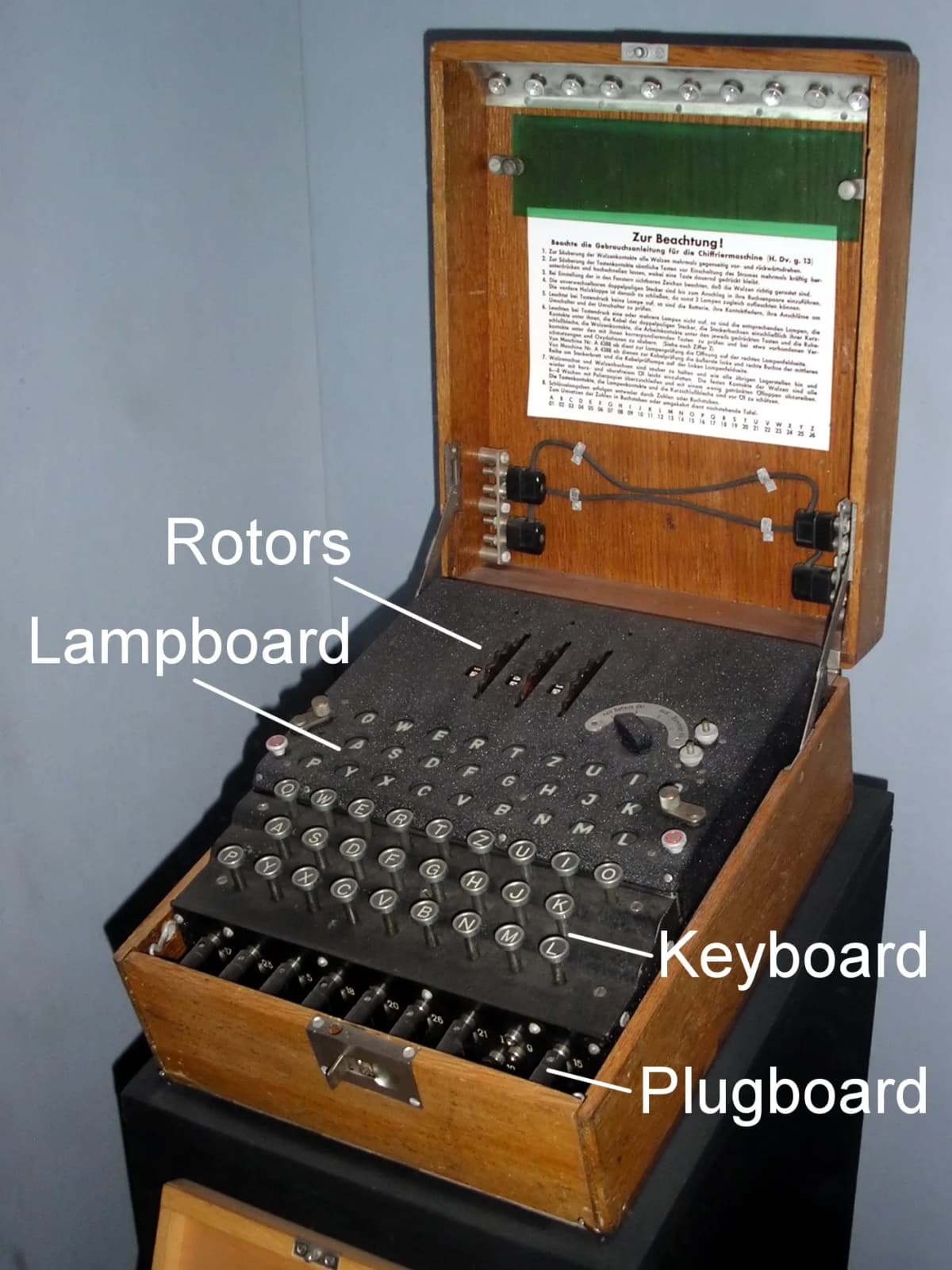
Photo: Karsten Sperling, public domain.
Both tools worked well against the Enigma as it existed through the mid-1930s. Then Germany started adding rotors and plugboard connections, multiplying the number of possible settings far beyond what six bomby (the Poles built one for each of six possible rotor orders) could brute-force with Poland's modest resources. By late 1938, the growing complexity — combined with a shrinking budget and a shrinking window before war arrived — pushed Poland toward a decision almost no intelligence service makes willingly: give the secret away.
It's worth pausing on how resource-constrained this all was. Britain's later codebreaking operation at Bletchley Park would eventually employ nearly 10,000 people at its wartime peak, backed by the full industrial capacity of the British state. Poland's Enigma codebreakers worked for years with a team that numbered in the dozens, building custom hardware through a private radio manufacturer because the state couldn't fund an equivalent in-house workshop. The gap in results between the two efforts, at least through 1938, wasn't a gap in resources — Poland was simply ahead.
The Pyry Forest Meeting: Poland Hands Over Its Biggest Secret
On 25–26 July 1939, barely five weeks before Germany invaded Poland, Polish Cipher Bureau chiefs met with French and British codebreakers in the Pyry Forest, in a bunker-like facility just south of Warsaw. The British delegation included Alastair Denniston, head of the Government Code and Cypher School, and cryptanalyst Dilly Knox. According to GCHQ's own account of the meeting, Poland disclosed its full progress against Enigma, including the workings of the bomba kryptologiczna, and handed over physical Enigma replicas for both allies to take home.
It's worth sitting with how unusual this was. An earlier meeting in Paris in January 1939 had gone nowhere, because none of the three services fully trusted each other with what they'd found. By July, with Britain and France having just formally committed to defend Poland against invasion, that calculus changed — full cooperation became possible only once war looked unavoidable. Poland gave away years of the hardest cryptographic work in Europe not because it had run out of ideas, but because it had run out of time.
The handover itself took place with almost no fanfare, and GCHQ's own retrospective on the meeting describes it as transformative for British cryptanalytic strategy — a striking admission, given how far ahead of London's own efforts Poland's Enigma codebreakers turned out to be. Poland asked for nothing in return beyond a shared commitment to keep fighting Germany, a request history would soon make tragically moot: the country was overrun before its own codebreakers ever got to see whether the intelligence they'd built would help defend it.
What Happened at Bletchley Park After Poland's Handover
The Polish material didn't hand the British a finished solution — German security procedures kept evolving after 1939, and wartime Enigma traffic used more complex settings than anything the bomba had been built to crack. What Poland handed over was a running start: a working understanding of the machine's internals, a proven mathematical method, and physical replica machines that meant Bletchley Park's cryptanalysts weren't starting from a blank page.
Alan Turing met with Marian Rejewski directly at a follow-up conference in January 1940. That meeting fed into the design of the British Bombe, an electromechanical device that took the core logic of the Polish bomba and adapted it to the far larger key space of wartime Enigma traffic.
Historians differ on exactly how much of Turing's Bombe design traces back to Polish engineering versus his own independent insight — but nobody seriously disputes that Bletchley Park's codebreakers started their war already knowing Enigma could be broken, because three Polish mathematicians had already proven it. Without that head start from Poland's Enigma codebreakers, Bletchley Park's timeline for cracking wartime Enigma traffic would almost certainly have stretched months or years longer than it did.
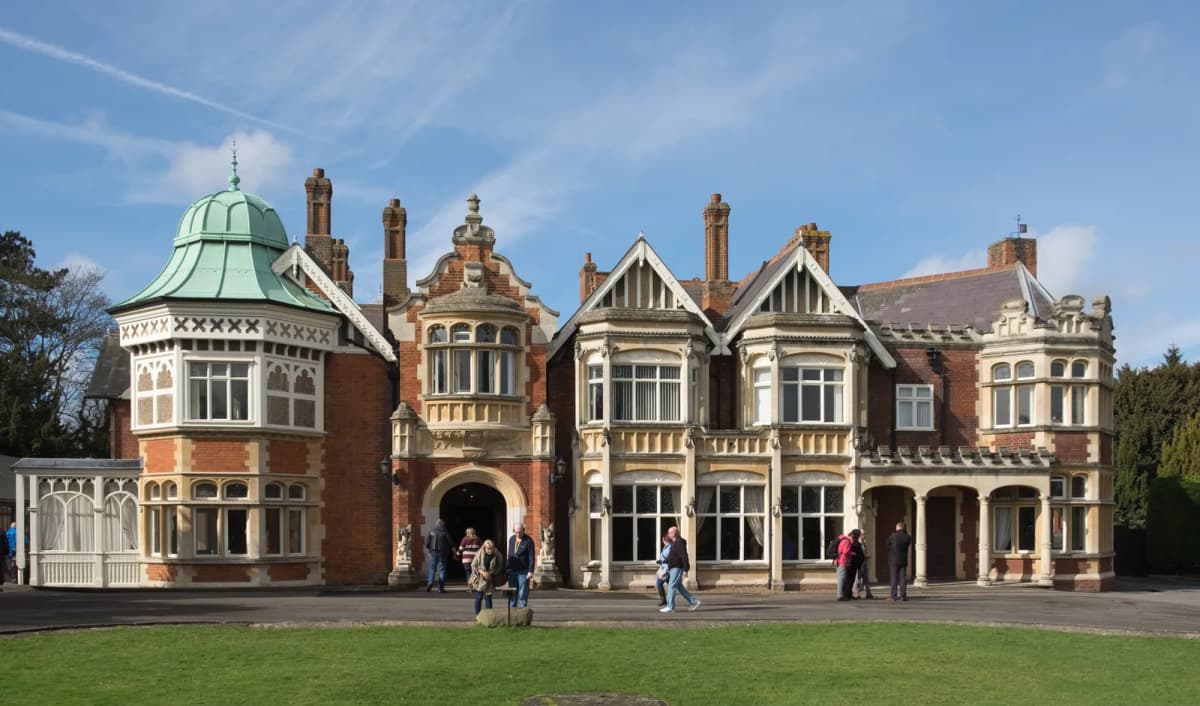
Photo: DeFacto, CC BY-SA 4.0, via Wikimedia Commons.
Why Poland's Role Almost Got Erased From the Story
For nearly three decades after the war, the entire Enigma story was classified under Britain's Ultra secrecy program, and the public simply didn't know Bletchley Park existed, let alone that Poland had gotten there first. When the story finally started leaking out in the 1970s, the version that reached popular culture centered almost entirely on Turing and Britain — a narrative cemented by decades of British books, documentaries, and eventually films.
The 2014 film The Imitation Game became a flashpoint for this exact complaint: Poland's contribution is reduced to a single line of on-screen text, with no Polish characters and no acknowledgment of Rejewski, Różycki, or Zygalski as people. Polish historians and cryptography enthusiasts pushed back hard, and rightly — the film's version of events implies Turing solved a problem essentially from scratch that Polish mathematicians had already cracked seven years earlier.
Różycki never lived to see any of this recognized. He died in 1942 when the ship carrying him back from French-controlled North Africa was torpedoed. Zygalski spent the rest of his life in Britain, working as a lecturer, largely unrecognized. Rejewski returned to communist Poland after the war, where his wartime intelligence work made him politically suspect rather than celebrated; he spent decades as an ordinary accountant, legally barred from even discussing what he'd done, and died in 1980 — nine years before Poland's full contribution was widely acknowledged in the West.
That's the part of the story that tends to land hardest once people hear it: the man who broke the war's most important cipher spent the rest of his working life doing accounts, forbidden by his own government from ever mentioning it. Rejewski only started writing detailed memoirs of his wartime work in the 1970s, once declassification made it legally possible — memoirs historians now treat as the primary source for almost everything known about how Poland's Enigma codebreakers actually did it. He died before seeing much of that recognition arrive in English-language histories at all.
Where to See This History in Poland Today
A modest granite memorial to Rejewski, Różycki, and Zygalski stands in the Kabaty Forest on the southern edge of Warsaw, not far from where the actual 1939 handover meeting took place in Pyry. It's an easy stop if you're already exploring Warsaw's outskirts, and a striking contrast to how prominently Bletchley Park itself is marketed as a tourist destination in England.
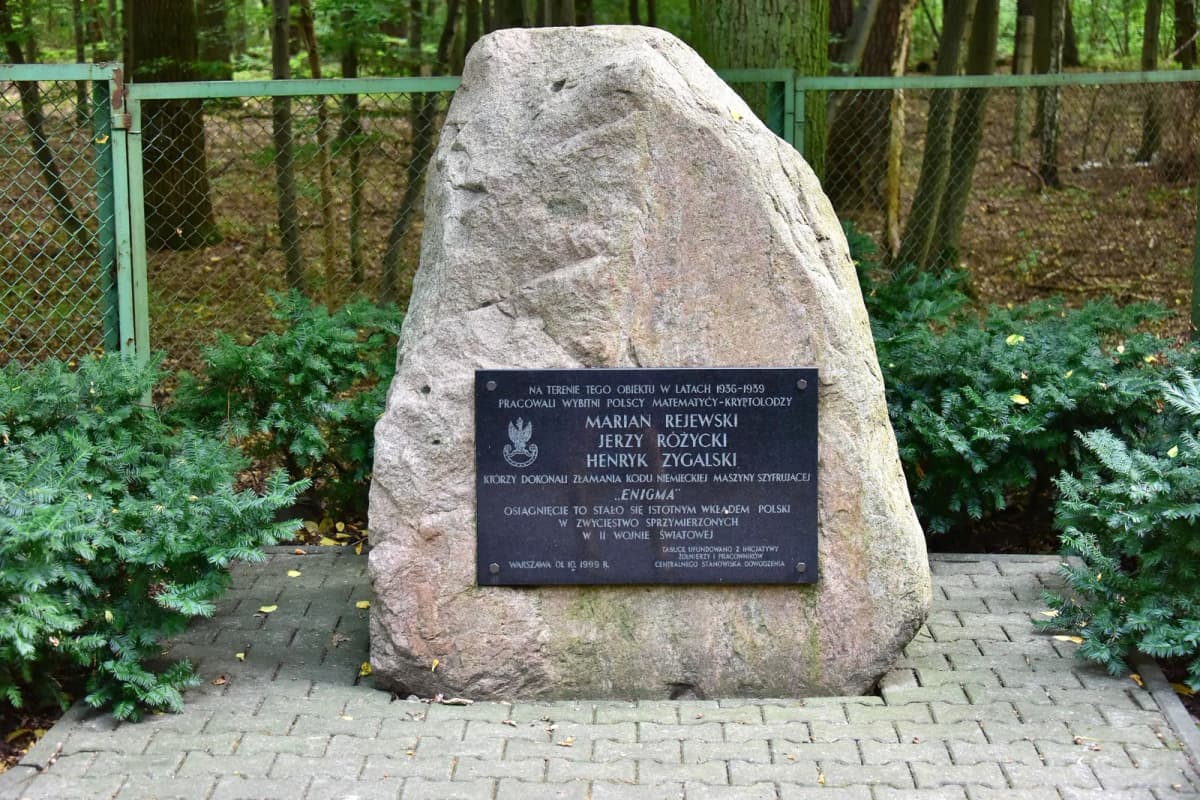
Photo: Adrian Grycuk, CC BY-SA 3.0 Poland, via Wikimedia Commons.
Poznań, where all three men studied mathematics, also runs an Enigma Cipher Centre with hands-on exhibits explaining the mathematics behind the break — a fitting home city for a story that keeps getting told everywhere except where it actually happened. Warsaw's own Polish Army Museum and the POLIN Museum's broader wartime exhibits touch on the Cipher Bureau's work as well, though neither treats it as a headline attraction the way Bletchley Park does for British visitors.
It's the same pattern this site keeps running into with Poland's other great origin story Hollywood undersells: a genuinely Polish achievement, filtered through decades of retelling until the Polish part quietly disappears. If Rejewski, Różycki, and Zygalski don't already have a place on your mental list of famous Polish people, they've earned one — Poland's Enigma codebreakers changed the outcome of the Second World War and got a forest plaque for it.
Frequently Asked Questions
Who actually broke the Enigma code first? Polish mathematician Marian Rejewski, working with Jerzy Różycki and Henryk Zygalski at Poland's Cipher Bureau, first broke German Enigma traffic in December 1932 — about seven years before Alan Turing's team at Bletchley Park began serious work on it.
Did Alan Turing use Polish research? Yes. Poland shared its Enigma-breaking methods, mathematical techniques, and physical replica machines with British and French intelligence at the Pyry Forest meeting in July 1939. Turing later met Rejewski directly in January 1940, and the British Bombe built on the logic of Poland's earlier bomba kryptologiczna.
What was the bomba kryptologiczna? It was an electromechanical device built by the Polish Cipher Bureau in the mid-1930s, widely considered the first machine ever purpose-built to attack a cipher — a direct ancestor of the British Bombe developed at Bletchley Park.
Why isn't Poland's role in breaking Enigma better known? The entire Enigma story stayed classified under Britain's Ultra secrecy program until the 1970s. By the time it became public, the popular narrative had already formed around Bletchley Park and Turing, and later depictions like The Imitation Game largely left the Polish contribution out.
What happened to Rejewski, Różycki, and Zygalski after the war? Różycki died in 1942 when his ship was torpedoed. Zygalski settled in Britain and worked as a lecturer. Rejewski returned to communist Poland, where he was barred from discussing his wartime work and lived the rest of his life as an accountant, dying in 1980 largely unrecognized.
Where can you see this history in Poland? A memorial to the three cryptologists stands in the Kabaty Forest near Warsaw, close to the site of the 1939 Pyry meeting, and Poznań — where all three studied — has an Enigma Cipher Centre with exhibits on the mathematics behind the break.
Three mathematicians in their twenties beat the war's best-funded intelligence services to its single most valuable secret, then gave that secret away for free because it mattered more than the credit. Poland's Enigma codebreakers took the rest of the world about seventy years to catch up on that story — which is roughly seventy years longer than it should have taken.