
What is Biedronka, and why does every Polish city seem to have one within walking distance? If Żabka is the small corner shop you duck into for a hot dog and a coffee, Biedronka is where Poles actually do their weekly grocery shopping — full aisles of produce, meat, dairy, and household goods, at prices built around the promise "Codziennie niskie ceny" (everyday low prices) printed right on the storefront.
Understanding Biedronka matters for anyone learning Polish or spending real time in the country, because it's where the actual logistics of daily life happen: the weekly shop, the weekend stock-up, the "we're out of milk" run. Knowing how it works — what it sells, how checkout works, why it's sometimes closed on a Sunday when the corner store isn't — saves you the small, avoidable confusions that make a place feel foreign longer than it needs to.
This guide covers what Biedronka actually is, how it differs from a minimarket like Żabka, what you'll find on the shelves, and the practical details — payment, produce weighing, trading hours — that trip up newcomers on their first few visits.
What Is Biedronka, Exactly?
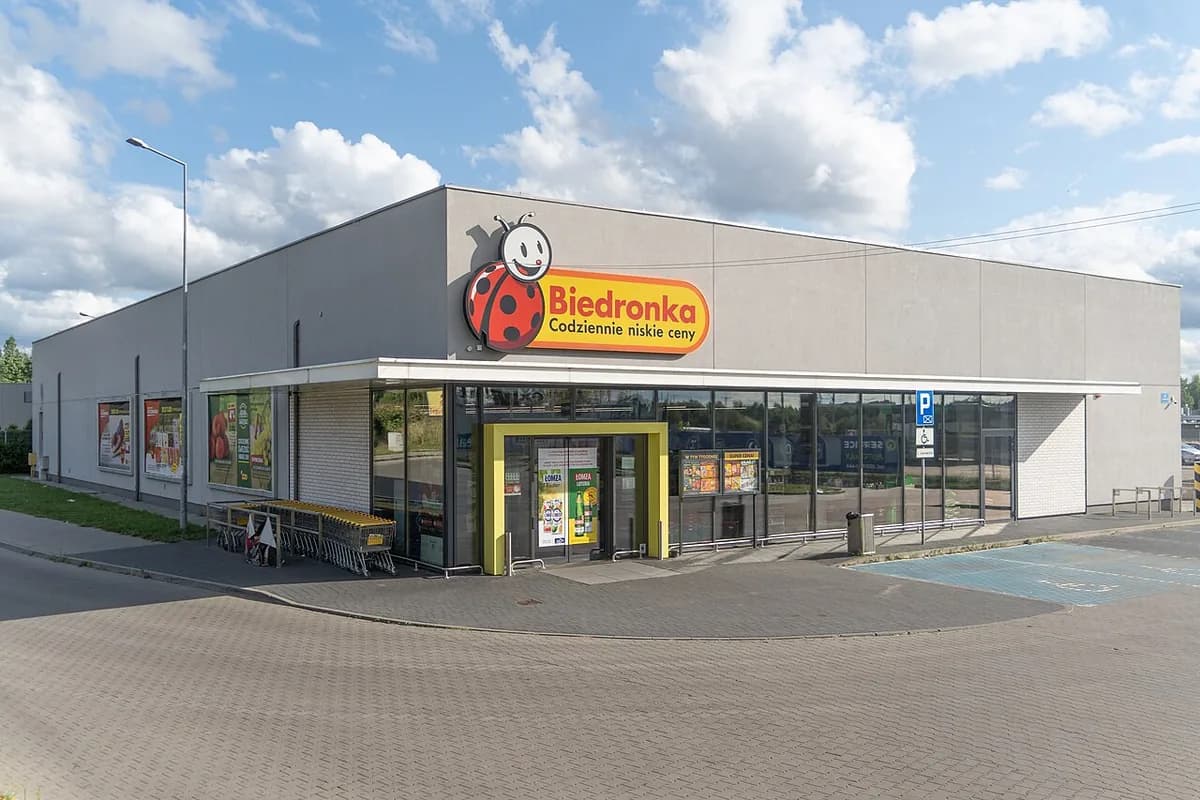
Photo: Krzysztof Popławski, CC BY 4.0, via Wikimedia Commons.
Biedronka is Poland's largest supermarket chain, and by most counts the largest retail chain of any kind in the country, with well over 3,700 stores nationwide according to Wikipedia's overview of the chain. It operates as a discount supermarket — similar in spirit to Aldi or Lidl elsewhere in Europe — built around low prices, a heavy rotation of weekly promotions, and a large share of own-label products.
The name "Biedronka" means "ladybird" in Polish, which is why a cartoon ladybird has been the company's mascot and logo since the beginning. It's a deliberately friendly, unthreatening image for a chain whose whole pitch is "affordable groceries, not fancy groceries."
Here's a detail that connects directly back to Żabka: both chains were founded by the same person, entrepreneur Mariusz Świtalski, and both got their start in Poznań. Biedronka came first, opening its first store there in 1995; Żabka followed in 1998. In 1997, the Portuguese retail group Jerónimo Martins acquired a controlling stake in Biedronka, and it remains the parent company today, running the chain as its single largest and most profitable business globally.
The scale of that growth is hard to overstate. From a single store in Poznań, Biedronka passed 1,500 locations by 2010, 2,000 by 2012, and crossed 3,000 in 2019, before reaching its current footprint of well over 3,700 stores. In 2025 it opened its first locations outside Poland, in neighboring Slovakia — a modest first step abroad for a chain that has otherwise spent three decades focused entirely on the Polish market.
Biedronka vs. Żabka: Supermarket vs. Minimarket
The simplest way to understand Biedronka is by contrast with the chain most learners meet first. If you've read our guide on what Żabka is, you already know it as a small, always-open minimarket built for quick, single-item stops — a hot dog, a coffee, a forgotten ingredient.
Biedronka is the opposite kind of trip. Stores are large-format, laid out like a proper supermarket with full aisles rather than a handful of shelves, and they're where Poles do the kind of shopping that fills a cart rather than a single bag: a week's worth of produce, meat for several dinners, laundry detergent, toilet paper. You go to Żabka because you need one thing right now. You go to Biedronka because you need everything for the week.
Price positioning differs too. Żabka trades on convenience and is priced accordingly — you pay a small premium for being able to grab a hot meal at 2am. Biedronka trades on being cheap, full stop, competing directly with Lidl and other discount supermarkets on the actual cost of a full trolley of groceries. Neither model is "better"; they simply solve different problems, and most Poles use both, just for different errands.
Store count reflects that difference in purpose, too. Żabka's minimarket format lets it fit into dense city blocks by the thousands, while Biedronka needs enough floor space for full aisles and a proper produce section, so its stores are larger but somewhat less densely packed per neighborhood. Even so, at over 3,700 locations, you're rarely more than a short drive or a couple of bus stops from one, wherever you are in Poland.
What's Inside a Biedronka
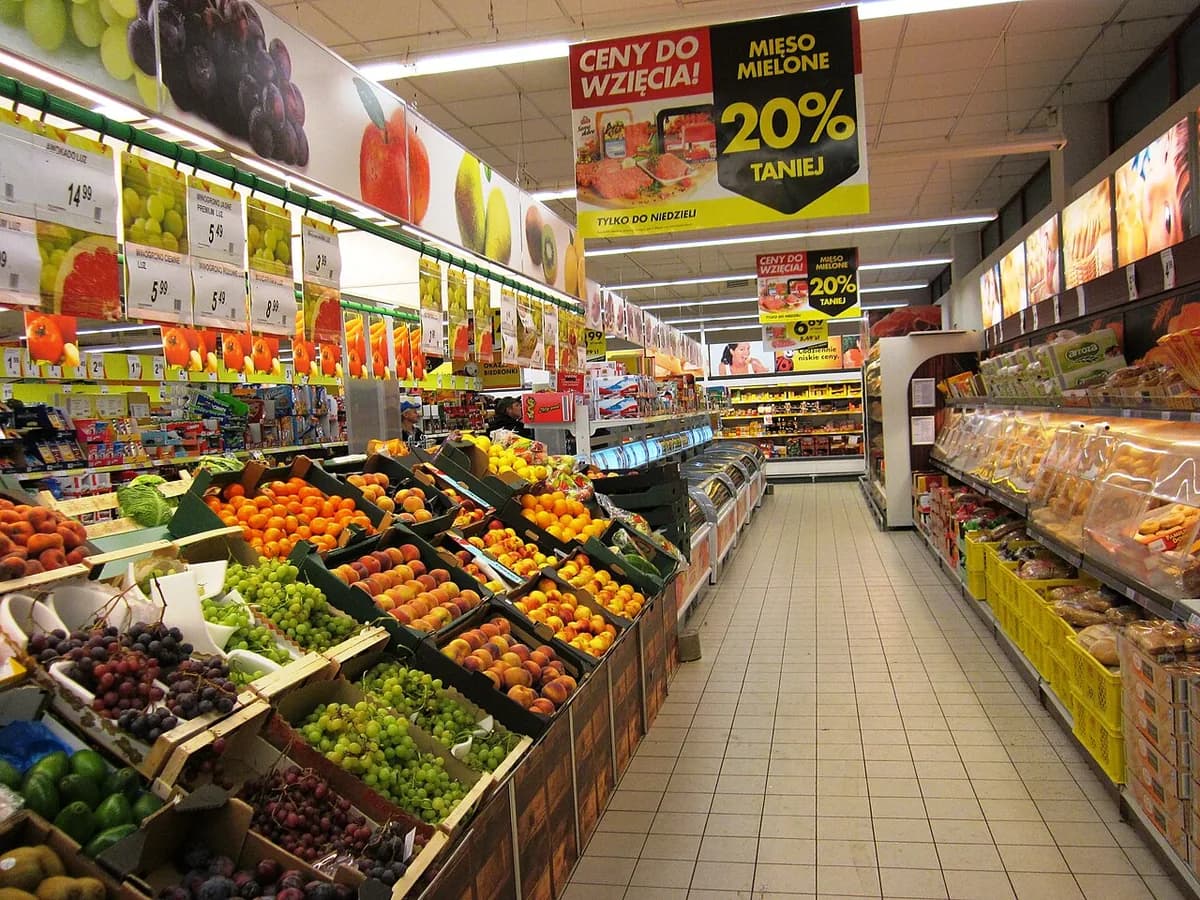
Photo: Henryk Borawski, CC BY-SA 3.0, via Wikimedia Commons.
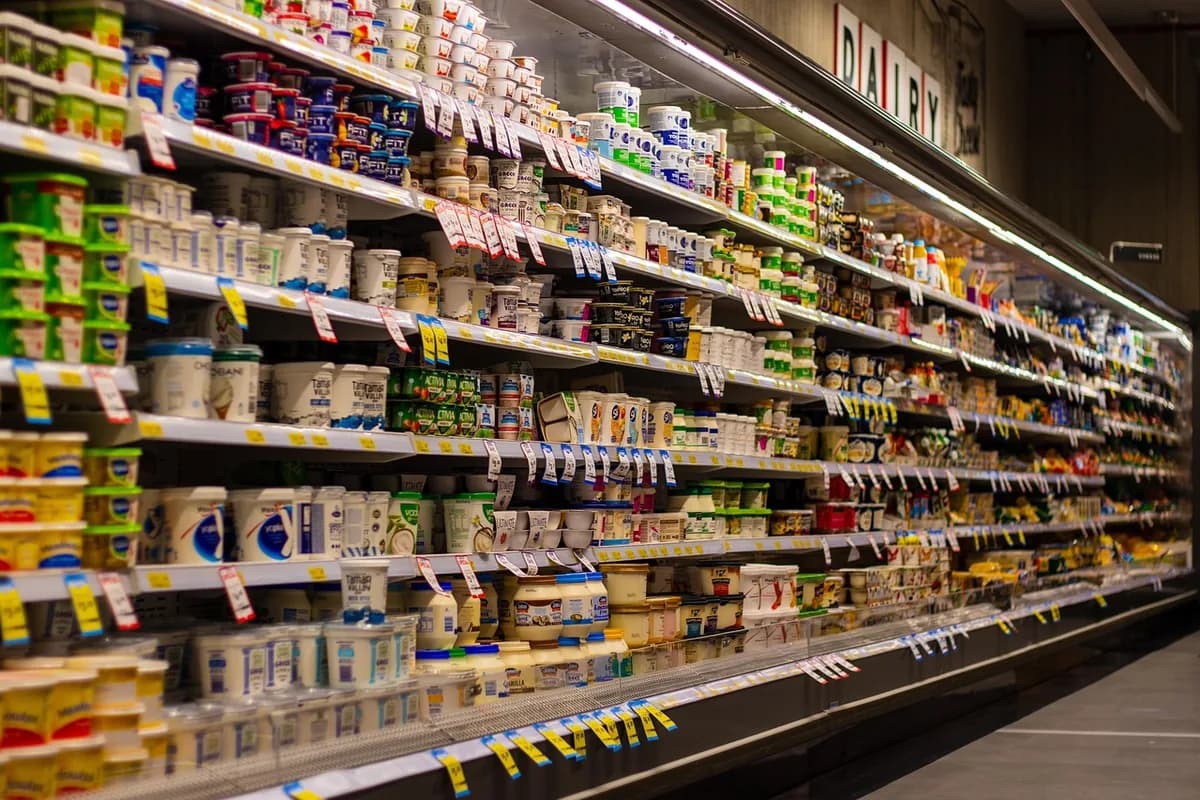
Walk into a Biedronka and the layout will feel familiar to anyone who's shopped at a supermarket anywhere: a produce section near the entrance, a bakery counter, a deli or meat counter, long aisles of packaged goods, a dairy and frozen section, and household basics — cleaning products, toiletries, basic kitchenware — toward the back or sides.
Own-label products make up a large share of what's on the shelves, spanning everything from staple groceries to snacks, and they're consistently the cheapest option in their category. Biedronka also carries a rotating selection of imported goods from Portugal, a small but distinctive nod to its parent company, alongside the standard mix of Polish and international brands you'd expect.
Weekly promotions are a genuine part of the shopping culture here, not just marketing noise — the bright yellow and red discount tags throughout the store change every few days, and plenty of regular customers plan meals around whatever's discounted that week rather than the other way around.
Meat and bakery counters deserve a specific mention, since they're a bigger deal here than at a typical convenience store. Fresh bread is baked in-store throughout the day rather than shipped in pre-packaged, and the meat counter carries a wider range of cuts than most first-time visitors expect from what's marketed as a discount chain. If you want a deeper sense of how food fits into Polish daily life beyond the supermarket shelf — from home cooking traditions to what actually ends up on the table — our guide to Polish food culture is a good next stop.
The Ladybird Logo and "Everyday Low Prices"
The smiling cartoon ladybird isn't just decoration — it's the entire brand promise condensed into one friendly image. "Biedronka" translates to "ladybird," a small, harmless, almost childlike symbol that signals approachability rather than luxury. Paired with the slogan "Codziennie niskie ceny" ("Everyday low prices"), the branding is consistent and unambiguous: this is where you go to spend less, every single day, not just during a sale.
That branding discipline is part of why the chain has stayed so recognizable at over 3,700 locations. Whether you're in a small town or a major city, the red-and-yellow ladybird sign means the same thing everywhere: the same discount model, the same rotating promotions, the same basic layout.
How Biedronka Fits Among Poland's Other Supermarkets
Biedronka isn't the only supermarket chain in Poland, but it's by far the most common one, and it helps to know where it sits relative to the rest of the field. Lidl is its closest direct competitor on price and format — both are discount chains with a heavy own-label focus, and plenty of Poles simply shop at whichever one happens to be closer.
Kaufland, Carrefour, and Auchan sit a tier up in format, running larger hypermarket-style stores with a wider non-food selection — electronics, clothing, seasonal goods — alongside groceries, closer to a big-box store than a neighborhood supermarket. They're worth knowing about for a bigger shopping trip, but they're less common per capita than Biedronka, and you'll typically find them on the edge of a city rather than within easy walking distance.
For everyday grocery shopping, though, Biedronka's sheer number of locations makes it the default choice for most people, in the same way a particular pharmacy or drugstore chain might be the one everyone defaults to simply because it's everywhere.
Prices, Payment, and Shopping Tips for Foreigners
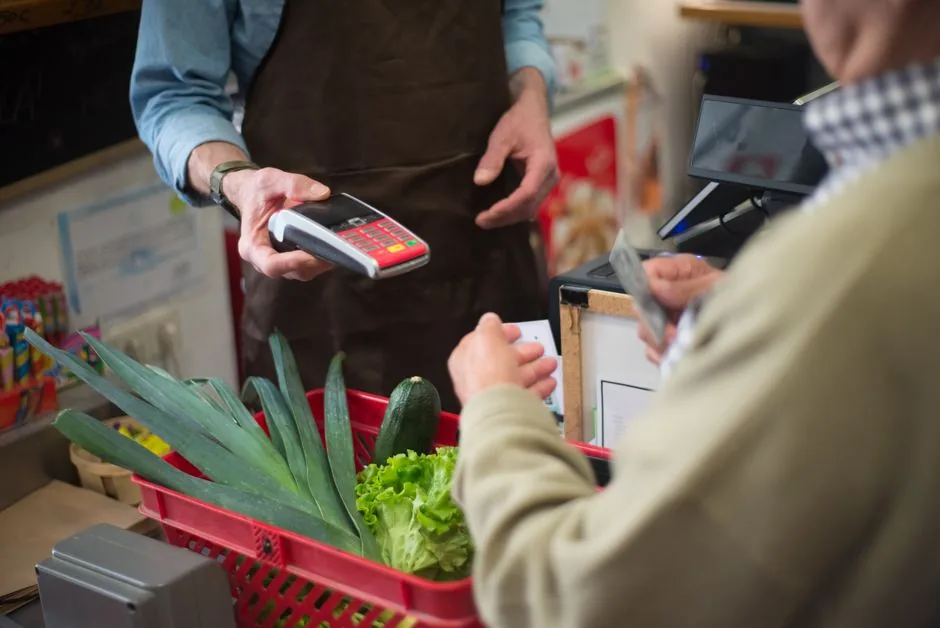
A few practical habits will make your first few Biedronka trips go more smoothly. Card payments, including contactless and phone payments, are accepted everywhere and are the default for most shoppers — cash is fine too, but increasingly rare at the register. Self-checkout kiosks are common in larger stores if you'd rather skip the line and the small talk.
Bring your own bag, or budget a few złoty for one at checkout. Like most of the EU, Poland charges for plastic shopping bags rather than providing them free, and regulars simply carry a reusable one out of habit.
One custom that catches almost every newcomer off guard: in the produce section, you're usually expected to weigh your own fruit and vegetables on a scale before reaching the checkout, print the price sticker yourself, and stick it on the bag. Skipping this step means a longer wait at the register while the cashier weighs it themselves — not a disaster, just a small tell that you're new.
Biedronka's loyalty program runs through its own mobile app, offering personalized coupons and discounts similar to loyalty schemes at other major European supermarkets. It's optional, but regulars use it enough that scanning a phone at checkout has become as normal here as anywhere else.
Prices are in złoty (PLN), and it's worth knowing that Poland has not adopted the euro, unlike some of its neighbors — a detail that occasionally surprises first-time visitors who assume every EU country shares the same currency. Receipts are itemized and printed by default, and, as in most of Poland, tipping isn't expected at a supermarket checkout the way it might be at a restaurant.
If you want the vocabulary to navigate all of this comfortably — asking where something is, understanding a price, handling the checkout — this lesson covers the essentials of shopping in Polish:
Shopping & Clothing Vocabulary
Why Biedronka Closes on Sundays (But Żabka Doesn't)
This is one of the most useful practical facts for any foreigner living in or visiting Poland: since March 2018, a national law has banned most large retail trade on Sundays, with only a handful of designated "trading Sundays" exempted each year, according to Poland's Ministry of Family, Labour and Social Policy. Biedronka, as a large chain retailer, is squarely covered by that ban — plan your big grocery trip for a weekday or Saturday, because showing up on an ordinary Sunday will mean a locked door.
Żabka, by contrast, is often open every day of the week. Small stores that are personally run by their owner are exempt from the ban, and many Żabka locations are structured — or partnered with postal or courier services — in ways that let them legally stay open on Sundays too. It's a genuinely useful thing to know as a practical matter, not just trivia: if it's Sunday and you need groceries, Biedronka is the wrong plan and Żabka is the right one.
In practice, Poland allows a handful of exempted "trading Sundays" a year — generally clustered around Easter, back-to-school season, and the Sundays leading up to Christmas — and the exact dates shift slightly from year to year as the law gets adjusted. Local news sites and shopping apps publish the current year's trading Sunday calendar well in advance, which is worth a quick check if a big shopping trip happens to fall near a holiday.
Frequently Asked Questions
What does "Biedronka" mean? It means "ladybird" (or "ladybug") in Polish — the source of the chain's cartoon ladybird logo.
Who owns Biedronka? The Portuguese retail group Jerónimo Martins, which acquired a controlling stake in 1997 and still runs it as its largest business today.
Is Biedronka cheaper than other Polish supermarkets? It's positioned as a discount chain, competing directly with Lidl on price, and is generally cheaper than mid-range or premium Polish supermarket chains.
Can I pay by card at Biedronka? Yes — card, contactless, and phone payments are all standard and widely used, alongside cash.
Is Biedronka open on Sundays? Only on a small number of designated "trading Sundays" each year. On an ordinary Sunday, expect it to be closed, unlike many Żabka locations.
Is Biedronka the same company as Żabka? No — they're separate companies today, though both were originally founded by the same entrepreneur, Mariusz Świtalski, with Biedronka launching first in 1995 and Żabka following in 1998.
Do I need to weigh my own fruit and vegetables? In most locations, yes. Use the scale in the produce section to print a price sticker before you reach checkout — skipping it just means a slower line while the cashier does it for you.
What's the difference between Biedronka and Lidl? They're direct competitors with a similar discount model and heavy own-label focus. The practical difference for most shoppers comes down to which one happens to be closer to home.
Does Biedronka sell fresh bread and meat, or just packaged goods? Both. Most stores bake bread on-site throughout the day and run a proper meat and deli counter, which is more than a lot of first-time visitors expect from a discount chain.
Between the two, you now have a genuinely useful map of Polish grocery shopping: Żabka for the quick, everyday stop, and Biedronka for the real weekly shop — and knowing which one to walk into, and when, is one of those small, practical wins that make daily life in Poland feel a lot less foreign.