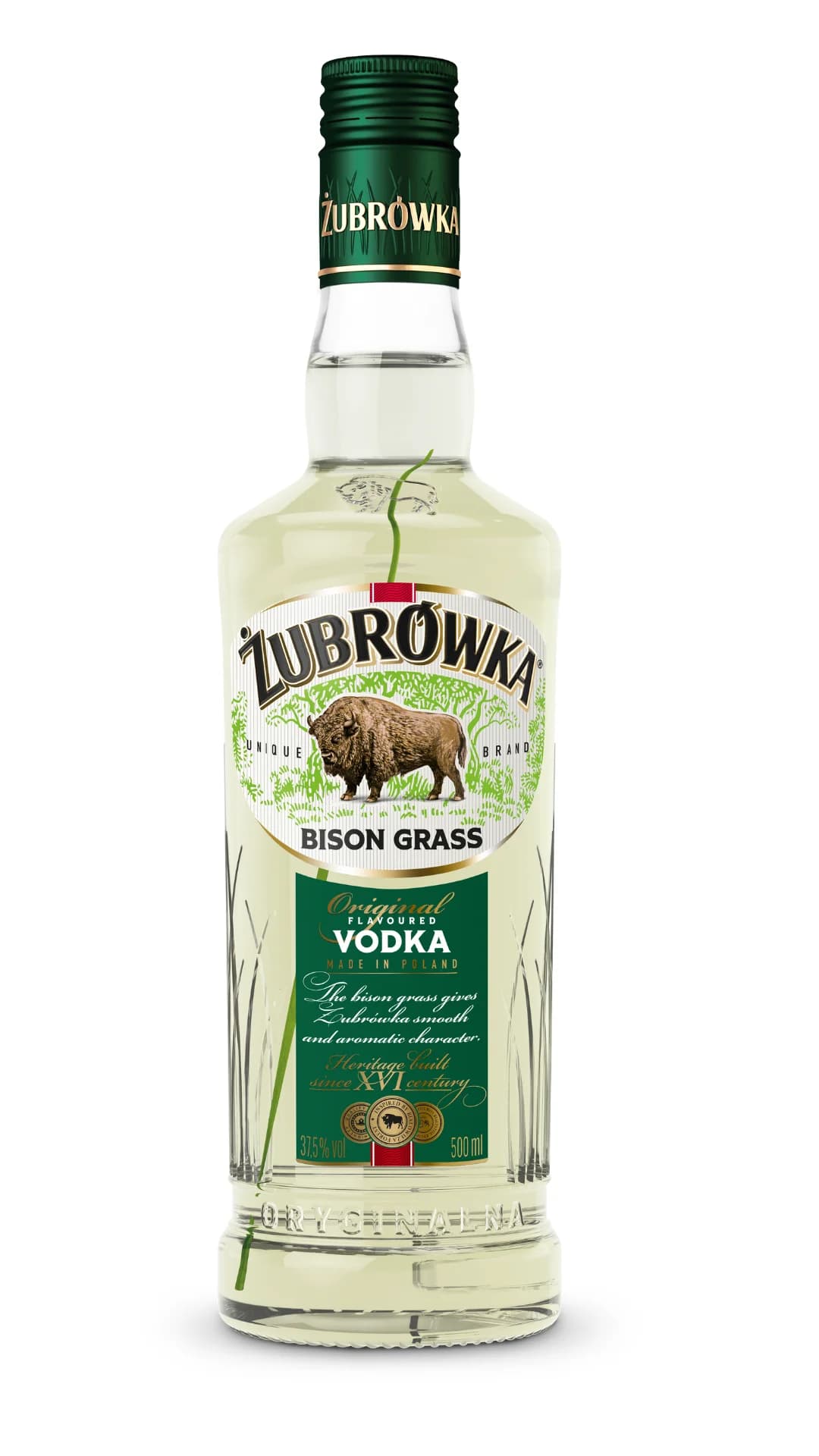
Order a vodka in Poland and someone will eventually ask if you've tried the one with the blade of grass floating inside the bottle. That's Żubrówka — a pale yellow-green spirit flavored with bison grass from one of Europe's last primeval forests, and easily the most distinctive vodka Poland exports. It smells faintly of vanilla and fresh-cut hay, tastes nothing like the neutral vodkas most people picture, and comes with a genuinely strange backstory involving a 30-year American import ban.
If you've only ever seen Żubrówka on a bar menu next to a mixer called "Tatanka," this guide covers where the name comes from, why a single blade of grass sits in every bottle, why it disappeared from U.S. shelves for three decades, and how to order it like you've done it before.
What Is Żubrówka, Exactly?
Żubrówka (pronounced roughly "zhoo-BROOF-ka") is a Polish flavored vodka infused with bison grass, or żubrówka in Polish — the plant and the vodka share a name, which comes from żubr, the Polish word for the European bison that grazes in the forest where the grass grows.
| Detail | Fact |
|---|---|
| Pronunciation | zhoo-BROOF-ka |
| Named after | Żubr (European bison) + the grass it grazes on |
| Alcohol content | Typically 37.5–40% ABV |
| Color | Pale yellow-green |
| Flavor notes | Vanilla, fresh hay, almond, coconut, faint cinnamon |
| First commercial production | 1928, Polmos Białystok distillery |
| Main producer today | Polmos Białystok |
| Signature detail | A single blade of dried bison grass inside every bottle |
Unlike the clear, deliberately neutral vodkas most people associate with Poland or Russia, Żubrówka is built around one ingredient doing all the work: a wild grass that only grows in a handful of untouched European forests. That's also what separates it from a generic bison grass vodka knockoff — the specific grass, the specific forest, and a production method that hasn't changed much since the 1920s.
Where the Bison Grass Vodka Flavor Comes From — Białowieża Forest
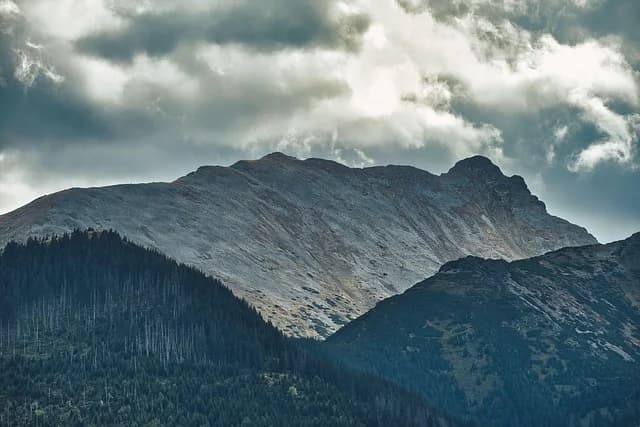
The grass itself is Hierochloe odorata, known in English as bison grass, sweet grass, or vanilla grass. It grows wild in the Białowieża Forest on the Poland–Belarus border, one of the last remaining fragments of the primeval woodland that once covered much of lowland Europe — and, not coincidentally, the last place in the world where European bison still roam free.
The bison graze on the grass, which is how it got its name and its association with the animal that appears on every bottle's label. For centuries, locals near Białowieża hand-harvested the grass for medicinal teas and as a flavoring long before anyone thought to steep it in spirit.
- Harvested by hand from wild stands in and around the forest, since the plant doesn't take well to large-scale cultivation.
- Dried naturally rather than kiln-dried, which preserves more of its delicate aromatic compounds.
- Protected species status means harvesting is regulated — you can't just wander into Białowieża and start cutting.
- One blade per bottle is included not for flavor (the vodka is infused separately) but as a visual signature and a nod to tradition.
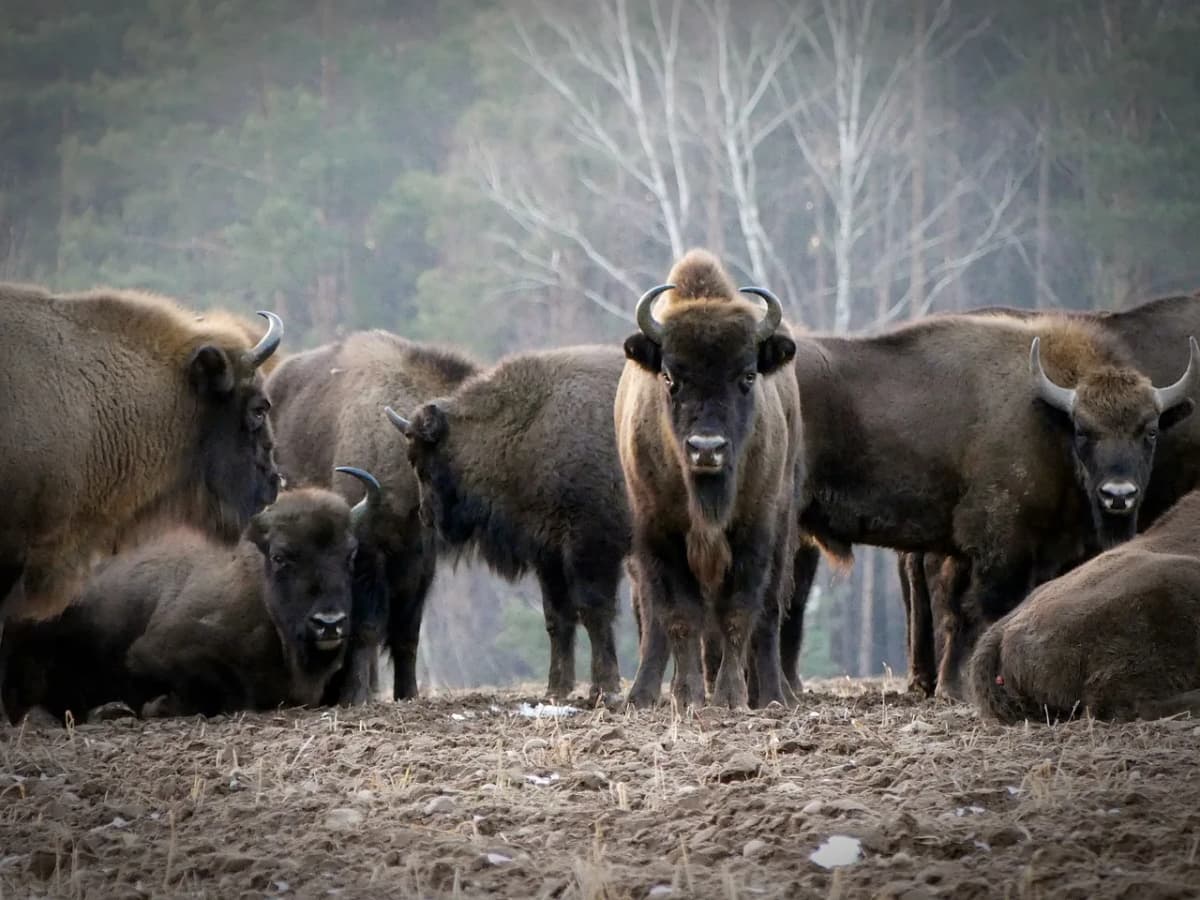
The forest itself is worth knowing about on its own terms. Białowieża is one of the few places in Europe where you can still find old-growth lowland woodland that was never clear-cut, and UNESCO lists part of it as a World Heritage Site. The European bison, or żubr, was hunted to extinction in the wild by the early 20th century and survived only in captivity — the population grazing in Białowieża today descends from a careful reintroduction effort, which makes the animal on every Żubrówka label a genuine conservation story, not just branding.
How Żubrówka Is Made
The production process is simpler than the flavor suggests — it's really about infusion, not distillation from the grass itself.
| Step | What Happens |
|---|---|
| 1. Base spirit | Neutral grain vodka is distilled first, same base as unflavored Polish vodkas |
| 2. Grass preparation | Bison grass is hand-picked in Białowieża, then dried under natural conditions |
| 3. Infusion | The vodka is filtered through bundles of dried bison grass, absorbing color and aroma |
| 4. Resting | The infused spirit rests to let the flavor settle and mellow |
| 5. Bottling | Bottled with one blade of grass added for visual identification |
The result is a vodka with genuine complexity — tasting notes commonly include vanilla, freshly cut hay, coconut, almond, and a whisper of cinnamon, which is unusual for a spirit that starts life as flavorless grain alcohol.
The Coumarin Ban — Why This Bison Grass Vodka Vanished From U.S. Shelves
Here's the part of the story most drinkers never hear. Bison grass naturally contains coumarin, a compound with a sweet, vanilla-like aroma that also acts as a mild blood thinner in concentrated doses.
The U.S. Food and Drug Administration banned coumarin as a food and beverage additive back in 1954, well before Żubrówka was ever exported there. By the late 1970s, American regulators had specifically blocked the vodka's import because of it — European rules were, and still are, considerably more permissive about coumarin levels in food and drink.
| Period | What Happened |
|---|---|
| 1954 | FDA bans coumarin as a food/beverage additive in the U.S. |
| Late 1970s | Żubrówka is specifically blocked from U.S. import over coumarin content |
| 1980s–2000s | American drinkers can only get it via personal imports or duty-free |
| 2010 | Polmos Białystok releases a coumarin-reduced recipe cleared for U.S. sale |
| Today | Legally available across the U.S., alongside the original recipe still sold in Europe |
The workaround wasn't dramatic. Producers adjusted the infusion so coumarin levels fell under the U.S. threshold, without gutting the flavor that made the vodka famous in the first place.
According to VinePair's coverage of the ban, even bartenders who'd tried both versions found the difference hard to detect. One Denver restaurateur quoted in the piece said he couldn't tell the reformulated U.S. version apart from the original Polish bottling in a blind pour.
So if you buy a bottle in the U.S. today, you're drinking a slightly adjusted formula. The one sold across Poland and the rest of the EU still carries the original, unmodified coumarin level, since European food safety rules have always been more permissive about it than American ones.
Żubrówka's Product Line: It's Not Just One Vodka
Confusingly, the Żubrówka brand today sells several distinct products, and only the original green-tinted bottle is the bison grass vodka this article is mostly about.
| Product | Base Grain | Filtration | Character |
|---|---|---|---|
| Żubrówka (original) | Rye | Bison grass infusion | Pale green, herbal, vanilla-hay notes |
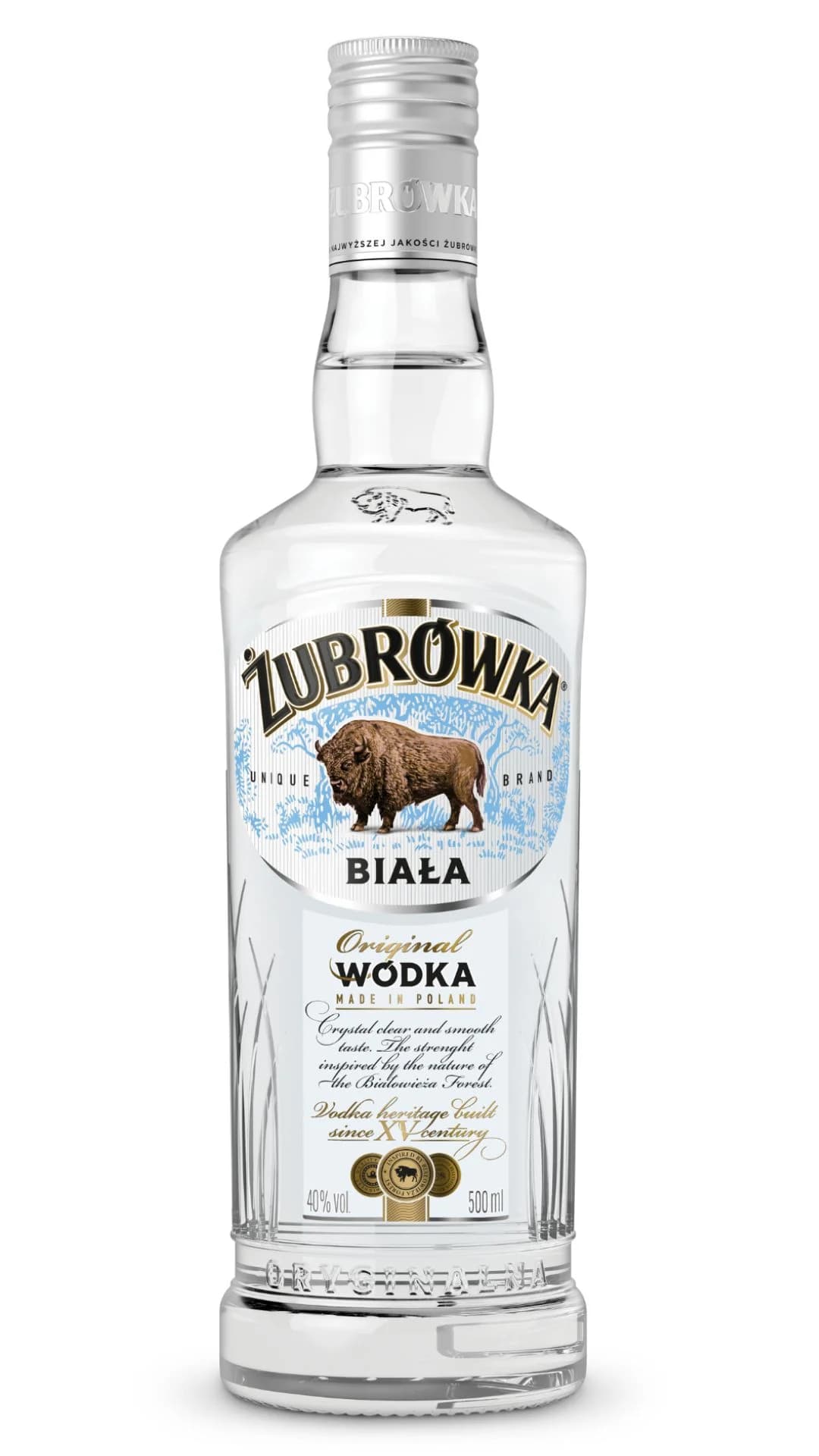
| Żubrówka Biała | Rye | Six-times distilled, platinum-filtered | Clear, deliberately neutral, no grass flavor |
| Żubrówka Czarna | Wheat | Charcoal filtered, oak-aged | Amber, warming, oaky and slightly sweet |
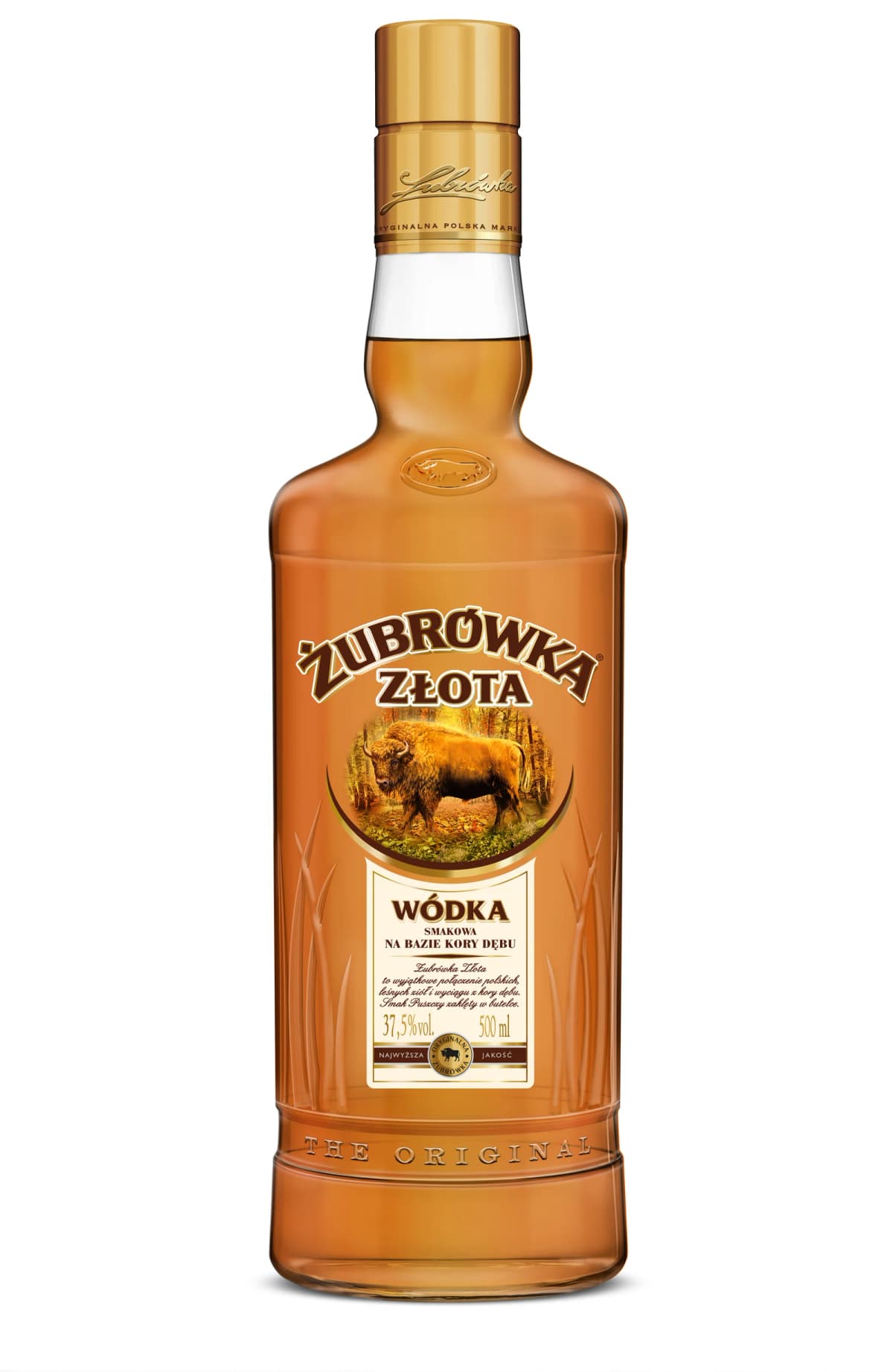
| Żubrówka Złota | Rye | Infused with oak bark, vanilla, and forest herbs | Amber, sweet-bitter, notes of dried plum and cinnamon |
If a bottle is labeled just "Żubrówka Biała" (white) with no grass blade inside, it's the brand's clean unflavored vodka — closer in style to Wyborowa than to the grass-infused original.
Czarna (black) is a different animal again: aged in oak barrels and filtered through charcoal, it drinks more like a light whisky than a vodka. Złota (gold), introduced more recently, leans further into dessert territory — it's built around oak bark and forest herb extracts rather than bison grass, so despite the shared branding, it tastes closer to a spiced liqueur than to the original.
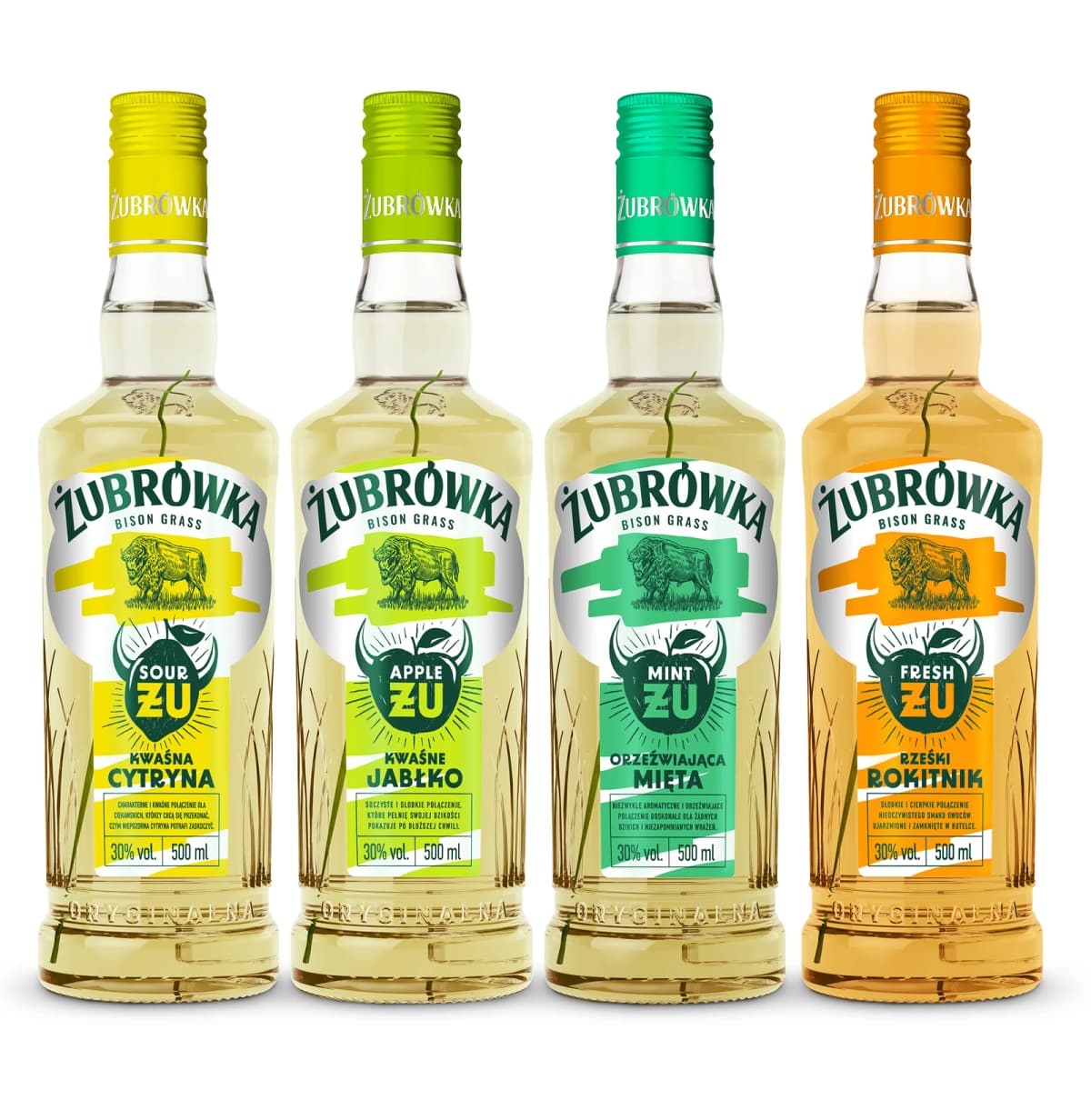
There's also a lower-proof "ŻU" flavored line — lemon, apple, mint, and rokitnik (sea buckthorn) editions at 30% ABV, aimed at a younger, mixed-drink crowd rather than traditionalists. Each still carries the bison grass branding and the grass blade inside the bottle, but the flavor profile is fruit-forward rather than herbal.
When people talk about "the" Żubrówka — the one with the grass and the bison on the label — they mean the original.
How Poles Actually Drink It — Tatanka Cocktail and Beyond
Żubrówka is rarely drunk neat in Poland, at least outside of small ceremonial sips. It's a mixing vodka, and one drink in particular built its modern reputation.
| Drink | Recipe | Notes |
|---|---|---|
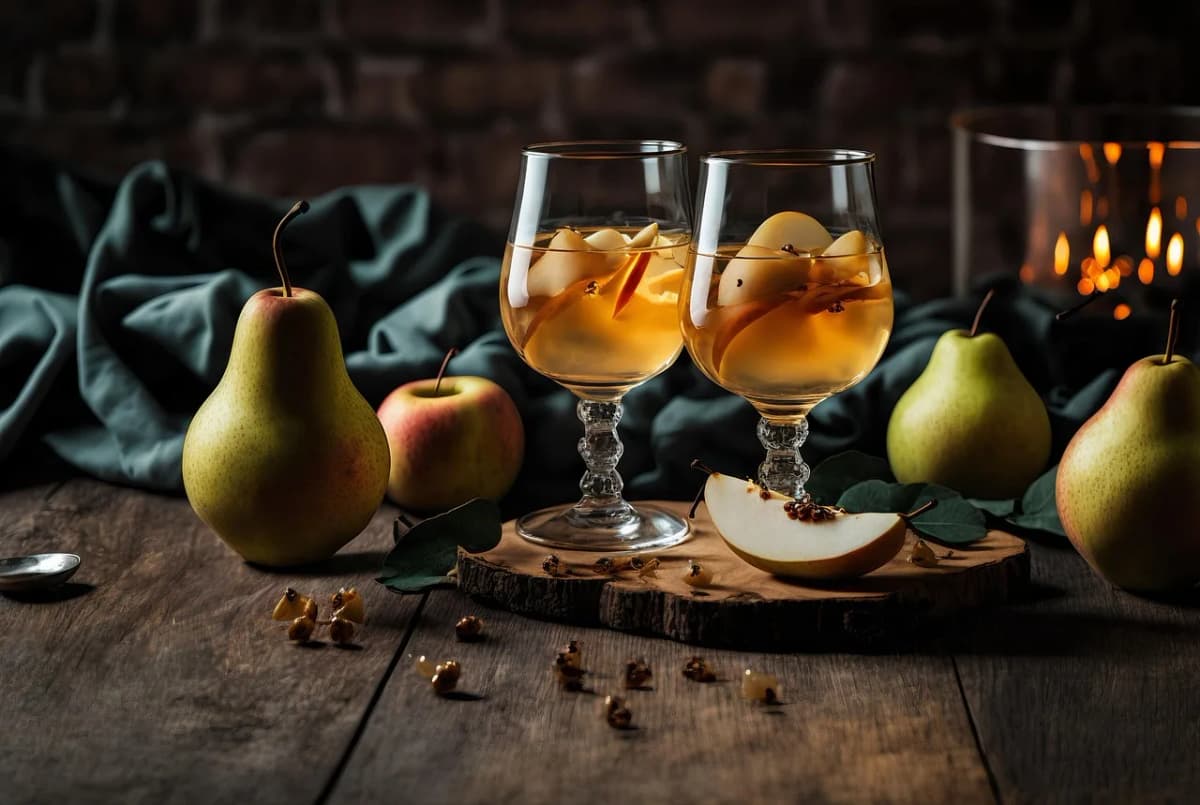
| Tatanka | Żubrówka + cloudy apple juice, over ice | The signature serve; named after the Lakota word for buffalo, popularized by Dances with Wolves |
| Szarlotka | Same as Tatanka | Regional name meaning "apple pie" — same drink, different name depending on where you order it |
| Neat, chilled | Straight from the freezer, small glass | How older generations and purists often take it |
| With grapefruit juice | Żubrówka + grapefruit juice | A tarter, less sweet alternative to the classic apple mix |
| In cocktails | Substituted for gin or vodka in modern bar menus | Bartenders outside Poland now use it in Bloody Marys and sours for the herbal edge |
If you only remember one word from this article, make it Tatanka — ask for "Żubrówka z sokiem jabłkowym" (Żubrówka with apple juice) anywhere in Poland and the bartender will know exactly what you mean, even if they call it Szarlotka instead.
Żubrówka vs Other Polish Vodkas
Poland exports several vodkas that regularly show up on international shelves, and they're not interchangeable.
| Vodka | Style | Best For |
|---|---|---|
| Żubrówka | Bison grass-flavored, pale green | Tatanka cocktails, anyone who finds neutral vodka boring |
| Wyborowa | Clear, rye-based, neutral | Classic mixed drinks, martinis |
| Belvedere | Clear, rye-based, premium/smooth | Sipping neat, higher-end cocktails |
| Sobieski | Clear, rye-based, mid-range | Everyday mixing, value |
| Żołądkowa Gorzka | Herbal, amber, bittersweet | Digestifs, after a heavy meal |
Żubrówka sits in its own category — it's the one Polish vodka most non-Poles could actually identify by smell alone.
How to Order It in Polish
Scenario: You're at a bar in Kraków and want to try the local specialty.
You: Czy macie żubrówkę? (Do you have żubrówka?) Bartender: Tak, mamy. Z sokiem jabłkowym? (Yes, we do. With apple juice?) You: Tak, poproszę Tatankę. (Yes, I'll have a Tatanka, please.) Bartender: Już się robi. (Coming right up.) You: Na zdrowie! (Cheers!)

That short exchange covers most of what you'll ever need — the drink name, the standard mixer, and the toast everyone expects when the glasses arrive. For more phrases like these that come up constantly in real conversations, our guide to essential Polish phrases for travel and everyday life covers ordering, small talk, and dozens of situational tables just like this one.
Common Mistakes When Trying Żubrówka
| Mistake | Why It's a Problem | Do This Instead |
|---|---|---|
| Ordering it "on the rocks" like whiskey | It's traditionally served ice-cold from the freezer or mixed, not over cubes | Ask for it chilled neat or as a Tatanka |
| Assuming it's sweet like a liqueur | It's a genuine vodka — dry, with herbal notes, not a dessert drink | Expect something closer to gin in dryness, not schnapps |
| Confusing the U.S. and EU recipes | The coumarin-adjusted U.S. version tastes very slightly different from the original | Try both if you travel — the difference is subtle but real |
| Thinking the grass blade is edible or a garnish | It's a production artifact, not meant to be eaten or fished out | Leave it in the bottle; it's just proof of origin |
| Calling it "Polish schnapps" | It's vodka-based, not a fruit brandy | Use "flavored vodka" if you need an English description |
Table of Important Żubrówka and Vodka Words
| Polish | English | Pronunciation Note |
|---|---|---|
| żubrówka | bison grass vodka | zhoo-BROOF-ka |
| żubr | (European) bison | zhoobr |
| wódka | vodka | VOOD-ka |
| sok jabłkowy | apple juice | sok yahb-KOH-vih |
| na zdrowie | cheers / to your health | nah ZDROH-vyeh |
| kieliszek | shot glass | kyeh-LEE-shek |
| poproszę | I'll have / please give me | poh-PROH-sheh |
| na lodzie | on ice | nah LOH-dzheh |
| czysta | neat / straight (lit. "clean") | CHIS-tah |
| lampka | small glass | LAHMP-kah |
Where to Buy It and What to Expect to Pay
Żubrówka is one of the more widely distributed Polish exports, so you don't need to travel to find a bottle — though the experience differs depending on where you're shopping.
| Location | Availability | Rough Price (750ml) |
|---|---|---|
| Poland (supermarkets, Żabka, liquor shops) | Everywhere, cheap | 20–35 PLN (roughly $5–9) |
| EU countries generally | Common in larger supermarkets and specialty spirits shops | €10–18 |
| United States | Widely available at liquor stores, reformulated recipe | $18–28 |
| Duty-free / airport shops | Often stocked, sometimes gift-boxed with two glasses | Varies, usually a premium over retail |
In Poland, it sits comfortably in the everyday-drinking price bracket rather than being treated as a specialty item — most Poles think of it the way an American might think of a mid-shelf whiskey, not as a novelty souvenir. If you're buying it abroad specifically to try the "real" version, double-check the label: bottles produced for EU distribution still carry the original coumarin level, while U.S.-market bottles use the adjusted 2010 recipe.
Frequently Asked Questions
Is Żubrówka legal in the United States? Yes. Since 2010, a reformulated version with reduced coumarin has been legally sold across the U.S., alongside the original recipe still available throughout the EU.
Does the blade of grass do anything to the taste? Not really — the vodka is already infused before bottling. The blade is a visual signature more than a flavoring agent at that point.
What does Tatanka mean? It's the Lakota word for buffalo, borrowed from the film Dances with Wolves and applied to the Żubrówka-and-apple-juice mix because of the bison connection.
Is Żubrówka sweet? No — it's a dry spirit with herbal, vanilla-like notes. Any sweetness in a Tatanka comes from the apple juice, not the vodka itself.
Where can I buy real Białowieża bison grass vodka? Polmos Białystok's Żubrówka is the most widely available brand internationally and remains the benchmark version most bars and shops stock.
Żubrówka is one of those things that sounds like a gimmick — flavored vodka with a blade of grass in it — until you actually taste one and realize the whole reputation is earned. It's a genuinely distinctive spirit with a real story behind it, from a protected forest to a decades-long standoff with U.S. food regulators.
It's also a small, useful entry point into Polish vocabulary. Ordering one correctly means using real words in real sentences, which is exactly the kind of practical, low-pressure practice that sticks better than flashcards ever do. If you want to build on phrases like these systematically rather than picking them up one drink order at a time, our guide to learning Polish online for free breaks down structured options — including PolishPal's own free A0 to A1 course — for turning scattered phrases into an actual foundation.