
Pierogi are Poland's most famous dish by a wide margin — boiled, half-moon dumplings stuffed with anything from potato and cheese to wild mushrooms, wrapped in a legend about a 13th-century saint, and, somehow, also the reason grown adults in giant foam costumes sprint around a Major League Baseball stadium between innings in Pittsburgh. Few foods manage to be a Christmas Eve religious tradition, an EU-protected recipe, and an American sports mascot all at once.
The short version of what pierogi actually are is simple enough: unleavened dough, rolled thin, cut into circles, filled, folded, sealed, and boiled (sometimes pan-fried afterward). The longer version — where they came from, why one particular filling combination has its own legal protection under EU food law, and how they ended up racing each other around a baseball diamond 4,700 miles from Kraków — is a lot stranger, and it's a good entry point into Polish food culture more broadly.
What Is Pierogi, Exactly?
The word is technically already plural — the singular is pieróg — though almost nobody outside a Polish grammar class uses it that way in English. It descends from the Proto-Slavic root pirъ, meaning "feast," the same root that gives Russian its pirozhki (small filled pies). That etymology alone tells you something: this was never conceived as everyday food. It was feast food, made for the table when there was something to celebrate.
The dough itself is about as basic as cooking gets — flour, egg, water, a pinch of salt — rolled thin and cut into circles, then filled and pinched shut along the curved edge into that recognizable half-moon shape. What goes inside varies enormously by region, season, and occasion, but the two dominant camps are savory (potato, cheese, meat, sauerkraut, mushrooms) and sweet (fruit, sweetened farmer's cheese), and most Polish households have a strong, mostly non-negotiable opinion about which filling belongs at which meal.
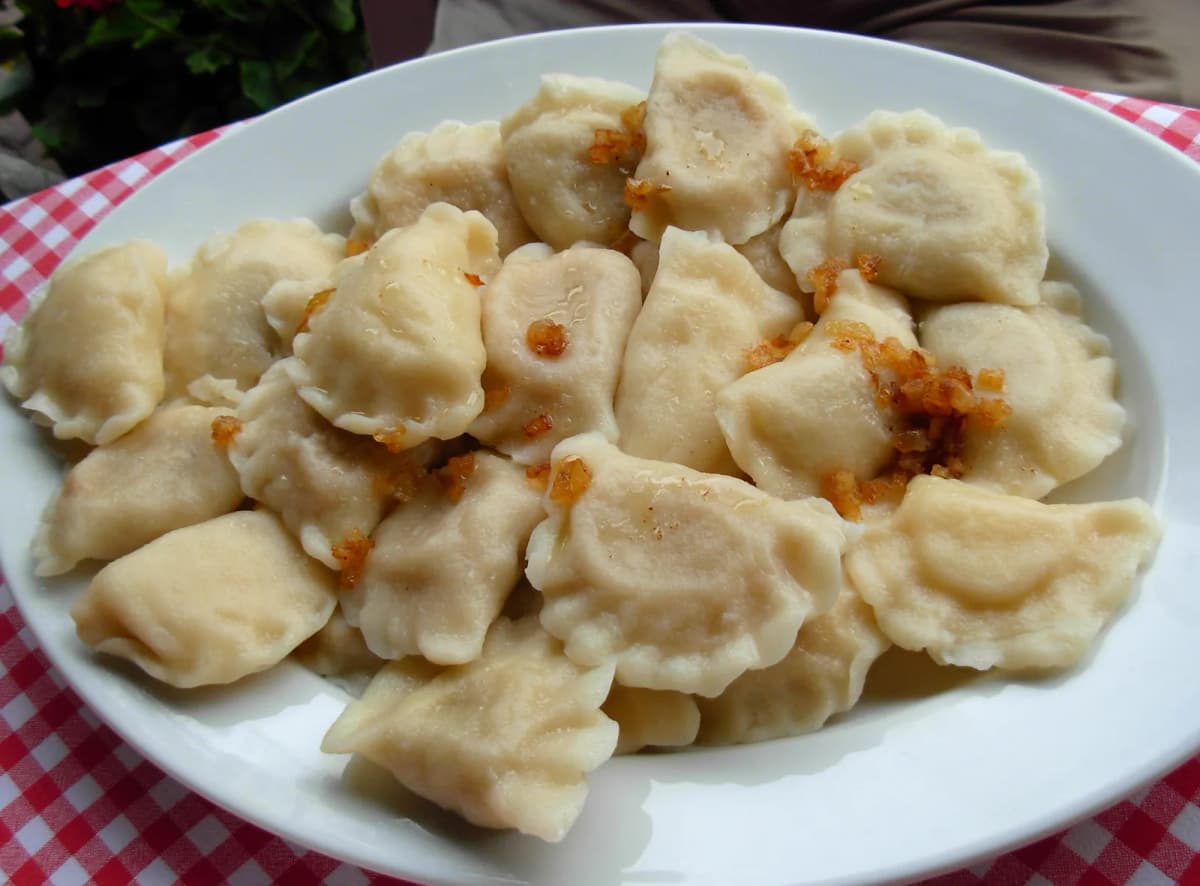
Photo: Piotrus, CC BY-SA 3.0, via Wikimedia Commons.
Cooking them is just as simple as making the dough: a rolling boil until they float to the surface, usually three to five minutes, sometimes followed by a quick pan-fry in butter for a crisped exterior. Leftovers freeze exceptionally well uncooked, which is part of why Polish households routinely make them in batches of fifty or more at once — a single dedicated cooking session, often a multi-generational kitchen event, can stock a freezer for weeks.
The making itself is genuinely simple to learn even if it takes years to get fast at: roll the dough to roughly the thickness of a coin, cut circles with a glass or a round cutter, spoon a small amount of filling just off-center, fold the circle in half, and pinch the curved edge firmly shut so nothing leaks out during boiling. Home cooks who grew up doing this by hand can fold hundreds in an evening without measuring or thinking about it; everyone else usually needs a few dozen ugly, filling-leaking attempts before the technique clicks.
Nobody can actually prove where the dish came from, and that's not for lack of trying. Poland's first known cookbook, Compendium ferculorum, published in 1682, already treats it as an established staple — meaning the recipe predates the written record by an unknown margin. Dumplings in general most likely trace back to Central Asia or China, spreading west along Silk Road trade routes over centuries, long before anyone in Poland was using this particular name.
The word has also fully naturalized into English, which is a genuinely useful thing for language learners to notice: Merriam-Webster carries its own dictionary entry, defining it as dough filled with a savory filling and cooked by boiling, sometimes followed by pan-frying. That's a rare distinction for a foreign-language food word — most borrowed culinary terms stay confined to menus and recipe blogs, but this one crossed fully into everyday English usage, plural form included.
The Legend of Saint Hyacinth, Poland's Patron Saint of Pierogi
Polish folk tradition doesn't bother with the Silk Road theory. It has its own origin story, and it involves a miracle. According to legend, the 13th-century Dominican friar Jacek Odrowąż — canonized as Saint Hyacinth of Poland — brought the recipe back from his travels through Kyivan Rus' and used it to save people from starvation.
The details shift depending on which version you hear. One account has Hyacinth arriving in the town of Kościelec in 1238 just as a hailstorm destroys the local crops; he tells the villagers to pray, the crops are miraculously restored overnight, and they thank him with a feast made from the saved harvest. A second, grimmer version places the miracle during the Mongol invasion of 1241, with Hyacinth feeding starving crowds in Kraków during the siege. Either way, he's remembered today as the unofficial patron saint of the dish — a genuinely rare honor for a dumpling, and one that still gets invoked every August at Kraków's own festival in his name.
Pierogi Ruskie and Poland's Regional Varieties
Ask a Pole to name one pierogi filling and most will say pierogi ruskie — potato, farmer's cheese (twaróg), and fried onion, folded into dough and traditionally topped with more fried onion or bacon bits. Despite the name, "ruskie" doesn't mean Russian; it refers to Ruthenia, the historical region straddling parts of modern Ukraine and southeastern Poland where this specific filling combination originated, which is also why foreigners routinely mistranslate it. The recipe is significant enough that the EU has registered it as a Traditional Speciality Guaranteed (TSG) product — a legal designation that protects the traditional recipe itself, rather than tying it to a specific place of production the way a geographical certification would.
Photo: Adam Sulich, CC BY-SA 4.0, via Wikimedia Commons.
Beyond pierogi ruskie, regional and occasion-specific varieties multiply fast. Uszka ("little ears") are a tiny mushroom-filled version traditionally floated in clear beet borscht at Wigilia. Pierogi kurniki are a wedding-feast specialty filled with chicken and baked rather than boiled. In the southeastern highlands, buckwheat groats mixed with farmer's cheese show up as a heartier, more rustic filling suited to colder weather, while sweet versions filled with blueberries, strawberries, or sweetened farmer's cheese take over in summer, usually finished with melted butter and a spoonful of sugar or sour cream.
None of these are fringe variants — they're all still made in home kitchens across Poland every week, and most families have a fixed rotation of two or three fillings they consider non-negotiable, passed down more or less unchanged from whoever taught them to fold the dough in the first place.
Pierogi at Wigilia: Poland's Christmas Eve Tradition
If pierogi have one single moment of maximum cultural importance, it's Wigilia — the traditional Christmas Eve supper, held the evening of December 24th, built around a twelve-course meatless meal. Pierogi filled with sauerkraut and mushrooms, or with potato and cheese, are near-universal fixtures on the Wigilia table, and the sauerkraut-mushroom combination specifically carries symbolic weight: the cabbage and mushrooms are traditionally read as symbols of strength and vitality for the coming year.
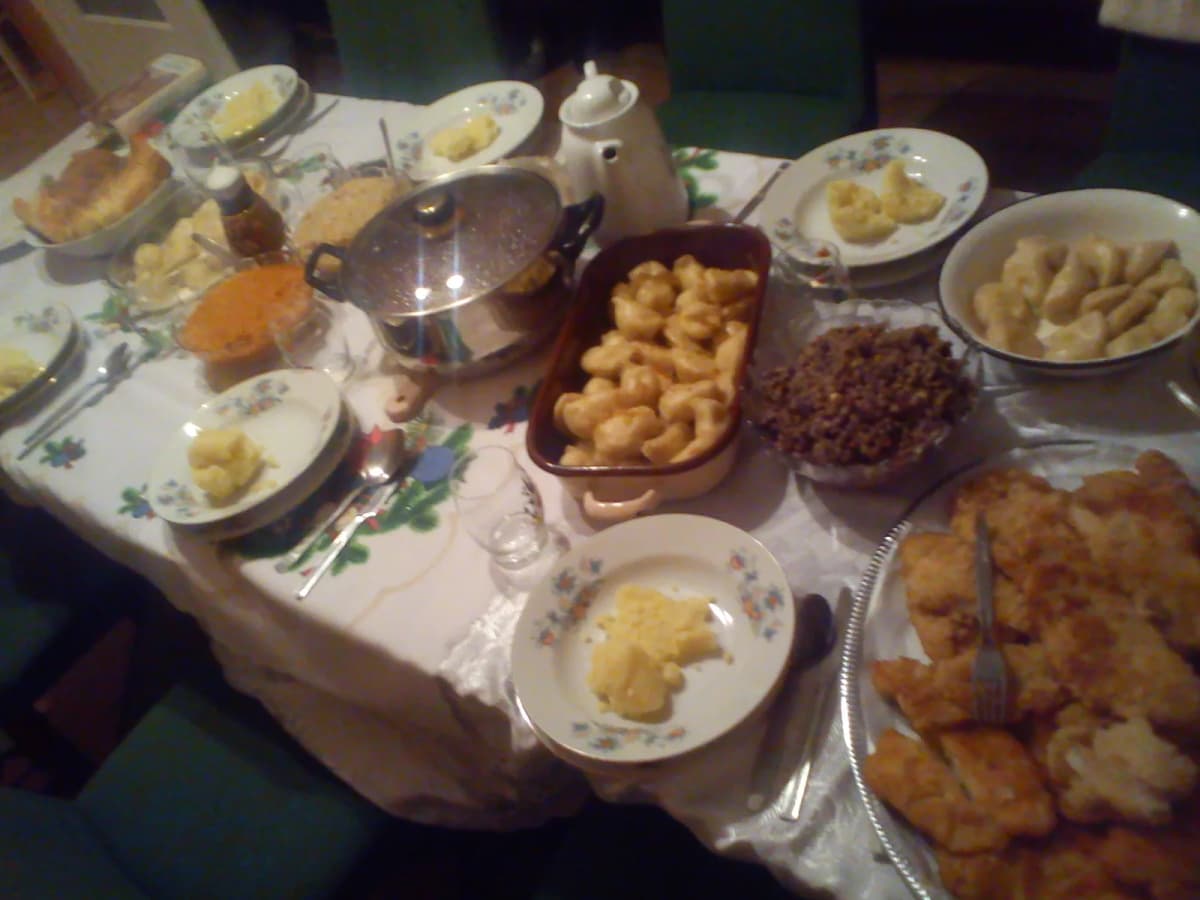
Photo: Adam Sulich, CC BY-SA 4.0, via Wikimedia Commons.
Every dish at Wigilia carries meaning, but this one occupies a strange middle ground — humble enough to be everyday food, formal enough to anchor a religious feast. That duality is arguably the most Polish thing about it: a food unpretentious enough for a Tuesday dinner and load-bearing enough for the single most important meal of the Polish calendar year. Families often assign specific fillings to specific relatives, with grandmothers and aunts each defending their own version as the correct one, in disputes that can outlast the meal itself by decades.
Where to Eat Pierogi in Poland Today
For visitors, the cheapest and most authentic way to try pierogi isn't a tourist restaurant — it's a bar mleczny, the state-subsidized cafeteria-style canteens that have served basic Polish home cooking at rock-bottom prices since the communist era. Pierogi are a near-guaranteed menu item at almost every bar mleczny in the country, usually sold by weight or by the plate for a fraction of restaurant prices, and eaten the way most Poles actually eat them: fast, plain, and without ceremony.
For a more festive version of the same dish, Kraków hosts the Krakowski Festiwal Pierogów (Kraków Pierogi Festival) every August on the city's Mały Rynek (Small Market Square), a tradition running since 2003. According to the official Kraków tourism board's festival page, the multi-day event draws dozens of vendors competing for the audience's favorite and for a jury prize modeled after Saint Hyacinth himself, alongside live cooking demonstrations and dough-making workshops open to visitors.
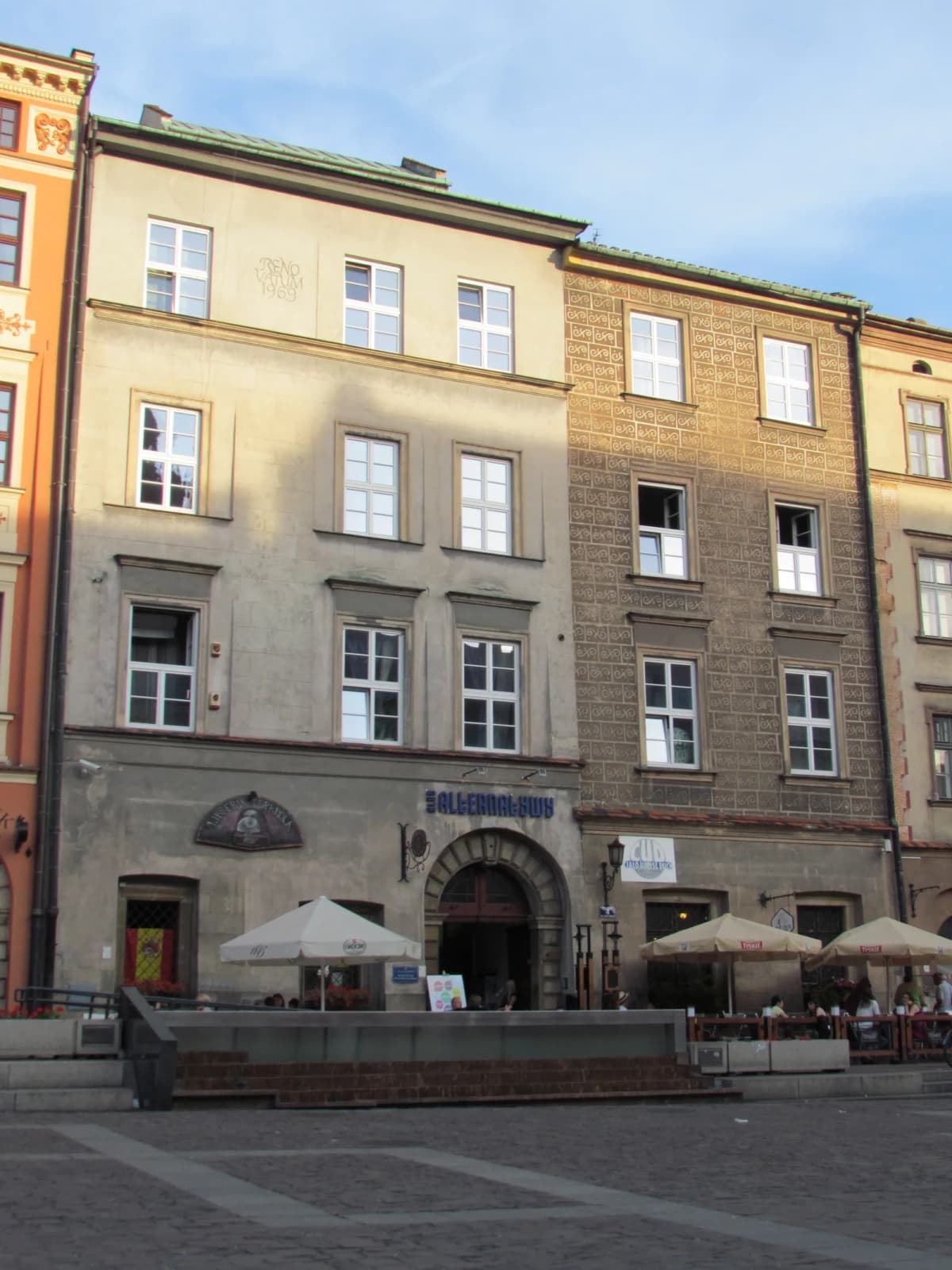
Photo: Michalwitulski, CC BY-SA 3.0 Poland, via Wikimedia Commons.
Between the bar mleczny counter and the festival stalls, the dish in Poland covers the entire spectrum from subsistence food to street-fair spectacle — and both versions are, by most accounts, worth the trip.
A newer, third category has emerged over the past decade: gourmet and fusion versions served at dedicated restaurants in Warsaw, Kraków, and Wrocław, filled with things like duck confit, wild boar, or seasonal vegetables well outside the traditional canon. Food writers in Poland have taken to calling this the "pierogi renaissance" — a reinvention of the country's most conservative culinary export by chefs who grew up eating the traditional versions and wanted to see how far the format could stretch without losing what makes it recognizable in the first place.
None of this has displaced the traditional fillings at home, though. The renaissance restaurants sit alongside, not instead of, the bar mleczny counters and family kitchens still turning out potato-and-cheese and sauerkraut-and-mushroom versions exactly as they've been made for generations — which is arguably the more remarkable outcome. Most national dishes that go through a "gourmet reinvention" phase eventually see the everyday version treated as old-fashioned or lesser; this one hasn't, and the humble version still outsells the fancy one by a wide margin at every level of Polish food culture.
How Pierogi Became a Pittsburgh Pirates Mascot
Pierogi's strangest chapter didn't happen in Poland at all. Pittsburgh absorbed a massive wave of Polish and Eastern European immigrants during the late 19th and early 20th centuries, drawn by jobs in the city's steel industry, and their food — pierogi especially — became a permanent fixture of the region's identity. By the late 20th century, Pittsburgh had effectively adopted the dish as a civic mascot in all but name.
In 1999, the Pittsburgh Pirates baseball team made that unofficial adoption literal. Following other MLB teams that ran mascot races between innings, the Pirates introduced the Great Pittsburgh Pierogi Race: a cast of oversized costumed characters — Potato Pete, Sauerkraut Saul, Cheese Chester, Jalapeño Hannah, and Oliver Onion among them — sprinting a short course around the field while fans cheer for their favorite filling. It's been a fixture of Pirates home games for more than two decades, sponsored for most of that run by a Polish-American food brand, and it remains one of the more unlikely tributes any Polish dish has received anywhere in the world.
Pittsburgh isn't actually alone in this. The same wave of late-19th and early-20th-century Polish immigration that reshaped Pittsburgh also landed heavily in Chicago, Cleveland, and Buffalo, all of which still support long-running Polish delis, church festivals, and family-run pierogi makers to this day. Pittsburgh just happened to be the city that put the dish on a Major League Baseball scoreboard, which is why it gets most of the credit.
Frequently Asked Questions
What does pierogi mean? The word comes from the Proto-Slavic root pirъ, meaning "feast." The singular form is pieróg, though "pierogi" is used as both singular and plural in English.
What is the most popular pierogi filling? Pierogi ruskie — potato, farmer's cheese, and fried onion — is generally considered the most iconic filling in Poland, though sauerkraut-mushroom and sweet fruit fillings are also extremely common.
Who is the patron saint of pierogi? Saint Hyacinth of Poland (Jacek Odrowąż), a 13th-century Dominican friar credited in folk legend with bringing pierogi to Poland and using them to feed people during a famine.
Why do Poles eat pierogi at Christmas? Pierogi filled with sauerkraut and mushrooms are a traditional part of Wigilia, the twelve-course Christmas Eve supper, where the cabbage and mushroom filling symbolically represents strength and vitality for the year ahead.
Where can I try authentic pierogi in Poland? A bar mleczny is the cheapest, most everyday option, serving pierogi at low prices the way most Poles actually eat them. For a festive version, the Kraków Pierogi Festival runs every August on the city's Mały Rynek square.
Why are the Pittsburgh Pirates associated with pierogi? Pittsburgh has a large Polish-American population going back to a wave of immigration during the steel industry boom. The Pittsburgh Pirates baseball team introduced the Great Pittsburgh Pierogi Race, a mascot race between innings, in 1999, and it remains a beloved part of home games today.
Can you freeze pierogi? Yes, and most Polish households do exactly that. They freeze exceptionally well uncooked, which is why a single home cooking session often produces fifty or more at once — enough to stock a freezer for weeks and boil straight from frozen whenever needed.
Are pierogi the same as Russian or Ukrainian dumplings? They're closely related but not identical. Ukraine's version, called varenyky, uses different dough recipes and a wider range of fillings, including fermented milk products worked into the dough itself. Russian pirozhki, despite the similar-sounding name, are usually baked or fried hand pies rather than boiled dumplings.
Do you eat pierogi with your hands or a fork? Almost always with a fork, typically after being topped with melted butter, fried onion, bacon bits, or a spoonful of sour cream. Savory versions are eaten as a main course; sweet versions usually appear as a dessert or light meal on their own.
Pierogi manage something very few foods pull off: staying humble enough for a weeknight dinner at a bar mleczny counter, sacred enough to anchor Poland's most important meal of the year, and famous enough to run laps around a Major League Baseball diamond in foam costumes. That's a strange amount of cultural weight to carry for a dish that, underneath all of it, is really just dough, filling, and a fold — repeated by hand, a few dozen times, in kitchens on two different continents.