The 9 famous Polish painters on this list will make you fall in love with Poland before you learn a single word of Polish — and that's exactly the point. Language-acquisition research consistently shows that emotional attachment to a culture accelerates retention. You remember vocabulary faster when it's tied to something you already care about. And for Poland, one of the fastest routes to that emotional connection is through its art. You don't need vocabulary to feel the weight of a Matejko battle scene or the strange pull of a Beksiński nightmare. The feeling arrives first — the language follows.
This guide introduces you to 9 famous Polish painters whose work captures something essential about the country. Each section gives you the short story of who they were, what feeling their paintings carry, and — most importantly — exactly where you can stand in front of their real work on your next visit.
One thing you'll notice as you read: these famous Polish painters don't share a single style or century. The term "Polish artist" covers everything from monumental battle canvases painted under partition-era oppression to Jazz Age Art Deco portraits of Parisian socialites. That range is the point. Poland isn't one mood, and neither is its art.
Jan Matejko Paintings — The Epic That Defined Polish Art History
If you remember only one name from this list of famous Polish painters, make it Jan Matejko. He is the most recognisable figure in Polish art history — the painter who spent his life putting Poland's national story on canvas at a time when Poland didn't exist on the map.
Born in Kraków in 1838, this most Polish of famous Polish painters lived through the partitions, when Poland was carved up between Russia, Prussia, and Austria. His response was to paint the nation back into existence. His canvases are enormous, crowded, and electric with movement — kings being crowned, battles being won, treaties being signed. His most famous work, Battle of Grunwald (1878), depicts the 1410 victory over the Teutonic Knights and measures over four metres tall by ten metres wide. It is not a painting you look at; it is a painting you stand inside.
The feeling: Pride, defiance, and the stubborn refusal to let a nation disappear. Matejko's paintings don't whisper — they declare.
Where to see it: Battle of Grunwald hangs in the National Museum in Warsaw. His murals also cover the ceiling of St. Mary's Basilica in Kraków, and the National Museum in Kraków holds an extensive collection of his smaller works. If you have time for only one museum for Polish art, make it the National Museum in Kraków.
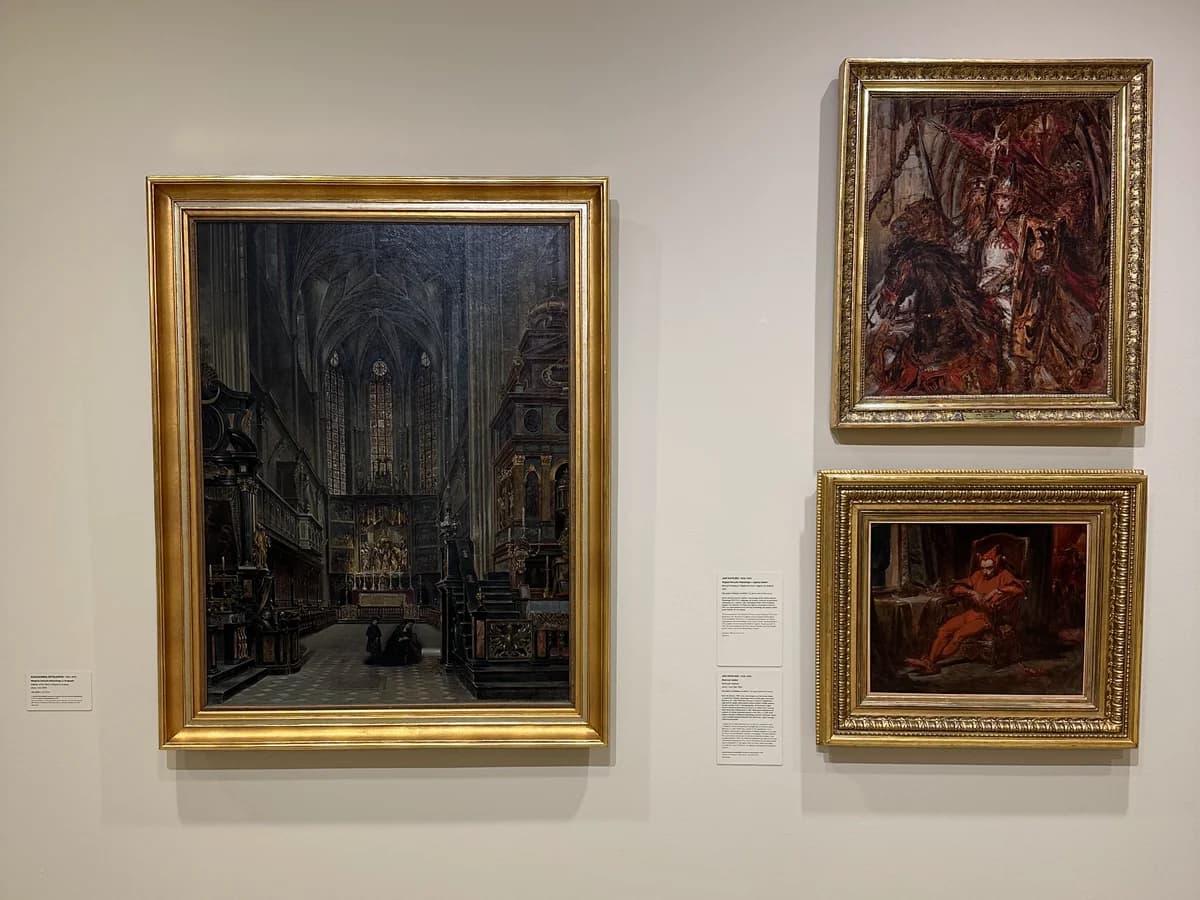
Stanisław Wyspiański — The Renaissance Man of Young Poland
Matejko's most gifted student — and the one who broke most decisively from him. Wyspiański was a painter, playwright, poet, and stained-glass designer, making him the closest thing Poland produced to a Renaissance man born three centuries too late.
Where Matejko painted battlefields, Wyspiański painted children. His portraits are quiet, intimate, and deeply personal — a sleeping daughter, a woman in a garden, a self-portrait that looks more tired than heroic. He also designed stained-glass windows for Kraków churches that remain some of the most beautiful in Europe, their colours as vivid today as the day they were fired.
The feeling: Tenderness, intimacy, and a softer kind of Polishness. Wyspiański's work says that national identity isn't only about grand gestures — it lives in quiet moments too.
Where to see it: The National Museum in Kraków holds the largest collection of his paintings. The dedicated Wyspiański Pavilion near the Planty park in central Kraków features his stained-glass designs and architectural sketches. For the stained glass itself, visit the Franciscan Church in Kraków, where his windows still glow above the altar.
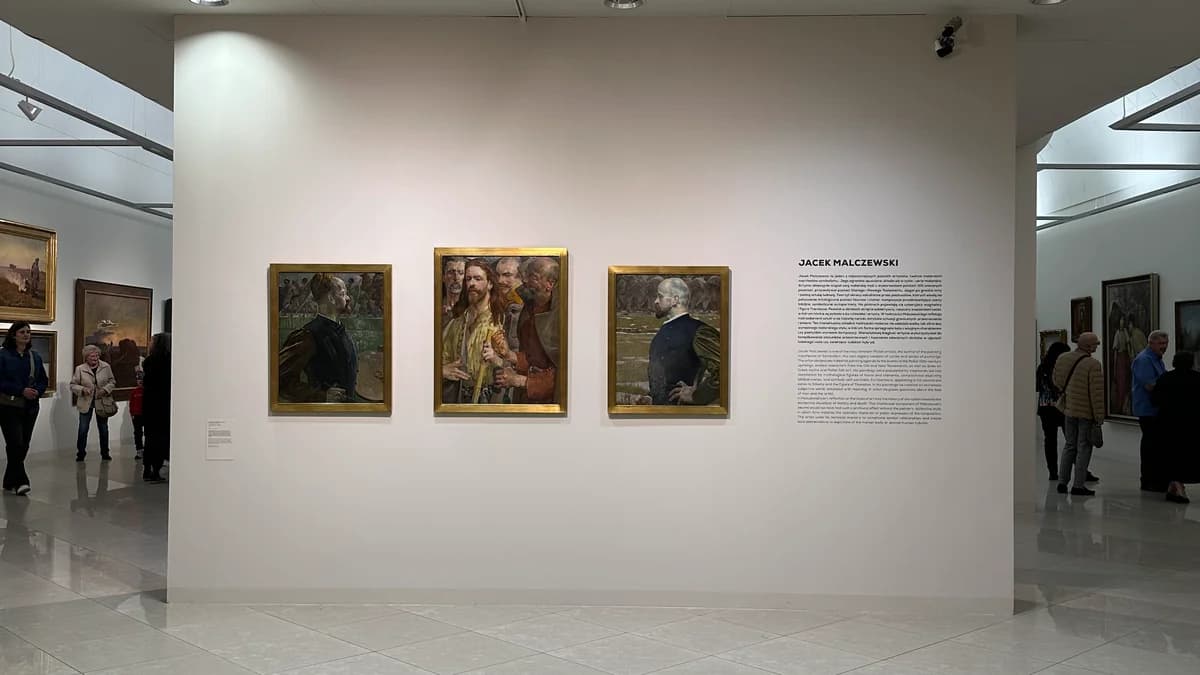
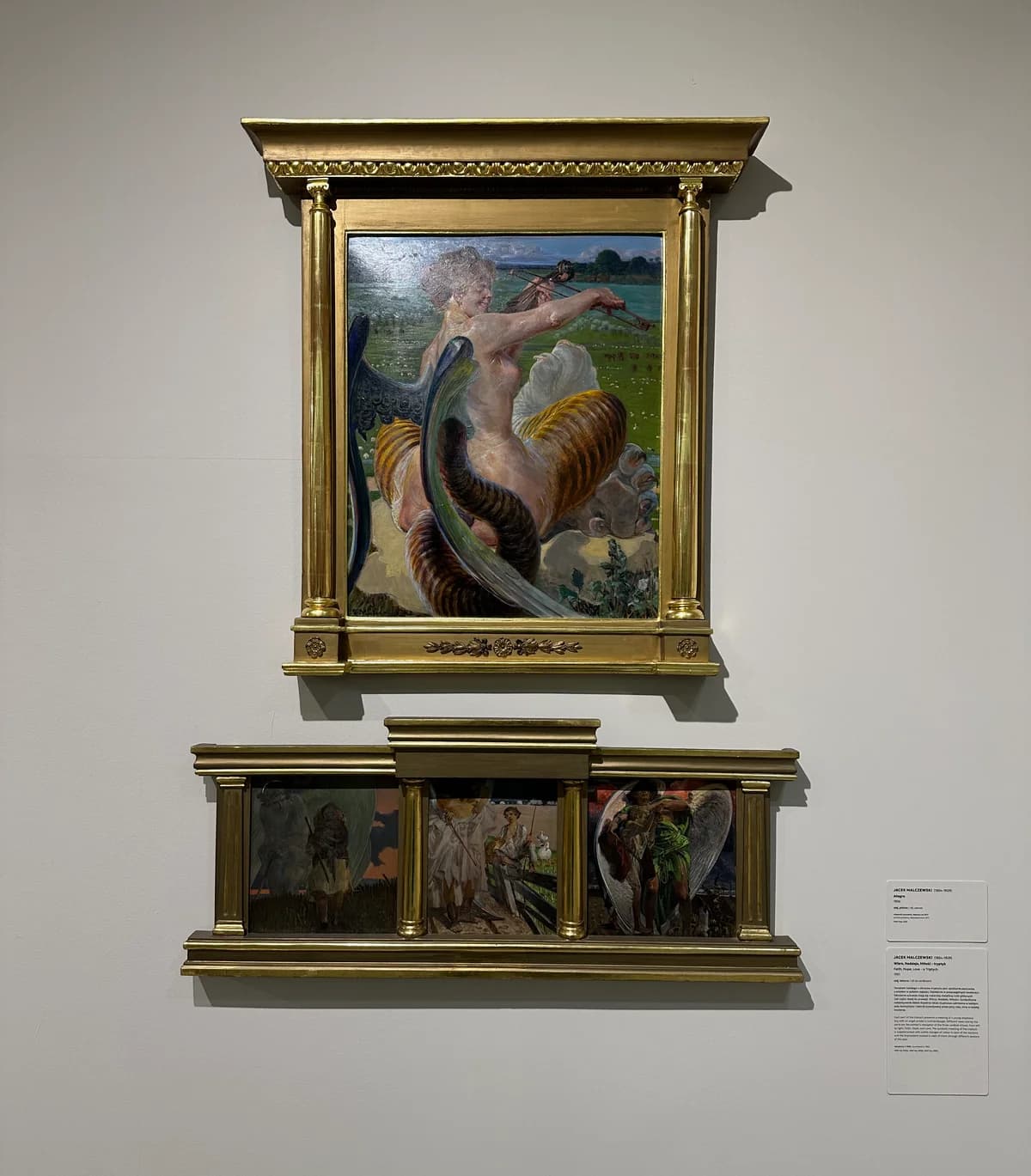
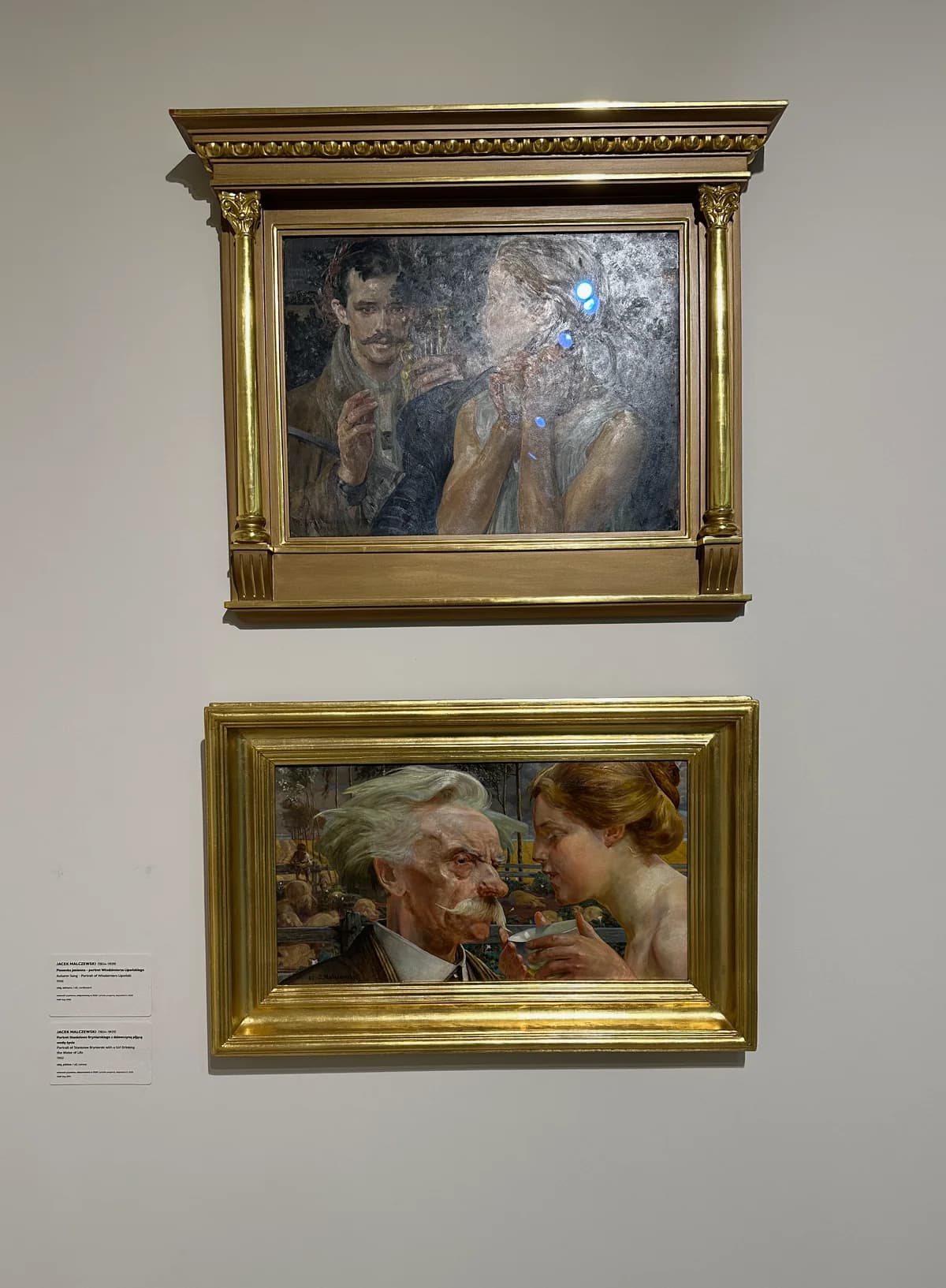
Jacek Malczewski — Poland's Symbolist Dreamer
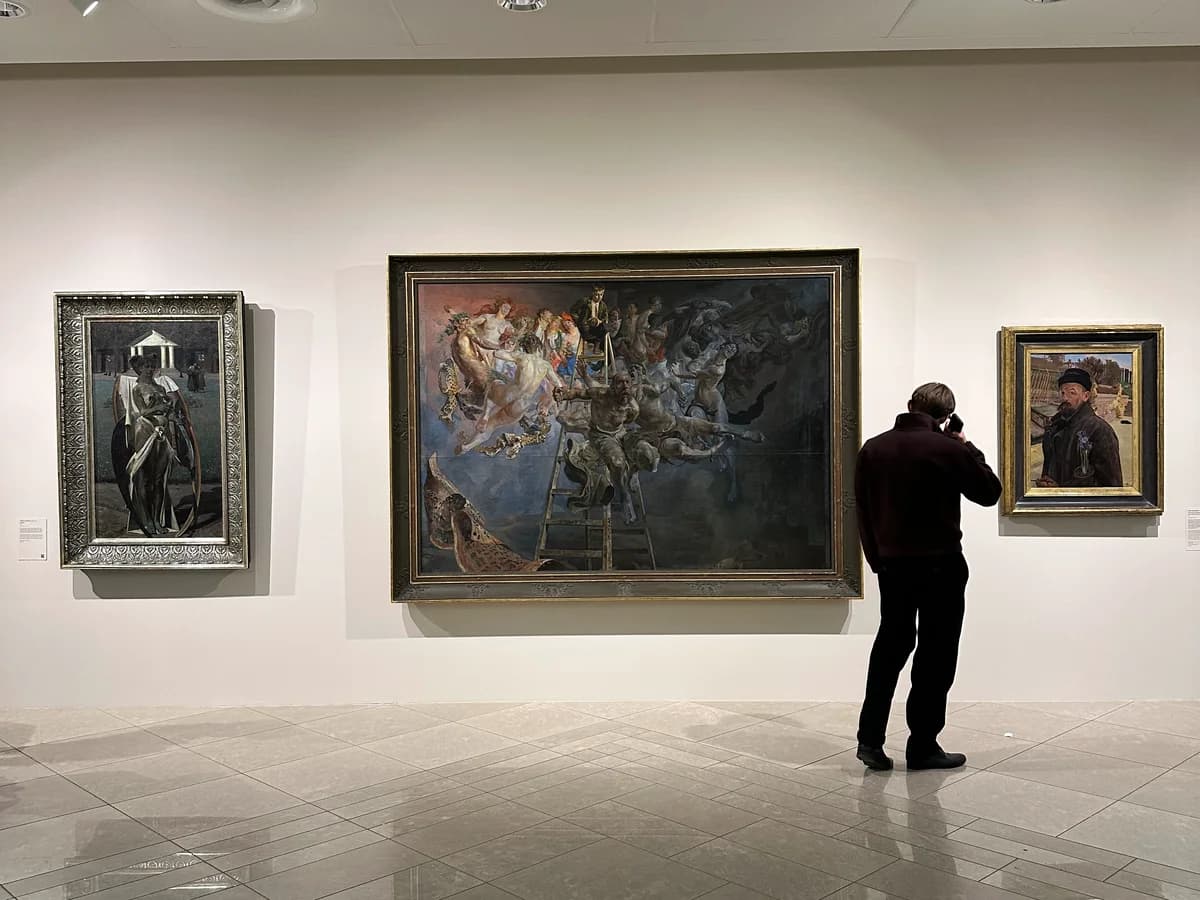
Malczewski painted himself — over and over — surrounded by mythological figures, fauns, chimeras, and visions drawn from Polish folklore and landscape. His self-portraits are not flattering; they are searching. He stares out from the canvas in a felt hat, sometimes with a faun whispering in his ear, sometimes against a backdrop of rolling Polish countryside that looks both real and hallucinated.
He is the leading figure of Polish Symbolism, a movement that rejected the literal in favour of the allegorical. His paintings feel like the visual equivalent of a dream you're not quite sure is yours.
The feeling: Curiosity, unease, and a sense that there's more to Poland than meets the eye. Malczewski's work invites you to look again — at the landscape, at the mythology, at the country itself.
Where to see it: The National Museum in Kraków holds the best and largest collection of his work, making this museum an essential stop for anyone exploring famous Polish painters. The National Museum in Poznań also has significant pieces worth seeking out.
Olga Boznańska — The Quiet Master of the Portrait
One of the few women to achieve major recognition in this era of Polish painting, Boznańska spent most of her career in Paris but was always claimed — and loved — as a Polish artist. Her portraits are muted, soft-focus, and almost melancholic. She painted people not as they posed but as they existed in memory: slightly blurred at the edges, captured in a moment of private thought rather than public performance.
Her most famous works are portraits of children and women, rendered in greys, greens, and muted pinks that feel like they're fading even as you look at them. She won international medals at a time when female painters were rarely taken seriously — the Paris World's Fair of 1889, where she exhibited, was a landmark moment for her career.
The feeling: Stillness, melancholy, and the ache of a moment already passing.
Where to see it: The National Museum in Kraków has the country's finest collection of her portraits — a reminder that famous Polish painters aren't only the men who painted battles. Her work is a quiet contrast to the bombast of Matejko a few rooms away.
Tamara de Lempicka — Poland's Art Deco Icon
Born in Warsaw in 1898, Tamara de Lempicka became one of the defining painters of the Jazz Age — bold, geometric portraits of glamorous women in sharp Art Deco lines, radically different from anything else on this list. Her figures look like architecture: sharp chins, angular arms, metallic fabrics that seem to gleam from inside the canvas.
She fled the Russian Revolution, settled in Paris, and painted the wealthy and the restless of the 1920s. Her self-portrait Tamara in the Green Bugatti has become one of the most reproduced images of the Art Deco era. She is proof that "Polish painter" doesn't mean one style or one century — it means a lineage stretching from battlefield murals to Parisian nightlife.
The feeling: Glamour, confidence, and the electric energy of a world between wars. Lempicka reminds us that famous Polish painters can also be international icons.
Where to see it: Her most famous works live internationally — the Centre Pompidou in Paris holds The Beautiful Rafaela — but the National Museum in Warsaw owns pieces that connect her back to her Polish roots. Check what's on view before your visit, as Lempicka's works rotate.
Zdzisław Beksiński Art — Why Poland's Darkest Painter Has a Cult Following
If Zdzisław Beksiński is the most surprising name on this list of famous Polish painters, that's because his work feels like it belongs to a different planet entirely. His paintings look like stills from a horror film nobody has made yet. Skeletal figures wrapped in bandages. Decaying cathedral interiors stretching into infinity. Apocalyptic landscapes painted in obsessive, photorealistic detail — every crack in every crumbling wall rendered with the same care a Renaissance painter gave to a saint's halo.
He worked in near-total isolation in the small town of Sanok in southeastern Poland, refusing to title his paintings so that viewers could bring their own meanings. The internet discovered Beksiński decades after his death, and he now has a cult following that spans continents. His life ended in tragedy — he was murdered in his Warsaw apartment in 2005 — which only deepens the haunted quality his fans read into his work.
The feeling: Something between dread and awe. Beksiński's art doesn't comfort — it confronts. And that confrontation is oddly liberating.
Where to see it: The Historical Museum in Sanok holds the world's largest dedicated collection of his paintings. This is a genuine pilgrimage destination for Beksiński fans — far off the standard Warsaw–Kraków tourist track, and absolutely worth the detour.
Leon Wyczółkowski — The Painter of the Polish Landscape
If Matejko painted Poland's history and Malczewski painted its myths, Wyczółkowski painted its actual physical beauty. He captured the Tatra Mountains, the Wieliczka Salt Mine, and rural Polish life with an Impressionist's eye for light and texture. His landscapes are alive — you can almost feel the wind moving through his renderings of mountain pines.
He also painted important portraits of other Polish artists on this list, including a famous portrait of Matejko at work in his studio. He was a bridge between generations — a student of Matejko who lived long enough to see Polish modernism emerge.
The feeling: Wonder at the natural beauty of Poland — the kind that makes you want to pack a bag and see it for yourself.
Where to see it: The Leon Wyczółkowski District Museum in Bydgoszcz is dedicated entirely to his work and is a hidden gem among the museums of famous Polish painters. Bydgoszcz is a lesser-known city that rewards the detour — a beautiful old town on the Brda River with far fewer tourists than Kraków or Wrocław.
Wojciech Kossak — The Painter of Horses and Cavalry
Wojciech Kossak was born into the Kossak family dynasty of painters, and he specialised in what he loved most: horses, cavalry charges, and battle scenes rendered with kinetic, almost cinematic energy. His paintings capture the romantic, doomed-cavalry image of Poland that shows up again and again in national memory — the lancer charging across a field, sabre raised, against impossible odds.
He co-created the Racławice Panorama, a massive 360-degree panoramic painting in Wrocław that depicts the Kościuszko Uprising of 1794. It is 15 metres high and 114 metres long — one of the most immersive art experiences in Europe, and one of Poland's most visited cultural attractions.
The feeling: Romance, heroism, and a touch of tragedy. Kossak's paintings make you want to cheer, and then they make you want to sigh.
Where to see it: The National Museum in Kraków holds many of his paintings. The Racławice Panorama in Wrocław is unmissable — a purpose-built rotunda displaying the painting in the round, with artificial terrain and lighting that makes you feel like you're standing on the battlefield itself.
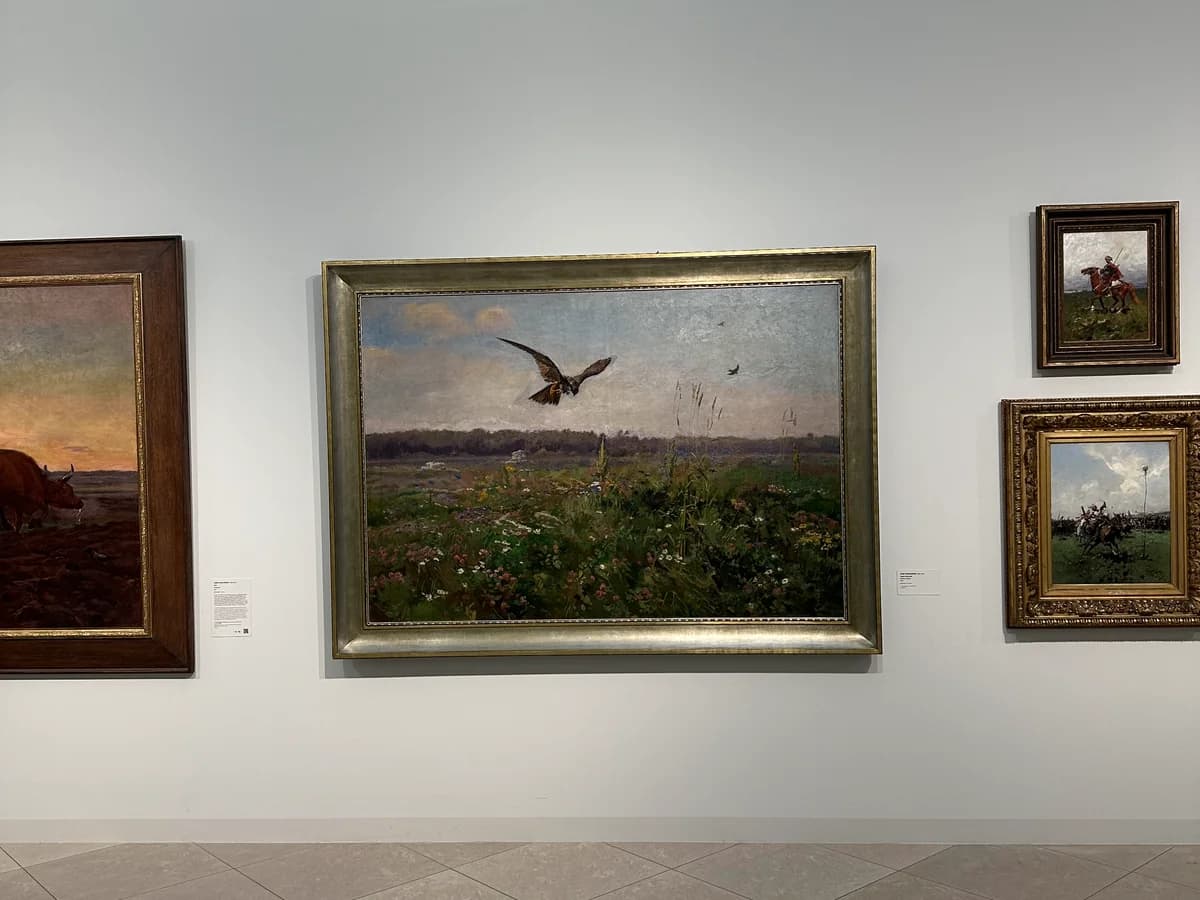
Józef Chełmoński — The Painter of the Polish Countryside
Chełmoński painted rural Poland the way other painters on this list painted battles and kings — as the truest soul of the nation. Born to a village leaseholder near Łowicz, he spent years in Munich and Paris (where the great Polish actress Helena Modjeska helped launch his career) before returning home to settle in the countryside for good.
His most famous work, Storks (1900), shows a father and son pausing mid-plough to watch a flock of storks overhead — spring arriving, the cycle of rural life continuing. It is often described as capturing the essence of Polishness itself. His Summer Evening (1875) is held by the National Museum in Poznań and is equally evocative — a golden-lit scene of peasants returning from the fields.
The feeling: Groundedness, nostalgia, and a longing for a simpler kind of life — whether or not you've ever lived it.
Where to see it: Storks hangs in the National Museum in Warsaw. Summer Evening is held permanently by the National Museum in Poznań — a city usually skipped in favour of Warsaw and Kraków, but whose art collection is genuinely significant. Poznań co-hosted a major 2025 Chełmoński retrospective alongside the Warsaw and Kraków national museums, confirming its place in the Polish art world.
Where to See These Famous Polish Painters — The Essential Museum Guide
National Museum Krakow Paintings — Your One-Stop Destination
The single most useful destination on this list is the National Museum in Kraków. It holds major works by Matejko, Wyspiański, Malczewski, Boznańska, Kossak, and others — you can see six of the nine painters on this list under one roof. If you have only one day for Polish art on your trip, spend it here. For anyone new to Polish art, a curated list of National Museum Krakow paintings is the perfect starting point.
The National Museum in Warsaw is the second essential stop, home to Battle of Grunwald, Matejko's largest work, plus Chełmoński's Storks and a significant collection of Kossak's battle scenes.
For the adventurous traveller, the Historical Museum in Sanok (Beksiński) and the Wyczółkowski Museum in Bydgoszcz reward the detour with world-class collections and far fewer crowds. The Racławice Panorama in Wrocław is a format you won't find anywhere else in Poland, and it's well worth learning how to say "Wrocław" correctly before you visit. Most of these famous Polish painters have dedicated rooms or entire wings in these museums, making it easy to spend a full day immersed in their work. For anyone interested in Polish art history, the National Museum in Kraków alone could occupy an afternoon.
Each of these cities has its own character. Learning how to pronounce their Polish names is a great first step toward navigating them with confidence, and checking the National Museum Krakow paintings list before you arrive will help you plan your route through the galleries.
Polish City Pronunciation GuideFrequently Asked Questions
Who is the most famous Polish painter? Jan Matejko is widely considered the most famous Polish painter, particularly for his monumental historical works like Battle of Grunwald. Internationally, Tamara de Lempicka and Zdzisław Beksiński have the largest global followings — proof that famous Polish painters span every style and audience.
Did any famous Polish painters work internationally? Yes. Tamara de Lempicka built her career in Paris and became an icon of the global Art Deco movement. Olga Boznańska also spent most of her career in Paris. Józef Chełmoński worked in Munich and Paris before returning to Poland.
What is Polish Symbolism? Polish Symbolism was an art movement centred in Kraków around 1900, associated with the Young Poland movement. Jacek Malczewski is its leading figure. It used allegory, mythology, and dreamlike imagery to explore Polish identity, spirituality, and the countryside.
What is the Young Poland movement? Młoda Polska (Young Poland) was a period of modernist art and literature from roughly 1890 to 1918. It rejected the positivist, practical focus of earlier generations in favour of symbolism, folk motifs, and emotional expression. Wyspiański and Malczewski are its most famous visual artists.
Where is the best museum to see Polish art? The National Museum in Kraków has the most comprehensive collection of Polish painting. For a single masterpiece, the Battle of Grunwald at the National Museum in Warsaw is unmissable. For something completely different, the Beksiński collection at the Historical Museum in Sanok is a world-class pilgrimage.
Can I visit the Beksiński museum in Sanok without speaking Polish? Yes. The Historical Museum in Sanok is accustomed to international visitors, especially Beksiński fans. English information panels are available, and the collection speaks for itself. It's also the perfect place to test your first Polish phrases — the staff appreciate the effort.
If this taster of Polish art has sparked an interest in the culture, you might enjoy our article on Polish food culture, which explores another gateway into Polish life that requires no vocabulary at all. For deeper reading on individual painters, Culture.pl offers excellent biographies — their article on Jan Matejko is a great place to start. And when you're ready to start learning, our beginner's guide to Polish walks you through the first steps from A0 to your first real conversation.