
Hejnał Mariacki is a five-note trumpet call played from the tallest tower of Kraków's St. Mary's Basilica every single hour, and it never finishes. The melody cuts off mid-phrase, abruptly, the same way every time, and has done so on the hour for longer than anyone alive can remember. Most visitors hear it once, assume it's a recording, and only later learn a real person is up in that tower playing it live.
The story most people get told about why it stops short involves a medieval guard and an arrow through the throat. It's a great story. It's also, as far as historians can tell, mostly invented — and not even invented in Poland.
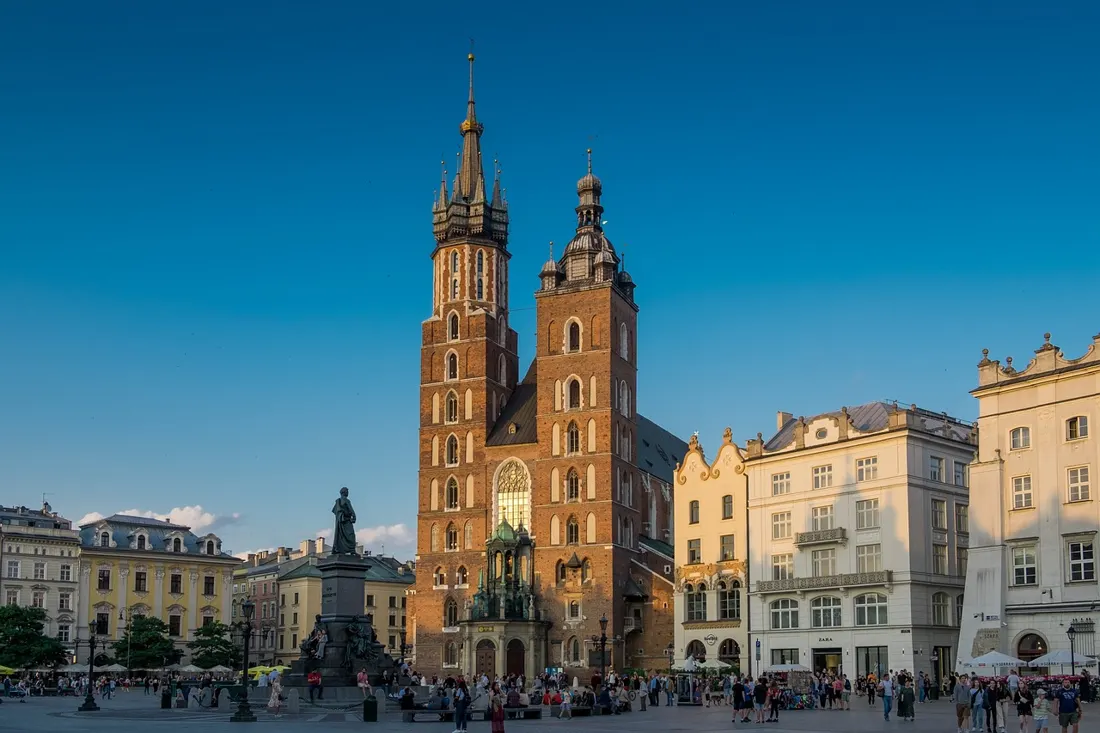
What Hejnał Mariacki Actually Is
The Hejnał Mariacki, or St. Mary's Trumpet Call, is played on the hour, every hour, in four directions from the highest tower of St. Mary's Basilica overlooking Kraków's Main Market Square. A trumpeter plays the same short phrase toward the north, south, east, and west in turn, a rotation that in earlier centuries let the call function as an actual signal audible across the whole city rather than just a ceremonial gesture in one direction.
The earliest confirmed written reference to a civic trumpeter performing this role appears in Kraków's pay records from 1392, tying the tradition to the reign of King Louis I of Hungary and Poland or his daughter, Queen Jadwiga. In its original form, the call likely marked the opening and closing of the city gates at dawn and dusk — a functional signal for a walled medieval city, not yet the tourist-facing ritual it's become.
Why the Tune Stops Abruptly
Every rendition of the Hejnał Mariacki ends the same unusual way: cut off mid-note, never resolving to a natural conclusion. This abrupt ending is the single most distinctive thing about the melody, and it's exactly what generates the question every first-time visitor to Kraków eventually asks a local: why does it stop like that?
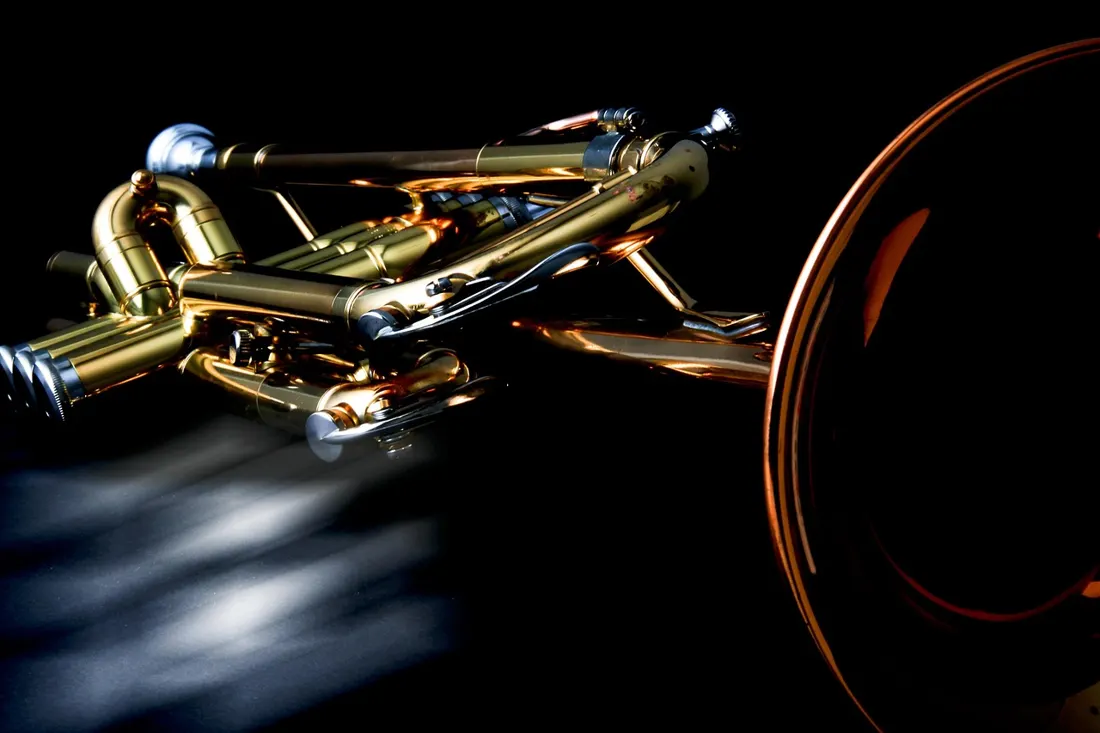
The Arrow Legend Everyone Repeats
The popular answer involves the Mongol invasions of the 13th century. As the story goes, a sentry in the tower spotted an approaching Mongol force and began sounding the alarm — only to be struck in the throat by an enemy arrow before he could finish the phrase, permanently freezing the melody's ending in tribute to his sacrifice. It's a vivid, tidy explanation, and it's repeated on tour buses and travel blogs constantly.
The Trumpeter of Krakow: A Novel That Invented a Legend
Here's the twist most retellings leave out: this specific version of the legend traces to a 1928 children's novel, The Trumpeter of Krakow, written by American author Eric P. Kelly — who by his own admission didn't speak Polish well and relied on French-speaking intermediaries while researching the book. According to the story behind the story, a Kraków tour guide named Aniela Pruszyńska improvised the arrow explanation on the spot when Kelly asked her why the tune stopped short, and Kelly then built it into his novel, which went on to win a Newbery Honor and spread the tale across the English-speaking world far more effectively than any Polish source ever had.
That doesn't mean the underlying history is fake — Kraków absolutely was struck by a Mongol invasion in 1241, and medieval trumpet calls absolutely did function as alarm signals from city towers. What's fabricated is the specific, cinematic detail of one named sentry, one arrow, one moment — a novelist's invention retrofitted onto a much older and vaguer civic custom, then repeated so consistently since 1928 that most people today assume it was always the official story.
It's worth sitting with how thoroughly the invented version won. Guidebooks, tour scripts, and even some official city tourism materials repeat the arrow story as settled fact, rarely footnoting it back to a 1928 American children's book. That's not a uniquely Polish problem — plenty of "ancient" traditions worldwide turn out to be much newer inventions that got retroactively treated as timeless once enough people repeated them — but it's a particularly clean example, since the paper trail back to Kelly's novel and his tour guide's on-the-spot improvisation is unusually well documented for a legend this widely believed.
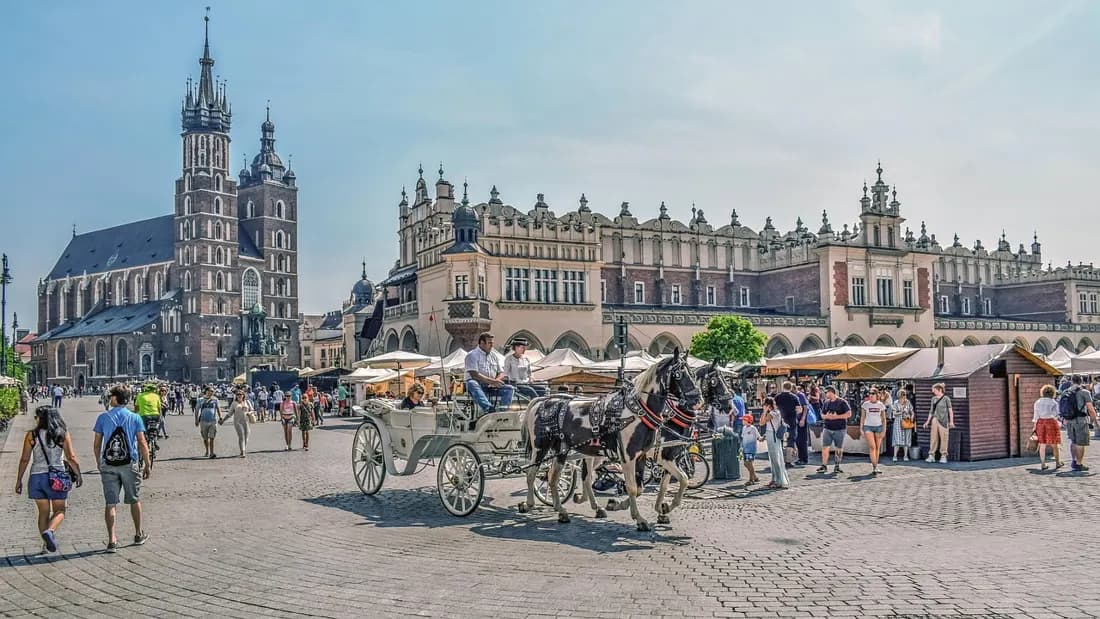
How the Krakow Trumpet Call Actually Works Today
Modern performances of the Hejnał Mariacki are handled by professional firefighters attached to Kraków's fire brigade, who take shifts in the tower and treat the trumpet call as a genuine civic duty rather than a tourist performance. Since 1927, the noon rendition has been broadcast live nationwide on Polskie Radio 1, meaning millions of Poles who have never set foot in Kraków have still heard the exact same five notes on the radio at some point in their lives.
A City Job With Serious History Behind It
Being selected to play the Hejnał Mariacki carries real institutional weight in Kraków — it's not an open audition for tourists, and the trumpeters who hold the post are trained musicians embedded within the fire service specifically because the role combines musical skill with the tower-watch duties the position has always implied. The job comes with a kind of local prestige that's hard to translate to outsiders: it's less "performer" and more "keeper of a four-hundred-plus-year-old civic clock."
Shifts rotate among a small pool of qualified trumpeters, each responsible for climbing the tower's narrow interior stairs multiple times a day, every day of the year, regardless of weather, holidays, or how many tourists happen to be filming from the square below. There's no understudy system in the theatrical sense — if a scheduled trumpeter can't make a shift, another qualified member of the rotation has to cover it, because the call has never, in living memory, simply been skipped.
The Krakow Trumpet Call as a Point of Local Pride
Locals in Kraków tend to treat the Hejnał Mariacki with a mix of genuine affection and total indifference to its novelty — it's simply part of the city's background rhythm, the same way a nearby church bell fades into the awareness of anyone who lives close enough to hear it daily. Ask a Krakow resident about it directly, though, and most will happily explain the basics, correct a tourist's version of the arrow legend, and point out which direction the trumpeter is currently facing without needing to check a watch.
A Guinness World Record and a Wartime Echo
The Hejnał Mariacki has had a couple of notable moments beyond its usual hourly cycle. In 2000, close to 2,000 trumpeters around the world performed the melody simultaneously in a coordinated event that secured a Guinness World Record for the largest simultaneous trumpet fanfare — a striking demonstration of how far the tune has traveled from its original single-tower context.
It also carries real wartime significance. In 1944, Polish buglers played the Hejnał Mariacki at Monte Cassino Abbey in Italy to announce the Allied victory in the brutal battle there, a battle in which Polish forces played a decisive role. Using Kraków's civic call to mark a Polish military triumph on foreign soil turned a local timekeeping custom into something closer to a national anthem for a moment.
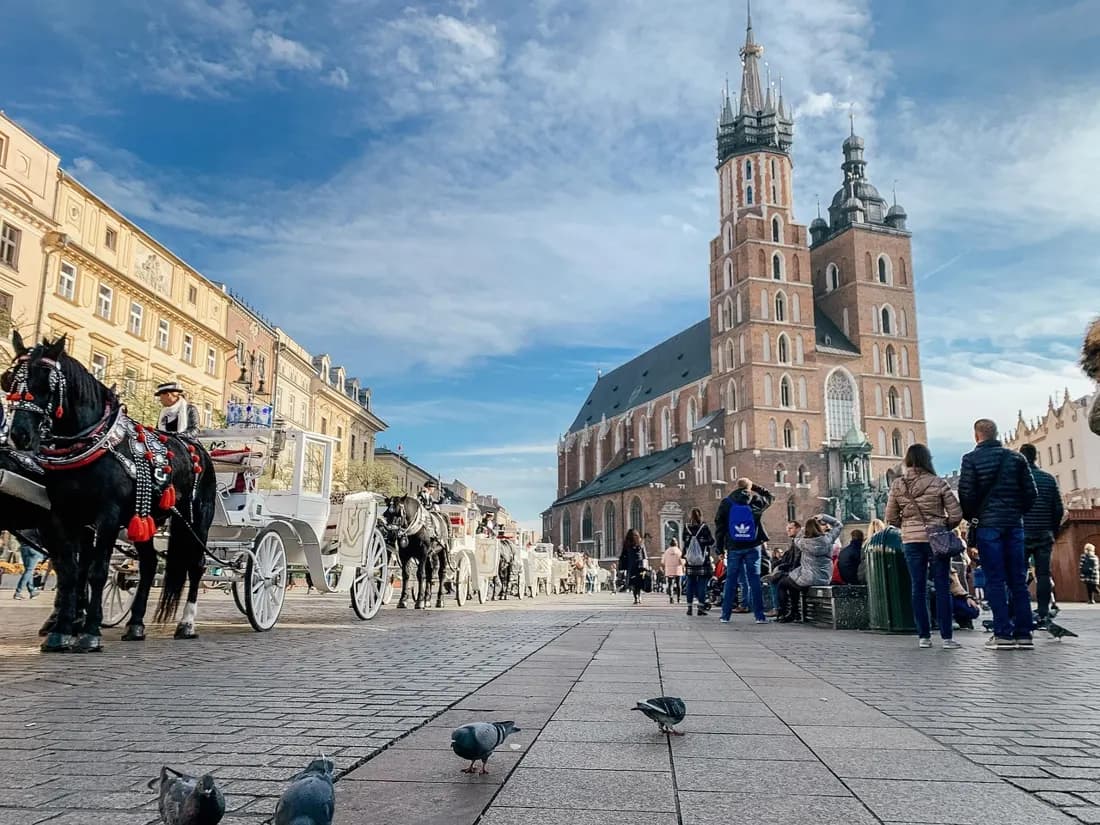
Watching the Hejnał Mariacki in Person
For visitors, the easiest way to actually catch the Hejnał Mariacki is to simply be standing in Kraków's Main Market Square a minute or two before the top of any hour, facing St. Mary's Basilica. The trumpeter appears at one of the tower's small windows, and the sound carries clearly across the square even over typical crowd noise — no ticket, tour booking, or special access required, since it's a public civic performance rather than an attraction run for tourists.
The noon performance draws the largest informal crowds, partly because it coincides with the live national radio broadcast and partly because midday simply has more foot traffic in the square to begin with. Evening and early-morning renditions are quieter, easier to hear clearly, and arguably more atmospheric precisely because there's no crowd competing for the trumpeter's attention.
Is Krakow's Trumpet Call Unique?
Tower-based signal calls aren't exclusive to Kraków — several other European cities kept similar traditions alive, from watchmen's horn calls in parts of Germany to Copenhagen's palace guard traditions. What makes the Hejnał Mariacki stand out isn't the basic concept of a tower signal, which was once common practice across medieval Europe, but the specific combination of factors that kept it alive intact: continuous documented use since at least 1392, a live daily national radio broadcast running since 1927, and a globally repeated legend that turned a local civic habit into an internationally recognized symbol of the city itself.
Most equivalent traditions elsewhere either died out entirely as cities modernized and lost their defensive walls, or survive today only as occasional ceremonial reenactments rather than a genuine daily civic function. Kraków's version never stopped being load-bearing in that sense — firefighters still climb the tower on a real schedule, rain or shine, rather than performing the call as a staged historical reenactment for visitors.
Learning the Melody, and Learning the Language Behind It
Part of what makes the Hejnał Mariacki such a good entry point into Polish culture is how much it packs into five notes and one syllable's worth of etymology — "hejnał" itself likely derives from a Hungarian phrase for dawn, a linguistic fingerprint of the medieval Polish-Hungarian political ties that shaped the custom in the first place. If you're the kind of learner who finds Polish city names intimidating on the page, Kraków is actually one of the friendlier ones once you know the pattern — our guide to how to pronounce Polish cities breaks down exactly that.
Frequently Asked Questions
What does Hejnał Mariacki mean? It translates roughly to "St. Mary's dawn call" or "St. Mary's bugle call." "Hejnał" is believed to derive from a Hungarian word connected to dawn, reflecting the custom's medieval Polish-Hungarian roots.
Why does the Kraków trumpet call stop abruptly? The popular explanation — a guard shot by an arrow mid-warning during a 13th-century Mongol attack — was popularized by a 1928 American novel, not a documented medieval event. The abrupt ending's real origin isn't definitively recorded, though it likely reflects the call's original function as a practical signal rather than a musical performance meant to resolve.
Is the Hejnał Mariacki played live or recorded? Live, every hour, every day. A professional trumpeter — typically a member of Kraków's fire brigade — climbs the tower and performs it in real time, including the noon performance broadcast nationally on Polskie Radio 1.
How old is the Hejnał Mariacki tradition? The earliest confirmed documentation dates to 1392, in Kraków's civic pay records, though the custom of using a tower trumpet call to mark the day likely predates that written record.
Did a Mongol invasion of Poland actually happen? Yes. Poland was struck by Mongol invasions in the 13th century, and Kraków was sacked during this period. The historical invasion is real; the specific "arrow through the throat" story attached to the trumpet call is the part that was invented later.
Who wrote The Trumpeter of Krakow? Eric P. Kelly, an American author, published it in 1928. The book popularized the now-famous arrow legend and won a Newbery Honor, cementing the story in English-language retellings of the Hejnał Mariacki ever since.
Can tourists watch the Hejnał Mariacki being played? Yes — it's visible and audible from Kraków's Main Market Square at the top of every hour, with the trumpeter appearing at one of the tower's windows facing each cardinal direction in turn.
What's the connection between the Hejnał Mariacki and Monte Cassino? In 1944, Polish buglers played the melody at Monte Cassino Abbey in Italy to mark the Allied victory in that battle, a moment that connected Kraków's civic tradition to a major Polish military achievement during World War II.
Is the Hejnał Mariacki mentioned anywhere outside Poland? Yes — most notably through Eric P. Kelly's novel, which introduced generations of English-speaking readers to the legend, and through the 2000 Guinness World Record event that had nearly 2,000 trumpeters worldwide perform the melody at once.
Do I need tickets to see the Hejnał Mariacki? No. It's performed publicly, for free, from the tower every hour, and can be watched and heard from anywhere in Kraków's Main Market Square without any booking or admission.
Which direction does the trumpeter face first? Traditionally the call is played toward all four cardinal directions in turn during each hourly performance, a detail that likely reflects its original purpose as a citywide signal rather than a display aimed at any single audience.
Is the Hejnał Mariacki played on Polish national holidays? Yes — the hourly schedule continues year-round without exception, meaning the call is performed on Christmas, New Year's, and every other holiday exactly as it is on an ordinary Tuesday afternoon.
The Hejnał Mariacki is a genuinely rare case where the "wait, that's not actually true" twist makes a legend more interesting rather than less — a centuries-old civic signal wrapped in a story a novelist made up less than a hundred years ago, both parts now inseparable from how Kraków is experienced by anyone standing in its main square at the top of the hour. If small details like this are what make a language and its history click for you, our guide to learning Polish for beginners is built around exactly that kind of curiosity.