
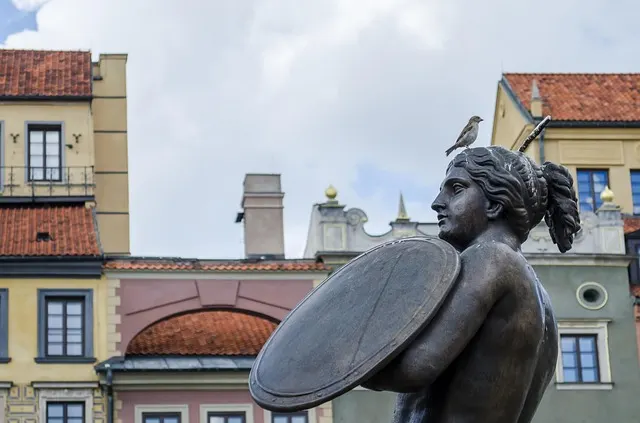
The Warsaw Mermaid stands guard over Poland's capital with a sword raised and a shield in hand — not the passive, romantic mermaid most people picture, but an armed defender who, according to legend, promised to protect the city forever. She's on the official coat of arms, on every municipal building, on the city's buses and trams, and in bronze at two different riverside spots in the city. Almost every visitor to Warsaw photographs her without knowing her actual story.
And it's a stranger story than it looks. The Warsaw Mermaid, known in Polish as Syrenka, wasn't even a mermaid originally — Warsaw's oldest surviving city seal shows something closer to a dragon with a man's head. Here's how that creature slowly turned into the sword-wielding guardian the city has now.

Who Is Syrenka?
Syrenka is simply Polish for "little mermaid," and she's Warsaw's official heraldic symbol and unofficial mascot rolled into one. She appears in profile on the city's coat of arms — a silver mermaid on a red field, long hair loose, human torso above a fish tail, a sword raised in one hand and a shield gripped in the other. Unlike most European mermaid imagery, which tends toward the decorative or tragic, Syrenka is explicitly a protector: armed, alert, and positioned as if actively defending the city rather than simply existing in it.
You don't have to look for her in Warsaw; she's genuinely everywhere. She's stamped on municipal buildings, painted on buses and trams and taxis, carved into building facades across the Old Town, and cast in bronze in at least two major public statues. Few European capitals have committed this hard to a single mythological figure as their default visual shorthand.
The Legend of the Mermaid Who Chose to Stay
Warsaw's founding legend and its mermaid legend are, depending on which version you're told, either the same story or two separate ones that got fused together over the centuries.
The older, more official version ties Syrenka directly to the city's founding. According to legend, a river spirit — a melusina, essentially a freshwater mermaid — guided Duke Bolesław II of Masovia to a small fishing village on the Vistula River around 1294, and it was there that Warsaw was eventually founded.
The more commonly told folk version is more of a rescue story. The mermaid, having swum up the Vistula from the Baltic Sea, stopped near what's now Warsaw's Old Town. Local fishermen noticed strange waves and tangled nets, then heard beautiful singing coming from the water and fell for the creature responsible. A wealthy merchant, hearing about her, had her trapped and caged, intending to profit from her. The same fishermen who'd fallen for her song freed her instead — and in gratitude, she vowed to defend the city and its people forever, which is why she's shown armed rather than simply decorative.
There's a third, much more playful version that's become popular in recent decades: that Syrenka and Copenhagen's famous Little Mermaid statue are sisters, who swam together from the Baltic Sea before going their separate ways — one settling into tragedy and passivity in Denmark, the other choosing to arm herself and stay a fighter in Poland. It isn't historical, but it's told often enough now that most Varsovians know it as well as the "official" version.
What all three tellings agree on, whatever their differences, is the basic emotional shape of the story: a creature that could have simply left, chose instead to stay and defend a place that had shown her kindness. That's a notably different arc from most European mermaid folklore, where the sea-creature is usually the one who needs rescuing, or the one who causes tragedy by falling for a human. The Warsaw Mermaid legend flips that dynamic — humans do the rescuing, and the mermaid repays it by becoming the protector.

The Coat of Arms of Warsaw: It Wasn't Always a Mermaid
Here's the detail almost no one expects: the coat of arms of Warsaw, in its oldest surviving form from 1390, doesn't show a mermaid at all. It shows a dragon with a male human head, carrying a sword and a shield, above the Latin inscription Sigilium Civitatis Varsoviensis — "Seal of the City of Warsaw."
Over roughly two centuries, that creature gradually changed. Through the 1500s, the male head and dragon-like body were slowly replaced with more feminine features, and the creature's tail shifted into something closer to a fish's tail. By the early 1600s, city records had begun explicitly describing a sword-wielding mermaid rather than a dragon-man hybrid, and since 1622 the symbol has consistently been rendered the way it's recognized today: a mermaid, armed with both sword and shield.
What's genuinely striking is that the sword and shield survived the entire transformation. The creature's species changed completely — dragon to mermaid, male to female — but the weapons never left. Whatever the city's coat of arms was meant to represent, it was never meant to represent something passive.
It's a strange historical echo of Kraków's own founding myth: like the Wawel Dragon, Warsaw's civic identity also started with a dragon-shaped monster on its oldest surviving seal, before folklore quietly reshaped it into something else entirely. Poland's two biggest cities both trace their oldest surviving symbols back to dragons, and both eventually smoothed those origins into gentler, more sympathetic figures — a fire-breathing beast turned into a beloved civic mascot in one city, a monster turned into an armed protector in the other.
The Warsaw Mermaid also has an odd, distant cousin in an unexpected place: coffee cups. She's frequently described, including in the city's own official heraldic history, as a melusina — a specific medieval type of freshwater mermaid figure popular across France and Northern Europe in the 15th and 16th centuries.
That same melusine imagery has, in modern retellings, been linked to the origins of the twin-tailed siren on the Starbucks logo, first sketched in 1971 from an old marine illustration. Nobody's claiming a direct historical line between a Polish river spirit and a Seattle coffee company, but both the Warsaw Mermaid and that far more famous logo draw from the same broad, centuries-old well of European mermaid folklore — a small reminder of just how far this imagery traveled.
Warsaw's Two Mermaid Statues
Syrenka exists in bronze in two very different parts of the city, and they tell two different chapters of her story.
The older and more famous Warsaw Mermaid statue stands in the Old Town Market Square. Sculptor Konstanty Hegel modeled it in February 1855, and it was cast in tin and later bronzed at a Warsaw foundry. That original statue stood in the square for well over a century, but decades of weather damage and repeated vandalism eventually forced the city's hand: in 2008, the damaged original was removed and transferred to the Museum of Warsaw for preservation, replaced in the square by a faithful copy that stands there today.

The Museum of Warsaw now houses the original Hegel statue as the centerpiece of its permanent "Room of Warsaw Mermaids" exhibition, which displays roughly a hundred different mermaid-themed objects — everything from official civic emblems to everyday keepsakes Varsovians have collected over generations. It's a strange, oddly moving thing to see: an entire museum room dedicated to just how many ways one city has depicted its own symbol.
The second Warsaw Mermaid statue is younger and stands beside the Vistula River itself, in the Powiśle district. Sculptor Ludwika Nitschowa created it in April 1939, cast in gunmetal, just months before the German invasion. Remarkably, it survived the Second World War with only minor damage — one of relatively few Warsaw monuments to make it through the war largely intact, in a city that lost most of its historic architecture. In 2006, the statue was awarded a silver Virtuti Militari plaque, Poland's highest military honor, commemorating General Władysław Sikorski's defense efforts during the 1939 siege — a small but pointed way of folding the mermaid's protector legend into real 20th-century history.

The two statues sit roughly a twenty-minute walk apart, connected by the same riverside path that runs along the Vistula through Warsaw's Old Town and down toward Powiśle, so visitors who want to see both versions of the mermaid — the ornate 19th-century original and the sparer, wartime-era riverside figure — can comfortably do it in a single afternoon.
Crown On, Crown Off: A Small Detail With a Big Story
Warsaw's official coat of arms went through one more politically charged change worth knowing about. The design that's used today — crown included, sword and shield intact — was formalized in 1938, just before the war. Under the communist government that ruled Poland from 1944 to 1989, the crown was quietly removed from official versions of the coat of arms, a small but deliberate edit stripping away a symbol of monarchy from the city's civic identity.
It wasn't restored until August 15, 1990, after communism had fallen, when Warsaw officially reinstated the pre-war design — crown, sword, shield, and all. The city's Latin motto, Contemnit procellas — "She defies the storms" — has rarely felt more literal than in that sixty-year gap between removal and return.
Why the Mermaid, Not the Dragon, Guards the Capital
It's worth sitting with the contrast between Poland's two most famous city guardians. Kraków chose to keep its dragon as a dragon — a monster the city eventually made peace with, turned into a mascot, and now literally sets on fire for tourists every few minutes. Warsaw took the opposite path: its own dragon-shaped monster was gradually rewritten into something protective and sympathetic, until the original monster had all but vanished from memory.
Neither choice was random. Kraków's dragon story is about a city outsmarting a threat through cleverness — the win belongs to the humans. Warsaw's mermaid story is about a threat that becomes an ally — the win belongs to the transformation itself. Two of Poland's biggest cities, two completely different relationships with their own oldest monsters.
If you're building a mental map of Polish folklore around specific cities, Syrenka and the Wawel Dragon are the natural starting pair, with the wider cast of Polish folklore creatures filling in everything else. And if Warsaw's mermaid statues end up on your own travel itinerary, they sit an easy walk apart — see our guide to Poland's best cities for expats for how Warsaw compares to the rest of the country before you plan the trip.
Common Questions About the Warsaw Mermaid
What does "Syrenka" mean? It's Polish for "little mermaid" — the diminutive form of syrena ("mermaid" or "siren") — and it's the name Varsovians use for their city's mermaid symbol specifically.
Why does the Warsaw Mermaid carry a sword and shield? According to legend, she promised to protect the city and its people after local fishermen freed her from a merchant who'd captured her — so she's depicted as an active defender rather than a passive decorative figure.
Was Warsaw's city symbol always a mermaid? No. The oldest surviving city seal, from 1390, shows a dragon with a male human head carrying a sword and shield. It gradually transformed into a female mermaid over roughly two centuries, arriving at today's familiar design by 1622.
Where can you see the Warsaw Mermaid statues? There are two main ones: a copy of Konstanty Hegel's 1855 statue in the Old Town Market Square, and Ludwika Nitschowa's 1939 statue on the Vistula riverbank in the Powiśle district.
What happened to the original 1855 statue? After decades of weather damage and vandalism, it was removed from the Market Square in 2008 and moved to the Museum of Warsaw, where it's now the centerpiece of a permanent exhibition. A faithful copy stands in the square today.
Did the Warsaw Mermaid statue survive World War II? The Powiśle riverside statue, cast just months before the German invasion in 1939, survived the war with only minor damage — unusual for a city where most historic architecture was destroyed.
Is the Warsaw Mermaid related to Copenhagen's Little Mermaid? Only in a popular modern legend, not in real history — the story that the two mermaids are sisters who parted ways after swimming from the Baltic Sea is a well-loved piece of folklore, not a documented connection.
Why was the crown removed from Warsaw's coat of arms? Poland's communist government (1944–1989) removed the crown from official versions of the coat of arms as a symbol stripped of monarchy. It was restored on August 15, 1990, after communism ended.
What is the Room of Warsaw Mermaids? A permanent exhibition at the Museum of Warsaw displaying around one hundred different mermaid-related objects and depictions, with the original 1855 Hegel statue as its centerpiece.
Is the Warsaw Mermaid the same as the founding legend of the city? They're connected but not identical. One legend credits a river spirit (melusina) with guiding the city's founder to the site around 1294; a separate, more popular folk tale explains why the Warsaw Mermaid is armed and protective. Both are told today as part of the same broader mermaid tradition, and most Varsovians grow up hearing some blend of both without worrying too much about which came first.
Does the Warsaw Mermaid appear anywhere besides statues? Constantly — on the official coat of arms, municipal buildings, public buses and trams, taxis, building facades across the Old Town, and countless pieces of local merchandise and civic branding.
Is the Warsaw Mermaid connected to the Starbucks logo? Only loosely, through shared folklore rather than direct history. Warsaw's mermaid is described as a melusina, a medieval European mermaid figure that has also, in modern retellings, been linked to the twin-tailed siren on the Starbucks logo — the connection is thematic, not a documented historical link between the two.
How far apart are the two Warsaw Mermaid statues? About a twenty-minute walk along the Vistula riverside path, making it easy to see both the Old Town Market Square copy and the Powiśle riverside original in a single visit.
Six centuries after that first dragon-headed seal, Warsaw's mermaid still stands sword-raised over the Vistula, still appears on every city bus, and still gets photographed by tourists who have no idea she started out as something else entirely. Few civic symbols have transformed that completely and still ended up saying exactly the same thing: this city defends itself.