
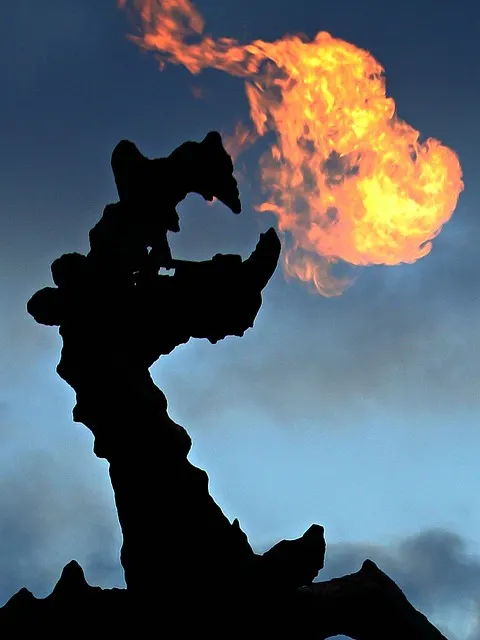
The Wawel Dragon is Kraków's most famous legend — a fire-breathing beast said to have terrorized the city from a cave beneath Wawel Hill until a clever commoner outsmarted it with a stuffed sheep. Eight centuries later, the story is still very much alive: a six-metre bronze statue at the mouth of the dragon's actual cave breathes real fire every few minutes, and it's one of the most photographed spots in Poland.
What makes the Wawel Dragon unusual as far as European folklore goes is that it isn't a single fixed story. It's been rewritten at least three times across 400 years, each version reflecting the politics and taste of the century that told it. And, strangely enough, a real prehistoric predator now shares the dragon's name. Here's the full story — legend, cave, statue, and the actual fossil — in one place.

What Is Smok Wawelski?
Smok wawelski is Polish for "the Wawel dragon," and it's the antagonist of Kraków's founding myth. The earliest surviving version comes from a chronicle written around the turn of the 13th century by Wincenty Kadłubek, Bishop of Kraków, who described the beast as a holophagus — "one who swallows whole."
In Kadłubek's telling, the city of Kraków was founded by a ruler named Krak (also written Krakus), and a monstrous dragon took up residence in a cave on the hill where Krak later built his stronghold. The Wawel Dragon demanded a weekly tribute of cattle, and if the town didn't deliver, it ate townspeople instead. This is the same basic shape almost every dragon legend across medieval Europe takes — a tribute-demanding monster, a besieged town.
It also belongs to a much wider pattern of European "founding dragon" myths, where a city's earliest legend involves defeating or outwitting a monster before civilization can properly begin (think of Saint George, or the wyverns woven into English town heraldry). What sets the Wawel Dragon apart is that Kraków never settled on one version of how the fight actually ended. The ending is where the Polish story starts to diverge, and diverge repeatedly, over the centuries.
Three Different Endings, 400 Years Apart
Most retellings today jump straight to a clever cobbler and a sulfur-stuffed lamb, but that's actually the third version of the story, not the original.
Version One: Kadłubek's 13th-Century Chronicle
In the oldest account, it's Krak's own two sons who defeat the dragon — not with a sword, but with a decoy. They fill a cattle hide with burning sulfur and leave it outside the cave. The dragon swallows it whole, and the sulfur burns it from the inside. So far, so heroic. Then the story turns dark: the younger son murders his older brother so he can claim sole credit for killing the dragon and inherit the throne alone. The murder is eventually discovered, the younger prince is banished, and it's Krak's daughter, Princess Wanda, who ends up ruling the city.
Version Two: Długosz's 15th-Century Revision
By the time the influential 15th-century historian Jan Długosz retold the legend, the murder subplot survived, but the credit shifted: it's now King Krak himself, not his sons, who masterminds the sulfur-hide trick, using a mixture of sulfur, tinder, wax, pitch, and tar. Długosz's version is more of a clean ruler's-triumph story, stripped of some of the moral messiness of the original.
Version Three: Bielski's 1597 Cobbler
The version everyone actually tells today comes from historian Marcin Bielski's 1597 chronicle, and it swaps the royal family out entirely for a working-class hero: a shoemaker named Skuba (sometimes spelled Skub). Skuba stuffs a calfskin, or in some tellings a whole lamb, with smoldering sulfur and leaves it near the dragon's cave. The dragon eats it without noticing, and the sulfur sets its insides on fire. Desperately thirsty, the dragon drinks and drinks from the Vistula River — until it drinks so much it bursts.
It's a more satisfying story on every level: no fratricide, a commoner outsmarts a monster through wit rather than violence, and the ending is genuinely funny. That's almost certainly why Skuba's version is the one that stuck, the one carved into children's books, and the one echoed on every tour guide's script at Wawel today.
Taken together, the three versions read almost like a timeline of Polish storytelling values. The 13th-century chronicle is preoccupied with royal succession and the messy business of who deserves a throne. The 15th-century revision smooths that mess away in favor of a cleaner, more flattering portrait of the monarchy.
The 1597 version drops royalty from the plot entirely, handing the Wawel Dragon's defeat to an ordinary tradesman — a shift that happens to line up with a period when Polish city guilds, Kraków's cobblers among them, were gaining real civic influence. Whether or not that connection was deliberate, it's telling that the version people actually kept retelling is the one where a working man, not a king, gets the credit.
Smocza Jama: The Cave Where It Actually Happened
The cave at the center of the legend is real, and you can walk through part of it. Smocza Jama ("Dragon's Den") is a limestone cave on the western slope of Wawel Hill that geologists say formed roughly 12 million years ago through karst erosion in Jurassic-era rock — long before any dragon, real or imagined, could have lived there.
The full cave system runs about 270 meters, but only around 81 meters are open to visitors, reached by descending 135 steep spiral stone steps (there's no way to make this part of the visit wheelchair- or stroller-accessible). A brick dome was built over the natural entrance in 1830, and the cave was first opened to tourists between 1843 and 1846, following an exploration by the historian Ambroży Grabowski in 1829. After Poland regained independence in 1918, architect Adolf Szyszko-Bohusz prepared the site more formally for visitors, and it's remained a fixture of any Wawel Hill trip ever since.
Today the cave is typically open daily from late April through October, with regular tickets running 15 PLN for adults and 10 PLN reduced, and free entry for children under seven. You exit the cave directly at the feet of the fire-breathing statue on the Vistula riverbank — which is, for most visitors, the actual highlight.

If you're planning the visit yourself, go early — the 135-step descent is narrow, one-directional, and gets genuinely crowded by midday in summer. Tickets for the cave are separate from the main Wawel Castle and Cathedral tickets, so budget them as their own short stop rather than assuming one pass covers everything on the hill.
The Statue That Breathes Real Fire
At the mouth of Smocza Jama stands a six-metre bronze dragon sculpture, designed by Polish sculptor Bronisław Chromy in 1969 and installed at its current spot in 1972. It isn't decorative — a natural gas line feeds a nozzle in its mouth, and the statue genuinely breathes fire at intervals of roughly five minutes, drawing a small crowd of phones and cameras every single time.
For a stretch of the 2010s, the dragon's fire was interactive: you could text the word "SMOK" (Polish for "dragon") to a short code, and the statue would breathe fire on command, typically within about 15 seconds. It became so popular — reportedly over 2,500 requests a day at its peak — that the feature was eventually discontinued, because the statue's gas system genuinely couldn't keep up with visitor demand. These days it's back to breathing on its own automatic schedule, no text message required.
The statue sits directly on the Vistula Boulevards, a ten-minute walk from Kraków's Main Square and St. Mary's Basilica, and it's one of the most reliable photo stops in the city, dragon-shaped souvenirs included.

Wait — There Really Was a "Wawel Dragon"
Here's the part almost nobody expects: paleontologists genuinely found a creature they nicknamed the Wawel Dragon, and it has nothing to do with folklore.
In the early 2000s, researchers led by Prof. Tomasz Sulej and Dr. Grzegorz Niedźwiedzki uncovered fossilized bones, three-toed footprints, fossilized droppings, and serrated teeth at a brickworks site in Lisowice, in the Silesia region of southern Poland. The remains belonged to a bipedal reptile roughly six meters long that lived around 210 million years ago, near the end of the Triassic period — a strange evolutionary in-between, blending features of early dinosaurs with those of Triassic-era crocodile relatives.
Scientists gave it the nickname Smok wawelski — Wawel Dragon — in a direct nod to Kraków's legend. As Wawel Royal Castle's own exhibition on the discovery documents, a reconstructed skeleton along with an authentic fossil tooth, on loan from the Museum of Evolution at the Polish Academy of Sciences, has been displayed at Wawel Castle as part of its "In Search of the Dragon" exhibition trail.
It's a rare case where a scientific discovery deliberately borrowed a folk legend's name rather than the other way around — and it means the name Wawel Dragon now technically refers to two completely different things, 210 million years apart: a mythical fire-breather from a 13th-century chronicle, and a genuine bipedal reptile that left footprints in Silesian mud at the tail end of the Triassic.
The Dragon That Never Really Left
The Wawel Dragon shows up far beyond the statue and the cave. Every June, the Groteska Theatre puts on the Great Dragon Parade (Wielka Parada Smoków) — a two-day festival where giant illuminated dragons, some up to 25 meters long, are floated and paraded down the Vistula River near Wawel Castle with fireworks, lasers, and music, followed the next day by a street parade of dragons built by local children and schools competing for a prize.
What started as a modest local event has grown into one of Kraków's biggest annual festivals, now well into its third decade, and it's arguably done more to keep the Wawel Dragon a living part of the city's identity than the statue and cave combined — an entire generation of Kraków kids has grown up building their own cardboard-and-tissue-paper dragons for it every spring.

The dragon also survives in everyday Polish. Smok simply means "dragon," and you'll spot it on shopfronts, football club crests, and beer labels across the city — Kraków has more or less adopted the beast as an unofficial mascot rather than a villain, in the same easy-going way it treats the Hejnał Mariacki trumpet call, another local legend the city turned into civic pride rather than tragedy. If you're building your Polish vocabulary around city landmarks and their stories, the Wawel Dragon is as good a starting point as any — it comes with its own verb, too: zionąć ogniem, "to breathe fire."
For travelers piecing together a Kraków itinerary, the dragon pairs naturally with the rest of the city's folklore — see our guide to Polish folklore creatures for the wider cast of Polish monsters and spirits, and check how to pronounce Polish cities before you try asking a local for directions to Wawel out loud.
Common Questions About the Wawel Dragon
What does "Smok Wawelski" mean? It's Polish for "the Wawel dragon" — smok means dragon, and wawelski is the adjective form of Wawel, the royal hill in Kraków where the legend is set.
Is the fire-breathing Wawel Dragon statue always working? Yes, under normal circumstances. It breathes fire automatically roughly every five minutes throughout the day. Very rarely it's turned off for maintenance.
Can you still text the dragon to make it breathe fire? No — the SMS feature was discontinued after visitor demand outpaced what the gas system could handle. It now runs on its own fixed schedule.
Where exactly is the Wawel Dragon statue? At the foot of Wawel Hill, right at the exit of Smocza Jama (Dragon's Den), on the Vistula riverbank side of the castle complex — an easy walk from Kraków's Old Town.
Can you go inside the dragon's actual cave? Yes. Smocza Jama is open to visitors (typically late April through October), reached via 135 spiral stone steps, and it exits directly at the statue.
Who really defeats the dragon in the legend? It depends which century's version you're reading. The oldest 13th-century account credits King Krak's sons; a 15th-century revision gives the credit to Krak himself; the most popular version today, from 1597, credits a cobbler named Skuba.
Did the Wawel Dragon actually drink the entire Vistula River? That's the folklore detail — after eating the sulfur-stuffed bait, the dragon drank so much river water trying to cool the burning that it burst. It's the story's punchline, not a literal claim.
Was there ever a real Wawel Dragon? Not the mythical one — but paleontologists did name a genuine 210-million-year-old Triassic reptile found in Lisowice, Poland, the "Wawel Dragon" in the legend's honor.
Why do Polish dragons get sulfur instead of being fought with swords? It reflects an older, trickster-style folk-tale tradition common across Central Europe, where cleverness beats brute strength — a contrast to the sword-and-shield dragon-slayer stories more typical of Western European legend.
Is the Wawel Dragon Kraków's official symbol? Not formally — the city's official coat of arms doesn't feature the dragon — but in practice it's treated as an unofficial mascot, appearing on merchandise, event branding, and the annual Dragon Parade far more than any official symbol does.
When is the Great Dragon Parade in Kraków? Traditionally in early June, organized by the Groteska Theatre, with a Saturday evening show of giant illuminated dragons on the Vistula River and a Sunday street parade through the Old Town.
How do you get from the Wawel Dragon statue back up to Wawel Castle? The two aren't directly connected inside — Smocza Jama has its own separate entrance and exit at street level. To visit both the castle grounds above and the dragon statue below, you walk the short path around the hillside rather than passing through the cave itself, so plan roughly 20–30 extra minutes if you want to see everything on Wawel Hill in one visit.
Is the Wawel Dragon story taught to Polish schoolchildren? Yes — it's one of the first legends Polish children learn, usually in the Skuba-the-cobbler version, alongside the Warsaw Mermaid and the Kraków trumpeter legend. It functions less like campfire folklore and more like a shared cultural reference point every Pole grows up with.
Eight hundred years after a bishop first wrote it down, Kraków's dragon still gets a parade every summer, still breathes fire on the hour by the river, and even lent its name to a creature that actually walked the earth. Few legends age quite that well.