How Polish survived 123 years without a country is one of the more remarkable, and least told, survival stories in European history. Between 1795 and 1918, Poland did not exist on any map. Its territory was split between three empires, its name was gone from diplomatic correspondence, and its language was actively targeted for removal from schools, courts, and public life. And yet when the country was reborn in 1918, ordinary Poles still spoke Polish, still read Polish poetry, and still knew exactly who they were.
That outcome wasn't inevitable. Empires with far more resources than Imperial Russia, Prussia, and Austria have successfully erased smaller languages in less time than 123 years. What happened in Poland is a case study in how a language can outlive the state that was supposed to protect it — through households, hidden classrooms, and a small number of writers who refused to let it go quiet.
The Partitions of Poland That Erased It From the Map
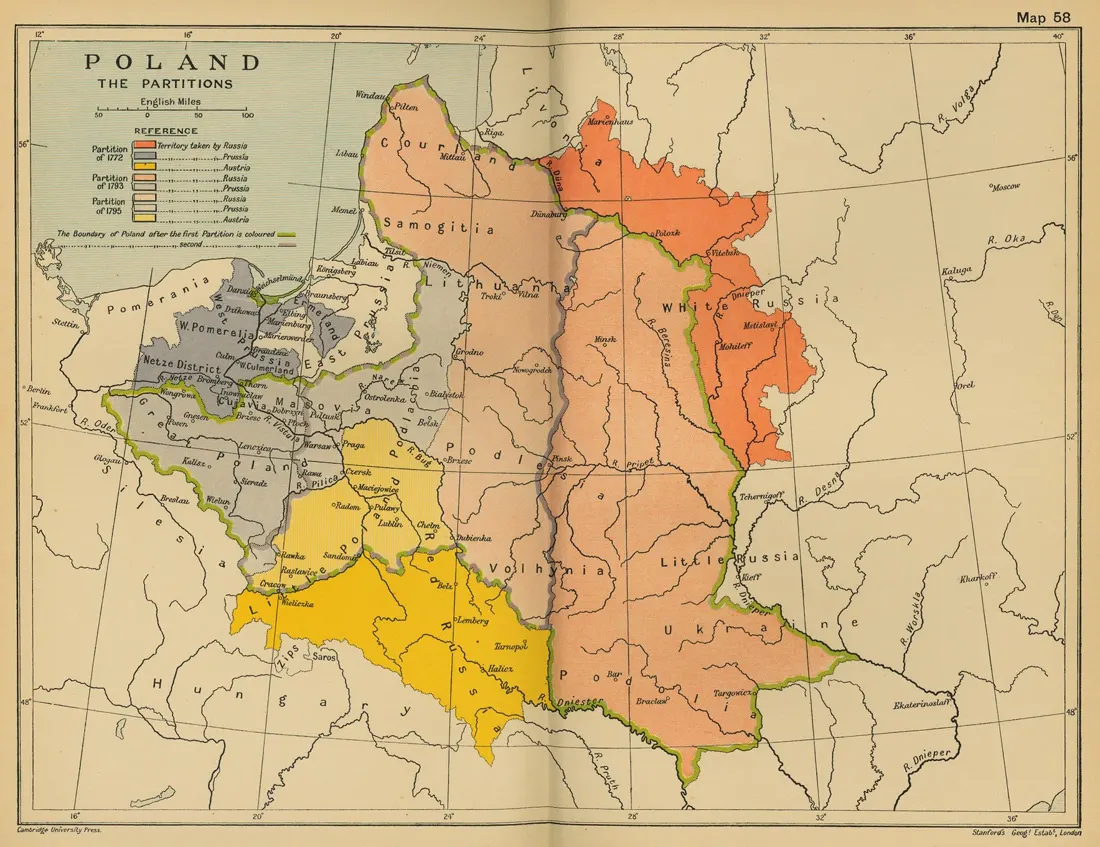
The partitions of Poland happened in three stages, not one sudden event. In 1772, Russia, Prussia, and Austria each carved off a slice of the Polish-Lithuanian Commonwealth, taking roughly a third of its territory and half its population between them. A second partition followed in 1793, after a failed attempt at internal reform panicked its neighbors into intervening again, leaving only a fraction of the original state standing.
The third partition, in 1795, finished the job entirely. Russia, Prussia, and Austria divided what remained of the Commonwealth between them, and the Polish state ceased to exist as a legal and political entity. For the next 123 years, "Poland" was a memory, a cultural identity, and eventually a resistance movement — but not a country with borders, an army, or a seat at any negotiating table.
Why the Occupying Powers Wanted the Language Gone
Language suppression wasn't a side effect of the partitions — in the Russian and Prussian zones especially, it was policy. After an 1830s uprising was crushed in the Russian-controlled territory, Polish autonomy was abolished outright: universities closed, property was confiscated, and Russian became the enforced language of secondary schooling, which caused literacy rates in Polish to fall sharply for a generation. Prussia ran a parallel program, restructuring its Polish subjects' entire school system around German instruction and treating Polish cultural institutions with active hostility rather than mere neglect.
The logic was straightforward from an imperial point of view: a population that stops learning to read and write its own language stops reproducing a separate national identity within a generation or two. It had worked elsewhere. It was supposed to work here too.

How the Polish Language Survived Underground
The Polish Language Survival Strategy Nobody Could Legislate Away
It didn't work, mainly because Poles built a parallel, invisible system to replace the one being dismantled. In the Russian partition, informal home-based classes known as tajne komplety — secret courses — taught children to read and write Polish, along with history and literature the state-run curriculum had erased. These weren't organized rebellions with manifestos; they were quiet, dangerous, and ordinary: a teacher, a handful of students, a private apartment, and books that would have gotten everyone involved in serious trouble if discovered.
Families did the same work at a smaller scale simply by insisting on Polish at home, reading Polish stories aloud, and treating the language as something worth protecting even when speaking it publicly carried risk. This is the part of the story that's easy to miss: the biggest reason Polish survived isn't a single heroic act, but millions of small, repeated, unglamorous ones — a language kept alive one household at a time because enough people refused to let it become their grandparents' language instead of their own.
The Poets Who Carried the Language Into Exile
Where the underground schools kept the language alive at home, a handful of writers kept it alive on the world stage. Adam Mickiewicz, writing from exile in Paris, became the era's defining Polish voice — his epic poem Pan Tadeusz is still considered the closest thing Poland has to a national epic, written by a man who spent most of his adult life unable to safely return to the country it describes.
Mickiewicz wasn't unique in this; an entire generation of Polish writers, composers, and intellectuals scattered across France, Britain, and beyond, and kept producing work in Polish specifically because doing so at home had become dangerous. Emigre communities became, almost by accident, some of the safest places left to write, publish, and preserve the language in a form that could eventually come home.
The 1791 Constitution That Came Just Before the End
One detail makes the story sharper: Poland didn't lose its independence for lack of trying to modernize. In 1791, the Polish-Lithuanian Commonwealth adopted a constitution — only the second in the world after the United States' — attempting real reform of a government its neighbors saw as dangerously unstable and worth intervening against. The reform effort helped trigger the second and third partitions rather than prevent them; the neighboring empires saw a modernizing Poland as a bigger threat than a weak one, and moved to erase it before the reforms could take hold.
That timing is part of why the loss stung the way it did, and why the cultural resistance that followed was so determined. This wasn't a slow, inevitable decline that people had made peace with. It was a rapid, deliberate erasure of a state that had just shown signs of real revival — which is precisely the kind of injustice that produces poets willing to spend a lifetime in exile rather than let the story end there.
Between the constitution and the final partition came one more attempt to reverse course: the 1794 Kościuszko Uprising, led by Tadeusz Kościuszko, already known abroad for his role in the American Revolutionary War. The uprising won early victories and briefly looked like it might hold off the neighboring empires, but it was ultimately crushed, and its failure directly opened the door to the third and final partition the following year. Kościuszko himself became, alongside Mickiewicz a generation later, one of the enduring symbols Poles abroad rallied around during the long stretch with no country to call home.
How Polish Survived 123 Years Without a Country, Parish by Parish
Schools and poetry weren't the only channels. Parish churches turned out to be one of the most durable, hardest-to-suppress vehicles for the language, particularly in the Russian and Prussian partitions where Polish identity and Catholic identity were already deeply intertwined. Mass, confession, and religious instruction in Polish gave millions of people a legitimate, regularly recurring reason to hear and use the language in public, in a setting occupying powers were reluctant to shut down outright.
Prussia eventually did try. Its Kulturkampf campaign in the 1870s targeted Polish-speaking Catholic clergy directly, removing Polish from religious instruction in an attempt to weaken the language's last legal foothold in public life. The campaign backfired more than it succeeded: it hardened Polish Catholic identity rather than dissolving it, and priests who resisted became local figures of quiet defiance in exactly the communities the policy was meant to pacify.
This is worth sitting with, because it's the pattern that repeats across every corner of this story: whenever an occupying power crossed from indifference into active suppression, resistance often got stronger rather than weaker. A policy would clamp down on schools, or churches, or print, and rather than an entire population quietly complying, ordinary people would find a narrower but more determined way to keep using the language anyway.
What "Reborn in 1918" Actually Looked Like
When Poland re-emerged as an independent state after the First World War, it wasn't recovering a language from near-extinction — it was reconvening a population that had never stopped speaking it. Polish had survived in homes, in underground classrooms, in the poetry Mickiewicz and his contemporaries wrote abroad, and in the sheer stubbornness of families who kept treating it as the language worth passing down.
That's a genuinely unusual outcome. Most languages under sustained, well-funded suppression for over a century show real damage: fewer fluent younger speakers, a narrowed vocabulary, a shift to the occupier's language for anything formal or written. Polish came out of 1918 essentially intact — still spoken at every social level, still capable of producing serious literature, still recognizably the same language that had gone into the partitions in 1795.
Traces the Occupation Left Behind
None of this means the partitions left no mark. Regional vocabulary and administrative terms borrowed from German and Russian still show up in older generations' speech in some areas, a quiet linguistic fingerprint of a century spent under three different governments. Poland's modern regional dialects, including Silesian and Kashubian, carry some of that layered history in their own right. But the core of the language — its grammar, its literature, its everyday vocabulary — came through recognizably whole, which is the part historians and linguists still find remarkable.
Frequently Asked Questions
How long was Poland actually gone from the map? 123 years, from the Third Partition in 1795 until independence was restored in 1918. That's the source of the number that shows up throughout this story — nearly a century and a quarter with no independent Polish state at all.
Did Russia, Prussia, and Austria all suppress Polish equally? No. Russian and Prussian policy toward the Polish language was openly restrictive, especially after the 1830s uprising, with closed universities and enforced schooling in the occupier's language. The Austrian partition (Galicia) was comparatively lenient for periods of its rule, which is part of why some Polish cultural and educational activity was able to continue more openly there than in the other two zones.
What were tajne komplety? Secret, informal classes — often held in private homes — that taught Polish-language literacy, history, and literature outside the state-approved curriculum. They were illegal in the areas where they operated and depended on total discretion to avoid being shut down.
Why does Adam Mickiewicz matter so much to this story? He's the clearest example of how the language survived not despite exile but partly through it — writing some of the most important Polish literature ever produced from Paris, at a time when doing the same work at home carried real danger. His work became a rallying point for Polish identity precisely because it proved the language could still produce great art under pressure.
Could Polish have actually disappeared? It's not a hypothetical worry — sustained, generational suppression of a minority language has erased or badly weakened other languages elsewhere in similar timeframes. What made the Polish case different was the scale and persistence of parallel, informal language transmission — in homes and secret schools — running the entire time alongside the official suppression.
Is this history still relevant to learning Polish today? It's part of why the language has the shape it does. Understanding that Polish was actively preserved, rather than passively inherited, gives some context for why Poles tend to take real pride in the language's grammar and literature — it's not just a subject to learn, it's a thing previous generations worked hard to keep intact. If you're starting from the basics, our guide on the Polish alphabet is a good place to begin the same language people spent over a century refusing to lose.
Did every part of partitioned Poland resist in the same way? No — the intensity and style of resistance varied a lot by region and by which empire controlled it. The Prussian partition saw organized, semi-legal resistance through cooperatives and the press; the Russian partition leaned harder on underground schooling after direct confrontation became too dangerous following the failed uprisings; the Austrian partition, given more breathing room, became a hub for open Polish-language publishing and education that fed back into the other two zones.
What happened to Polish place names and administration during this period? Officially, they were frequently replaced or Germanized/Russified on maps, in courts, and in government paperwork — a formal erasure that could make the region look thoroughly assimilated on paper. Day-to-day life told a different story: the same towns kept their Polish names in local speech, church records, and family memory, ready to resurface the moment the official pressure lifted in 1918.
Did the partitions affect all three empires' territories to the same degree over time? No, and the differences shifted across the full 123 years rather than staying fixed. Policy in each zone tightened and loosened depending on the ruling government of the moment — a crackdown following an uprising, a period of relative tolerance under a different administration — so the pressure on Polish speakers was never a single constant experience across the whole occupation.
The partitions are sometimes framed as the sad part of Polish history and the 1918 rebirth as the happy ending, but that framing skips the most interesting stretch — the 123 years in between, when a state disappeared and a language simply declined to. It's also worth remembering how quickly that resilience got tested again: independence lasted barely two decades before the Second World War brought fresh occupation, and Polish survived that far shorter but far more brutal period for many of the same underlying reasons — households, clandestine teaching, and a refusal to treat the language as negotiable.
If this kind of history makes you want to actually learn the language people fought this hard to keep, our beginner's guide to learning Polish is the natural next stop.