The Polish cow is a looping internet meme: a black-and-white cartoon cow bobbing and spinning to a fast, bouncy Polish track that sounds like the happiest song ever recorded. Millions of people have watched it without understanding a single word. The song is "Gdzie jest biały węgorz? (Zejście)" by the Polish artist Cypis, and once you know what the lyrics say, the cheerful cow becomes one of the internet's darkest jokes.
This guide explains everything search results don't: what the Polish cow meme actually is, who made the song, what the Polish cow lyrics mean in English, what biały węgorz and zejście translate to, and why Poles laugh a little nervously when foreigners ask them to sing it. The song is about drug withdrawal, so we describe it plainly, without glamorising it and without a lecture.
You'll also learn how to pronounce the famous opening line properly, why the track is not Russian, and, because someone always asks, which real cows Poland actually raises. If you came here to learn Polish rather than just decode a meme, there's a short vocabulary table and a dialogue you can borrow.
What Is the Polish Cow Meme?
The Polish cow meme is a short video loop of a low-poly cow dancing in front of a plain background while the opening of Cypis's song plays. Nothing else happens. The cow sways, twirls and occasionally pauses, the beat keeps going, and the loop repeats, often for a full hour.
Its spread is unusually well documented. According to the meme database Know Your Meme, a one-hour loop of the dancing cow was uploaded to YouTube on 13 July 2020, a second hour-long cow video followed on 16 July and passed 1.7 million views in under a month, and Polish TikTok users pushed the song under the hashtag #tylkojednowgłowiemam. By the end of July 2020 the Polish cow had become one of the summer's most recognisable sounds.
That is the whole meme. Its humour comes from the contrast between a goofy animal and a song that, as every Polish speaker immediately notices, is about something very unfunny. Outside Poland, most viewers simply enjoyed the cow. Inside Poland, the joke had two layers.
The Polish Cow Song: Cypis and "Gdzie Jest Biały Węgorz? (Zejście)"
The Polish cow song is called "Gdzie jest biały węgorz? (Zejście)", which translates as "Where Is the White Eel? (Comedown)". It is performed by Cypis, the stage name of Cyprian Racicki, born in 1989 in Inowrocław in central Poland. His Polish Wikipedia entry describes his music as a mix of electronic dance music, hip-hop and comedy hip-hop, and he publishes much of it directly on YouTube.
The track was uploaded to YouTube on 19 October 2015. It appeared on the 2015 album Narkotyki są nielegalne ("Drugs Are Illegal"), which, according to the Polish Wikipedia article on Cypis, came out on 3 December 2015 under his earlier alias Norman Price. The album title is deadpan irony: almost every song on it is about drugs and their consequences.
For almost five years the song lived a quiet life as a cult track among Polish internet users. Then the Polish cow loops appeared in July 2020 and everything changed. Cypis noticed fast: he posted an Instagram clip of a boy dancing to the song on 28 July and released a remix on 31 July 2020. Big Polish YouTubers such as Gimper reacted to the craze in August.
The Taiwanese cactus toy
The Polish cow song's strangest afterlife came a year later. In July 2021, a Polish woman living in Taiwan discovered that a popular dancing, singing plush cactus toy played Cypis's track in Polish, listed on the toy as "Dancing Polish Cow". Polish media, including Wprost's report on the toy, described it as marketed for small children. Cypis said nobody had asked for permission or bought a licence and that he had handed the matter to his lawyers.
Polish Cow Lyrics in English: What the Song Is Really About
The Polish cow lyrics describe a man in drug withdrawal. That is what zejście in the title means: the crash after a high wears off. Almost everything in the song follows from that one situation, told in the first person with a mix of gallows humour and genuine misery.
We won't reproduce the lyrics, because they are copyrighted, but here is what they say in English, section by section.
The chorus: one thing on his mind
The chorus opens with the line everyone knows, Tylko jedno w głowie mam ("I've only got one thing on my mind"). The next line names that one thing: koksu pięć gram ("five grams of coke"). The rest of the chorus is about wanting to drift away on his own to a place where he can forget everything. In short, the bouncy hook that the cow dances to is a craving.
The verses: withdrawal, debt and daydreams
The verses describe how bad he feels. His body aches, he can barely move, his thoughts are scattered, and he compares himself to a wilting plant. He is broke, owes money to people around him, and has been selling his belongings. Later verses add fever, chills and the feeling that he might not survive the night.
Between the symptoms he daydreams. He imagines fast cars and endless supplies and makes cartoonish jokes about his own state, then drops back into reality. The narrator never sounds proud or cool. He sounds sick, desperate and slightly ridiculous, which is the point of the satire.
So, when people ask what the Polish cow lyrics mean in English, the honest answer is this: a darkly comic first-person sketch of addiction, in which the high is fantasy and the withdrawal is very real. Polish media coverage of the toy scandal described the song in exactly those terms, as a track about the negative effects of addiction.
What "Biały Węgorz" and "Zejście" Mean
The title of the Polish cow song is a riddle for learners, because a dictionary will give you a literal answer that makes no sense.
| Polish | Sounds like | Literal meaning | Meaning in the song |
|---|---|---|---|
| biały | BYAH-wih | white | white |
| węgorz | VENG-gosh | eel | part of a nickname |
| biały węgorz | BYAH-wih VENG-gosh | white eel | cocaine (Cypis's own nickname for it) |
| zejście | ZAY-shcheh | descent, coming down | the comedown after drugs |
| koks | koks | coke (the fuel) | cocaine, common slang |
| odlecieć | od-leh-CHETCH | to fly off | to get high, to zone out |
Biały węgorz is not standard Polish slang. It is a recurring nickname in Cypis's songs, and Poles understand it from context rather than from everyday speech. The common colloquial word is koks, which also means coke in the coal sense. If you want to recognise words like these in films and rap, our guide to Polish slang covers the vocabulary young Poles really use.
Zejście comes from the verb zejść, "to come down" or "to go down". On a mountain trail it simply means the descent. In drug slang it means the comedown, and in medical language zejście śmiertelne means death, which gives the subtitle an extra shadow that Polish listeners pick up.
Why the Polish Cow Song Sounds So Cheerful
Part of the joke is musical. The beat is fast and simple, the synth melody is bright and bouncy, and Cypis half-sings, half-chants over it in a flat, almost cheerful voice. To a non-Polish ear it sounds like a party track.
Polish ears hear something else too. The cheap-and-cheerful keyboard sound echoes disco polo, the much-mocked and much-loved Polish dance-pop played at weddings, village festivals and on long coach trips. Pairing that sunny sound with lyrics about withdrawal is classic Polish internet humour: the more upbeat the music, the bleaker the subject.
That contrast is also why the Polish cow meme travelled so well. You don't need the words to enjoy the cow. The Polish speakers watching simply got a second, much darker joke on top.
How Poles React to Foreigners Loving the Polish Cow
Ask a Pole about the Polish cow and you will usually get a grin followed by a pause. Most Poles find it funny that the rest of the world adopted, of all things, a comedy song about cocaine withdrawal as a sort of unofficial Polish anthem. Many are a bit embarrassed when a foreign friend sings the chorus loudly in public, and slightly delighted at the same time.
It sits comfortably next to other Polish memes that went global, such as the onion-loving Polaczek Cebulaczek. The difference is that Polaczek Cebulaczek is a self-mocking stereotype that Poles invented about themselves, while the Polish cow was turned into a meme mostly by people who had no idea what they were dancing to.
A practical tip: if you sing the Polish cow song to Polish colleagues or a Polish partner's parents, expect laughter, not admiration. It is a meme, not a folk song. If you want songs to sing with Polish families, a toast-time classic like the Sto lat song will win you far more points.
How to Sing the Polish Cow Chorus
If you're going to sing it anyway, sing it properly. The opening line is short and makes a good pronunciation drill, because it contains three classic traps for English speakers: the Polish y, the ł and the w.
Tylko jedno w głowie mam
Say it as TIL-ko YED-no v GWO-vyeh mam.
- Tylko (TIL-ko): Polish y is a short, dull sound between the vowels in "bit" and "but". Don't say "tee-lko".
- Jedno (YED-no): Polish j is always an English "y".
- W (v): the one-letter preposition "in" is pronounced "v" and glued onto the next word. Before a voiceless consonant it becomes "f", but here it stays close to "v".
- Głowie (GWO-vyeh): ł sounds like English "w", and w sounds like English "v". So głowie is "GWO-vyeh", never "glow-ee".
- Mam (mam): "I have", short and flat.
Polish stress almost always falls on the second-to-last syllable, so lean on TIL, YED and GWO. For the full system behind these sounds, see our guide to mastering Polish pronunciation.
Koksu pięć gram
The second line is KOK-soo pyench gram. The ę in pięć is nasal, but before ć it softens into something close to "en", and the final ć is a soft "ch". A small grammar note: a textbook would say pięć gramów, because numbers from five upwards take the genitive plural. The short pięć gram is everyday spoken Polish, the kind of shortcut you hear constantly in shops and kitchens.
Polish Sounds and PhoneticsIs the Polish Cow Song Russian?
No. The Polish cow song is Polish, sung by a Polish artist from Inowrocław, in Polish, with Polish slang. The confusion is understandable: many English speakers file every Slavic language under "Russian", and the meme itself travelled without any words on screen.
Three quick ways to tell. First, written Russian uses the Cyrillic alphabet, while the song's title is written in the Latin alphabet with Polish letters such as ł, ę and ś. Second, Russian has no ł, ę or ą. Third, the words themselves are Polish: Russian would say угорь (ugor') for eel, not węgorz.
The Polish cow is also not a folk song or a children's song, despite the Taiwanese toy. It is a 2015 internet-era track by a living artist, which is why using it without a licence caused a legal row.
Bonus: Real Polish Cow Breeds
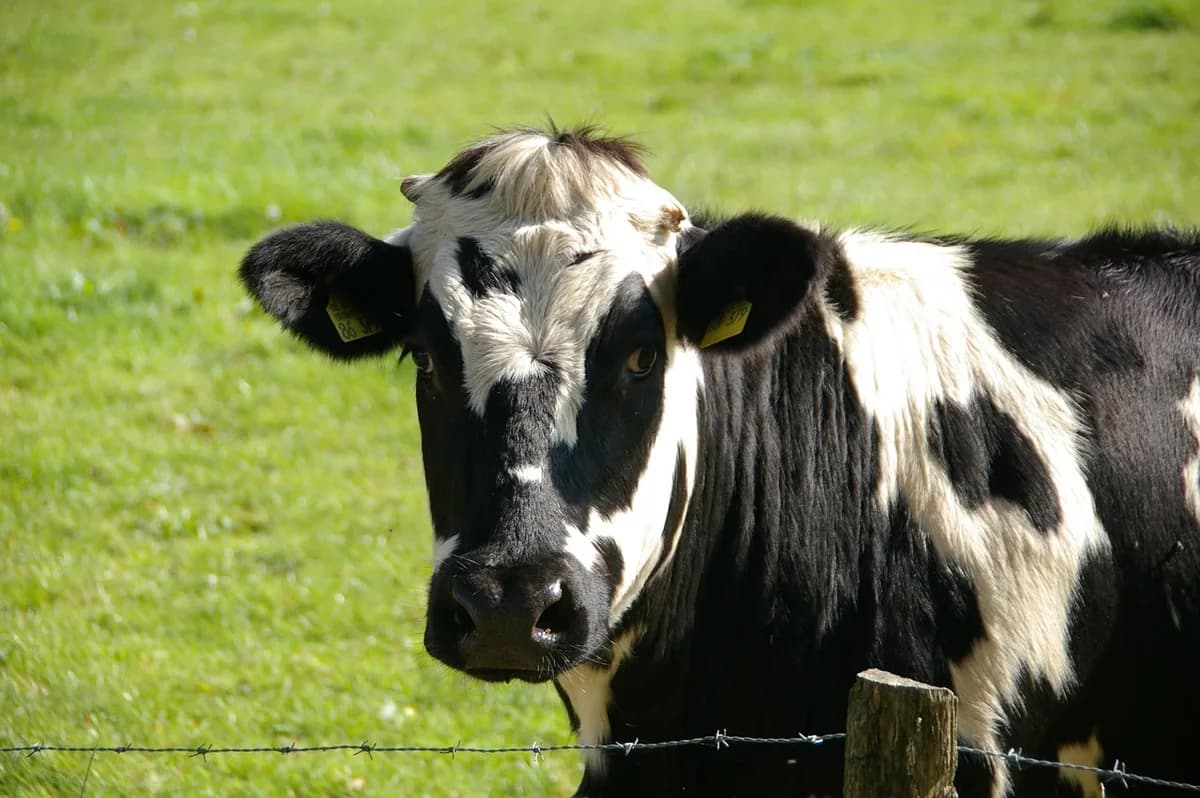
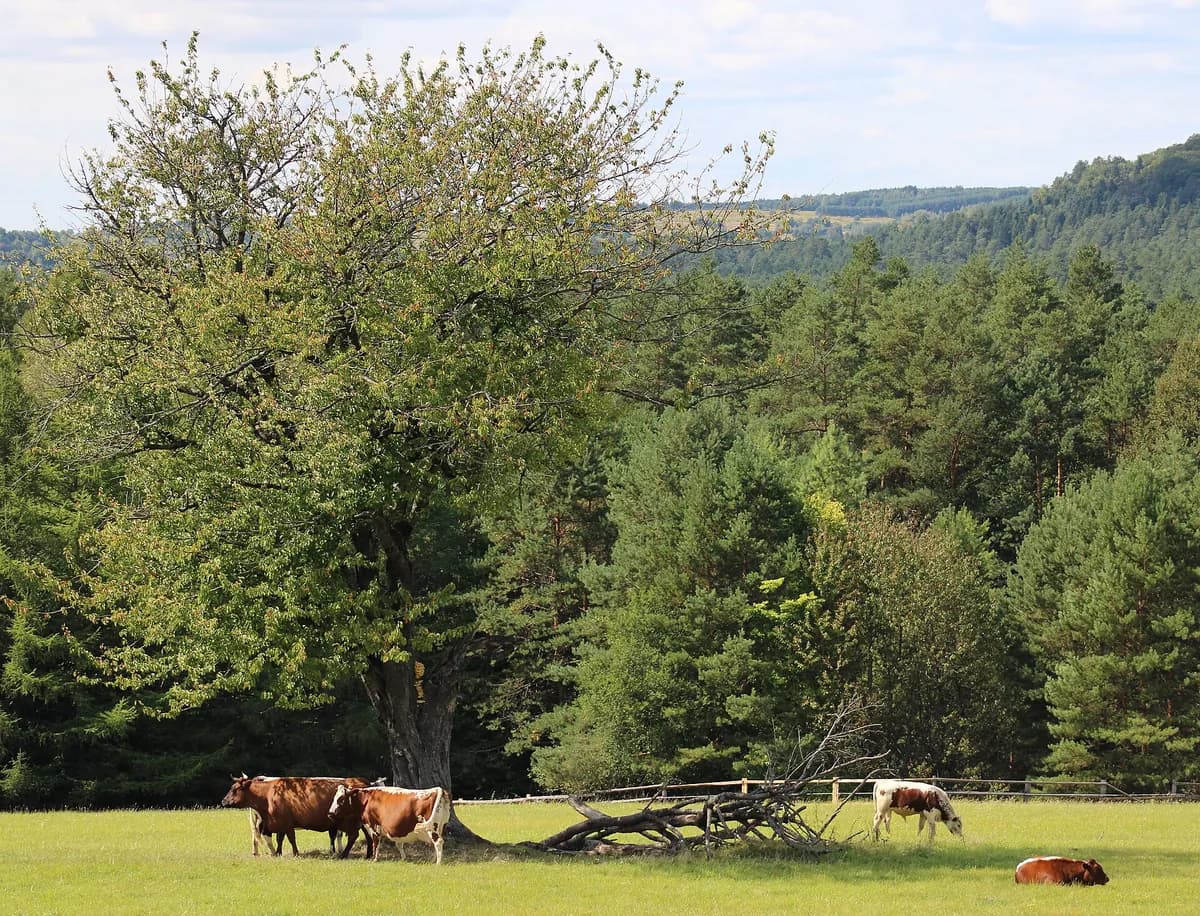
The cartoon in the meme is not based on any particular breed, but Poland has real native cattle with their own conservation programmes. Four native breeds are protected: polska czerwona (Polish Red), białogrzbieta (White-backed), polska czerwono-biała (Polish Red-and-White) and polska czarno-biała (Polish Black-and-White).
The Polish Red is the oldest of them and the one most people mean by a traditional Polish cow. It is a dual-purpose breed, kept for both milk and meat, developed in the late 19th century by crossing local red cattle with red breeds from Denmark, Germany and Sweden. A typical cow gives about 4,000 kg of milk a year. Informal protection of the breed began in 1973, when numbers had fallen dramatically.
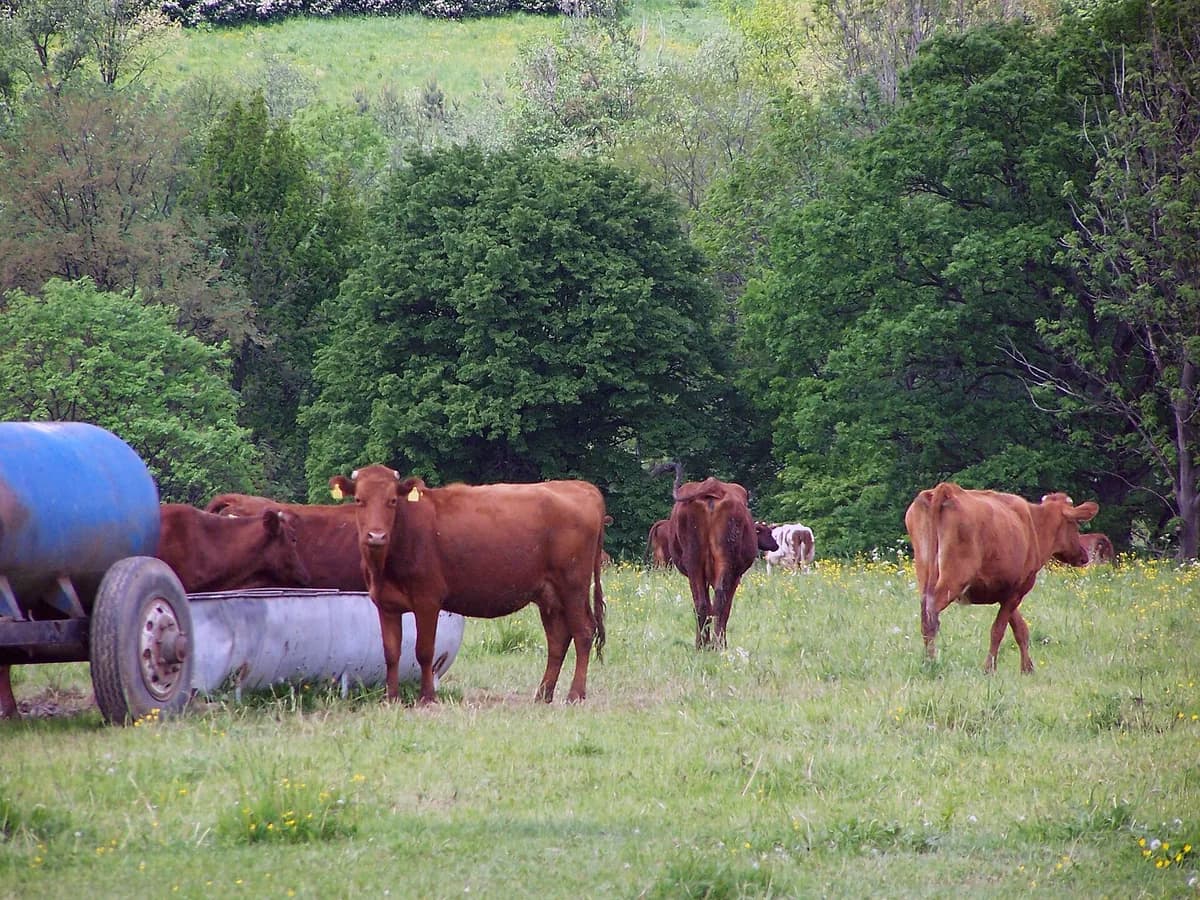
The White-backed breed is easy to spot: reddish or dark sides with a white stripe running along the spine. Its protection programme started in 2003, followed by the Red-and-White in 2007 and the Black-and-White in 2008. Small herds still graze in protected landscapes such as Roztocze National Park in eastern Poland.
Cow vocabulary in Polish
| Polish | Sounds like | English |
|---|---|---|
| krowa | KRO-vah | cow |
| byk | bik | bull |
| cielę | CHEH-leh | calf |
| bydło | BID-wo | cattle |
| mleko | MLEH-ko | milk |
| łąka | WON-kah | meadow |
| krówki | KROOF-kee | "little cows", Polish milk fudge sweets |
The last word is worth knowing. Krówki are soft, crumbly milk fudges sold in every Polish shop, usually in paper wrappers with a cow on them. They make a far better souvenir than the Polish cow song.
Scenario: Asking a Polish Friend About the Polish Cow
You've just played the Polish cow meme to your Polish colleague Kasia during a coffee break. Here's how the conversation might go.
You: Kasia, znasz tę piosenkę? Ta z tańczącą krową? (Kasia, do you know this song? The one with the dancing cow?)
Kasia (laughing): Jasne, że znam. Wiesz, o czym ona jest? (Of course I know it. Do you know what it's about?)
You: Nie. Brzmi bardzo wesoło. (No. It sounds really cheerful.)
Kasia: No właśnie. A jest o facecie na zejściu, który marzy o kokainie. (Exactly. And it's about a guy on a comedown who dreams about cocaine.)
You: Serio? A ja to puszczałem dzieciom! (Seriously? And I've been playing it to my kids!)
Kasia: Spokojnie, krowa jest niewinna. (Relax, the cow is innocent.)
Notice tańczącą krową: after the preposition z ("with"), both the adjective and the noun take the instrumental case. If you are a woman, the past-tense verb changes too: puszczałam instead of puszczałem. Short exchanges like this are exactly the kind of real Polish you can pick up from films and series; our guide to learning Polish with Netflix shows how to practise with them.
Frequently Asked Questions
What is the Polish cow song called?
It's called "Gdzie jest biały węgorz? (Zejście)", meaning "Where Is the White Eel? (Comedown)". Many people know it by its first line, Tylko jedno w głowie mam, which became the meme's hashtag.
What do the Polish cow lyrics mean in English?
They describe a man going through drug withdrawal. The chorus says he has only one thing on his mind, cocaine, and wants to escape somewhere he can forget everything. The verses list his physical symptoms, his debts and his daydreams. It's satire, told with dark humour.
Who sings the Polish cow song?
Cypis, the stage name of Cyprian Racicki, a Polish artist born in 1989 in Inowrocław. The track was uploaded to YouTube in October 2015 and appeared on the 2015 album Narkotyki są nielegalne.
Is the Polish cow song Russian?
No. It's sung in Polish by a Polish artist. The title uses Polish letters like ł and ę, and the slang is Polish. People sometimes assume it's Russian simply because both are Slavic languages.
Why is the Polish cow a meme?
Because a silly dancing cow and a catchy, upbeat hook are fun to watch on loop. The dancing cow videos took off in July 2020, and for Polish speakers there's a second joke: the cheerful song is about cocaine withdrawal.
What does biały węgorz mean?
Literally "white eel". In Cypis's songs it's a nickname for cocaine. It isn't everyday Polish slang; the common colloquial word is koks.
What does zejście mean in Polish?
Zejście literally means "descent" or "coming down", for example from a mountain. In drug slang it means the comedown after a high, which is the situation the Polish cow song describes.
The Polish cow will probably keep dancing on loop for years. Now you know what it's dancing to, how to pronounce the line it made famous, and that Poland's real cows are a lot calmer. If the meme got you curious about the language itself, pick up the sounds properly first and the jokes will follow.