
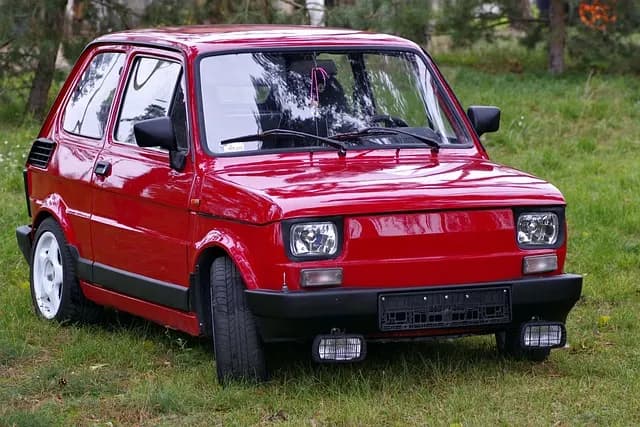
The Fiat 126p is a car most of the world has never heard of and most Poles over 40 have a personal story about. Barely three meters long, powered by an engine smaller than some modern motorcycles, it became — almost by accident — the vehicle that put communist Poland behind the wheel for the first time. Poles nicknamed it Maluch, "the little one," and forty years after it debuted, the nickname stuck so hard the manufacturer eventually made it official.
The Fiat 126p's story starts in Italy but becomes something specifically, stubbornly Polish almost immediately: a car people waited years and saved a fortune for, a car tangled up in a prepayment scandal that Polish courts are technically still resolving today, and a car that hundreds of enthusiasts now trailer to a Polish campsite every August purely to celebrate. Here's how a tiny Italian economy car became one of the most emotionally loaded objects in modern Polish history.

What Is the Polski Fiat 126p, Exactly?
The Fiat 126p is a rear-engined economy car built in Poland under license from Italy's Fiat, starting in 1973. The "p" stands for polski — Polish — distinguishing it from the Italian-market Fiat 126 it was based on. The deal was struck with FSM (Fabryka Samochodów Małolitrażowych, "Small-Displacement Car Factory"), a state-owned manufacturer, and the very first hundred units were actually assembled in Cassino, Italy, before debuting publicly at the 1972 Turin Motor Show and, fittingly, inside Warsaw's Palace of Culture and Science.
Full Polish production began on June 6, 1973, split between two factories: Bielsko-Biała and, later, Tychy. Under the hood — or rather, in the back, since the engine sat over the rear axle — was a tiny air-cooled two-cylinder engine, just 594cc at launch, bumped to 652cc in 1977. A later 1987 variant, the 126 BIS, switched to a water-cooled 704cc engine. The whole car weighed barely 600 kilograms, roughly a third of an average modern hatchback.
It wasn't fast, comfortable, or remotely powerful by any standard — even at launch. What made the Polski Fiat 126p matter wasn't the engineering. It was what owning one meant.
It also wasn't Poland's only Fiat-derived car of the era — the larger Fiat 125p, built separately at Warsaw's FSO factory from 1967 to 1991, served as the more "serious" family sedan and company car. But the 125p never became a folk icon the way the 126p did. It was simply too expensive and too scarce to reach ordinary households the way the tiny, cheaper 126p eventually could, which is precisely why the smaller car is the one Poland got emotionally attached to.
Driving a Maluch: What It Was Actually Like
By modern standards, a Fiat 126p was a genuinely difficult car to live with. Top speed on the later 652cc engine topped out around 105 km/h, reached slowly and loudly. Heating was famously inadequate, meaning Polish winters were spent scraping frost off the inside of the windshield as much as the outside. There was no trunk in the conventional sense up front — that space was largely taken up by the spare wheel and fuel tank — while the "real" cargo area sat over the rear-mounted engine, cramped and warm from the motor beneath it.
None of that mattered much in practice, because the car's real selling point was how easy it was to fix. The engine was simple enough that plenty of owners learned to service it themselves in a home garage or even on the roadside, without specialist tools or a dealership visit. That mechanical simplicity is a big part of why so many Fiat 126p units are still running decades later, from Polish collector garages to the streets of Havana.

Maluch: The Nickname That Became the Real Name
Poles started calling the Fiat 126p Maluch almost immediately — a word that means "little one," typically used the way English speakers say "toddler" or "tot." It's an affectionate diminutive, the same kind of warmth Polish speakers stack onto names and pets, now aimed at a car. The nickname was so universal that in 1997, FSM's successor formally adopted Maluch as the car's official name, decades after the public had already decided.
It picked up a second, less flattering nickname too: Kaszlak, "the cougher," a nod to the distinctive, wheezing rattle of its tiny two-cylinder engine turning over — a sound anyone who grew up around one can still recognize instantly. Between the two nicknames, the Fiat 126p had essentially been renamed twice by the public before its manufacturer ever caught up.
The Car You Waited Years For
Here's what made the Fiat 126p genuinely different from a normal Western economy car: in communist Poland, simply having money wasn't enough to buy one. Private car ownership was treated as a controlled luxury, production capacity was a fraction of demand, and the state rationed access through years-long waiting lists.
By the end of 1973 — the Fiat 126p's very first year of production — an estimated 1.65 million people had already registered for a chance to buy one. The launch price was 69,000 złoty, roughly twenty times an average monthly wage at the time, which meant most buyers weren't paying outright; they were queuing for years while saving, sometimes prepaying the state years in advance for a car that hadn't been built yet. Factories occasionally rewarded particularly productive or well-connected workers with vouchers that let them skip years of the queue — a small, telling detail about how scarcity worked under central planning.
For an entire generation, getting a Maluch wasn't a purchase. It was closer to a life event.

The Prepayment Story Poland Still Hasn't Fully Closed
The waiting-list system produced one of the stranger unresolved footnotes in modern Polish consumer history — and it's still technically live today.
Between 1982 and 1985, roughly 1.5 million Poles prepaid the state for a Polski Fiat, either a 126p or its larger sibling, the 125p, banking on eventually being allocated one. When communism collapsed in 1989, the prepayment scheme collapsed with it, and around 340,000 of those people never received their car at all. Poland's post-communist government eventually passed compensation legislation in 1996, offering indexed cash payments to anyone still holding an unfulfilled prepayment receipt.
Those payments have kept rising with inflation ever since. As Notes from Poland reported, by 2021 the compensation for an unfulfilled Fiat 126p order had climbed to roughly 13,852 złoty (about €3,040), and there's no filing cutoff date — meaning that, decades later, it's technically still possible for someone holding a 1980s Polski Fiat receipt to file a claim and get paid out. It's a genuinely strange piece of unfinished business: a car most owners have long since scrapped, still generating paperwork in Polish courts forty years on.
A Small Car With a Surprisingly Global Reach
Despite being designed for a captive domestic market, the Fiat 126p traveled further than its size suggests. It was exported across the Eastern Bloc, and roughly 30,000 units a year were sold in China throughout the 1980s. Cuba imported thousands as well — as of 2016, an estimated 10,000 were reportedly still registered and running on Cuban roads, a testament to just how mechanically simple and repairable the car was.
Australia is the strangest chapter. A localized version, badged the FSM Niki, was sold there from 1989 to 1992, well after the car had already become a familiar Polish institution. A convertible variant in particular developed a small but genuine cult following among Australian budget buyers looking for something cheap, unusual, and easy to park — a long way, culturally and geographically, from the queues and prepayment coupons of communist Poland that had made the same car a necessity rather than a novelty back home.
By the time Polish production ended on September 22, 2000, at the Tychy plant, total global output — combining the original Italian Fiat 126 and the Polish-built 126p — had passed 4.67 million vehicles, with roughly 3.3 million of those built in Poland alone. For a car this small, that's an enormous footprint.
Why Poles Still Race and Restore It Today
The Fiat 126p should, by most logic, have quietly disappeared once Poland's roads filled up with newer, safer, faster options after 1989. Instead, it became a nostalgia object almost immediately — a physical stand-in for an entire generation's memories of queuing, saving, and finally getting somewhere on four wheels of their own.
That nostalgia has real, organized momentum behind it. The National Fiat 126 Rally, held annually at a campsite in Krzykawka, is billed as the largest annual gathering of Fiat 126 and 126p owners and fans in Poland — and arguably in Europe — regularly drawing hundreds of cars for a weekend that's part car show, part reunion, part deliberately retro camping trip. Łódź separately holds its own annual event each September marking the anniversary of the model's discontinuation. Restoration culture around the Maluch is thriving too: enthusiasts strip them down to bare metal, repaint them in period-correct colors, and show them off at meets the same way American collectors treat a first-generation Mustang.

It's worth noting the Maluch isn't PolishPal's first stop into PRL-era nostalgia — see our guide to Bar Mleczny, the communist-era cafeterias that outlasted the regime that built them, or Polish Lektor, the single monotone voice that still dubs every foreign film on Polish TV. The Fiat 126p belongs to the same cluster of everyday institutions Poland didn't just tolerate under communism but somehow grew fond of, kept, and eventually turned into cultural shorthand. If disco polo is the soundtrack of that nostalgia, as we cover in our disco polo guide, the Maluch is arguably its vehicle — sometimes literally.
And the word itself outlived the car: maluch is still ordinary Polish vocabulary today, used affectionately for any small child, small pet, or small object, completely independent of cars. If you hear a Polish parent call their toddler mój maluch — "my little one" — it's the exact same word, no car required.
Common Questions About the Fiat 126p Maluch
What does "Maluch" mean in Polish? "Little one" — a warm, diminutive term normally used for small children, that Poles affectionately applied to the tiny Fiat 126p and which the manufacturer eventually adopted as its official name in 1997.
Why is it called the Fiat 126p and not just Fiat 126? The "p" stands for polski (Polish), marking it as the Polish-manufactured, Polish-market version built under license from Fiat's original Italian 126, with its own factories, minor spec differences, and eventually its own separate cultural identity.
How long did people actually wait to buy one? Waits commonly stretched several years. By the end of the Fiat 126p's first production year alone, roughly 1.65 million people were already on the waiting list, and buyers frequently prepaid the state years ahead of actually receiving a car.
Is it true people can still claim compensation for undelivered Polski Fiats? Yes. Around 340,000 people who prepaid between 1982 and 1985 never received their car after communism ended. A 1996 law created ongoing, inflation-indexed compensation with no filing deadline, meaning claims are technically still possible decades later.
What engine did the Fiat 126p have? A small rear-mounted, air-cooled two-cylinder engine — 594cc at launch, enlarged to 652cc in 1977. A later water-cooled 704cc version arrived with the 126 BIS in 1987.
When did production end? September 22, 2000, at the Tychy factory in Poland, closing out 27 years of production and more than 4.67 million units built worldwide across both the Italian and Polish versions.
Was the Fiat 126p sold outside Poland and Italy? Yes — it reached markets across the Eastern Bloc, China (around 30,000 units a year through the 1980s), Cuba (thousands, with an estimated 10,000 still registered as of 2016), and Australia, where it was sold locally as the FSM Niki.
Why did it get the nickname "Kaszlak"? "The cougher" — a nickname inspired by the rough, wheezing sound of its small two-cylinder engine, distinct enough that Poles who grew up around one can usually still recognize it by ear.
Can you still see Fiat 126p cars in Poland today? Yes, though mostly at classic car shows, rallies, and among dedicated collectors rather than on daily roads. The National Fiat 126 Rally in Krzykawka is the largest annual gathering, drawing hundreds of restored cars from Poland and abroad every summer.
Was the Fiat 126p actually a good car? Not by objective engineering standards — it was slow, cramped, and mechanically basic even for its era. Its significance was never about performance; it was the first realistically attainable private car for millions of families in communist Poland, which is why it's remembered with affection rather than judged on specs.
Is "maluch" only used for cars in Polish? No — it's everyday vocabulary for any small child or small creature, completely unrelated to cars in its normal use. The Fiat 126p simply borrowed an already-existing term of endearment, the same way English speakers might nickname a small car a "little guy."
What was the Fiat 126p's top speed? Roughly 105 km/h (about 65 mph) for the later 652cc models — modest even by the standards of small economy cars, and reached slowly given the engine's limited power.
Did the Fiat 126p have a proper trunk? Not much of one. The front compartment mostly held the spare wheel and fuel tank, while genuine cargo space sat over the rear-mounted engine — cramped, oddly warm, and one of the more affectionately mocked quirks among long-time owners.
How is the Fiat 126p different from the Fiat 125p? The 125p was the larger, pricier "serious" family sedan built separately in Warsaw, aimed at professionals and company fleets. The smaller, cheaper 126p was the one ordinary households could realistically save up for, which is why it became the folk icon and the 125p mostly didn't.
Nearly three decades after the last one rolled off the line in Tychy, the Fiat 126p still pulls a genuine crowd every August in Krzykawka, still generates compensation paperwork in Polish courts, and still lends its nickname to toddlers who've never seen one in person. Few economy cars anywhere have aged into that much affection.