Polish cookies are small, but they carry a surprising amount of culture: a honey-spiced heart from Toruń, a crisp ribbon of fried dough eaten before Lent, a folded jam pastry that Polish-American grandmothers still bake every December. If you grew up with a Polish family, you probably know at least one of them by smell alone. If you're learning Polish, they are also a sweet way to pick up real vocabulary, because every cookie on the plate has a name worth knowing.
This guide walks through the traditional Polish cookies you're most likely to meet, from kołaczki and pierniczki to faworki, rogaliki and the shop-bought classics in every Polish kitchen cupboard. For each one you'll get the Polish name, a simple pronunciation hint, what it actually is, and when people eat it.
It isn't a recipe blog, but where a short ingredient outline helps you picture a cookie, you'll find one. By the end you should be able to walk into a Polish bakery, point at the right tray and ask for it in Polish.
What Counts as Polish Cookies?
Start with the words, because Polish sorts baked sweets a little differently from English. Ciasto (CHAHS-toh) means both "dough" and "cake". Its diminutive ciastko (CHAHST-koh) is a single small cake or pastry, and the double diminutive ciasteczko (chahs-TECH-koh) is a little cookie. In everyday speech, Poles use ciastka and ciasteczka (the plurals) for most of what English speakers would call cookies or biscuits.
That diminutive habit is very Polish. Small, sweet, loved things get small, sweet word endings, which is why so many Polish cookies end in -ki or -czki: pierniczki, kołaczki, rogaliki, faworki. Once you notice the pattern, you'll start spotting it on bakery labels everywhere.
Another useful distinction: a cukiernia (tsoo-KYER-nyah) is a pastry shop, while a piekarnia (pyeh-KAR-nyah) is a bakery that mainly sells bread. If you want the widest choice of Polish cookies, the cukiernia is your best bet, although many neighbourhood bakeries keep a tray of ciasteczka by the till.
Kołaczki (Kolaczki): The Folded Jam Cookie
If you've searched for Polish cookies in the United States, kołaczki (often written kolaczki, said koh-WAHCH-kee) probably came up first. In Polish-American kitchens, kolaczki are small squares of rich, tender dough, folded corner to corner around a spoonful of fruit filling and dusted with powdered sugar after baking. The word is plural; you'd normally bake and eat a whole tray of them, not just one.
The American version is famous for a dough made with cream cheese and butter, with no yeast at all. That cream-cheese style is best known in the US, where it became one of the best-loved Polish cookies in Polish-American families every December. In Poland itself you'll find plenty of Polish cookies made from shortcrust and jam, but you're less likely to hear them called kołaczki.
Kołacz in Poland vs Kolaczki in America
The name comes from kołacz (KOH-wahch), a much older and bigger thing. In Poland a kołacz is a round ceremonial bread made from yeast dough, traditionally baked for weddings and also for Christmas, Easter and harvest festivals. According to the Wikipedia entry on kołacz, the name is linked to the Old Slavonic word for a circle or wheel, which survives in modern Polish as koło (KOH-woh), "wheel". So the word started life as a big round festive loaf and, in America, ended up as a bite-sized folded cookie.
There's a Czech cousin too: the koláč, a sweet yeast pastry with a pocket of fruit or sweet cheese in the middle. Czech-American bakeries made "kolache" popular in parts of the US, which is one reason the two words often get mixed up online.
Typical Kolaczki Fillings
| Filling | Polish word | Pronunciation |
|---|---|---|
| Apricot jam | dżem morelowy | jem moh-reh-LOH-vih |
| Raspberry jam | dżem malinowy | jem mah-lee-NOH-vih |
| Plum butter | powidła śliwkowe | poh-VEED-wah shleef-KOH-veh |
| Poppy seed | mak | mahk |
| Sweet cheese | ser | sehr |
Powidła deserves a special mention. It's a thick, dark plum butter cooked down for hours without much added sugar, and it's one of the most traditional fillings for Polish cookies, doughnuts and pierogi. If a family recipe says "prune filling", powidła is usually what it means.
A Simple Kolaczki Outline
You don't need a full recipe to understand how kolaczki work. The American cream-cheese version usually looks like this:
- Dough: flour, cold butter and cream cheese in roughly equal weights of butter and cheese, sometimes a pinch of salt or sugar.
- Shaping: the dough is chilled, rolled thin, cut into squares, filled in the middle, then two opposite corners are pinched together over the filling.
- Finish: a short bake until just golden, then a snowfall of cukier puder (TSOO-kyer POO-der), "powdered sugar".
If you enjoy desserts built on soft cheese, Poland's own cheese-based classic is sernik, and our guide to sernik, the Polish cheesecake made with twaróg explains why Polish bakers get so particular about the cheese.

Photo: Istvan Szabo on Pexels.
Pierniczki: Polish Christmas Cookies with Honey and Spice
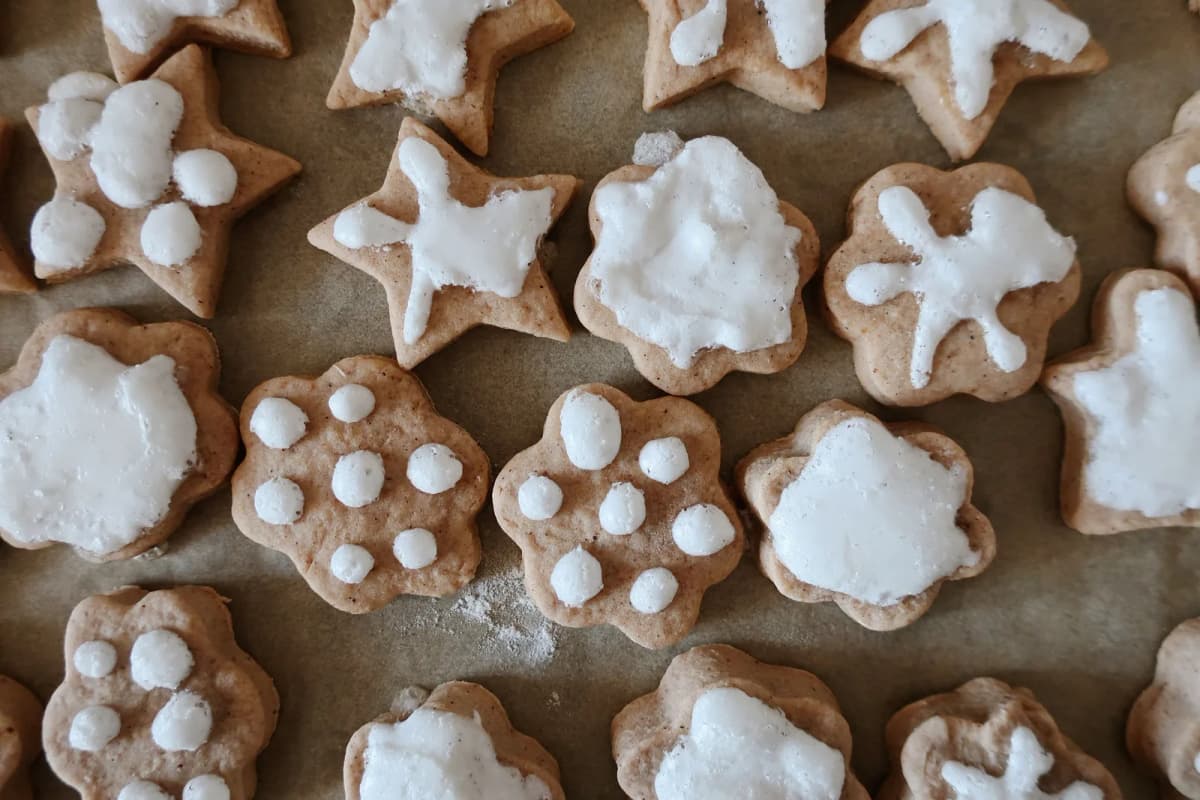
If kolaczki rule Polish-American Decembers, pierniczki (pyer-NEECH-kee) rule Christmas in Poland. Of all Polish cookies, they're the most festive: small gingerbread cookies made with honey and a warm spice mix, cut into stars, hearts, Christmas trees and little figures, then decorated. Ask a Polish family which Polish Christmas cookies they bake every year, and pierniczki will almost certainly be the first answer.
The word comes from piernik (PYER-neek), the larger gingerbread cake, which in turn is related to pieprz (pyepsh), "pepper". Old recipes called for so many strong spices that "peppery" was a fair description. Today's blends typically use spices such as cinnamon, cloves, ginger, nutmeg, cardamom and pepper, and Polish shops sell it ready-made as przyprawa do piernika (pshih-PRAH-vah doh PYER-nee-kah), "gingerbread spice".
Decorating with Lukier
The classic decoration is lukier (LOO-kyer), a simple white icing of powdered sugar and egg white or lemon juice, piped in dots, swirls and outlines. Some families dip pierniczki in chocolate instead, and others press almonds or candied peel into the top. Decorating is the part children wait for all December.
There's also a practical tradition behind the timing. Polish-language Wikipedia notes that dough for Christmas gingerbread is traditionally mixed about a month ahead, and baked pierniki start out firm before softening as they absorb moisture from the air. That's why many families bake early in December and store their Polish cookies in a tin, sometimes with a slice of apple, so they're tender by Christmas Eve.
Toruń and the Katarzynki
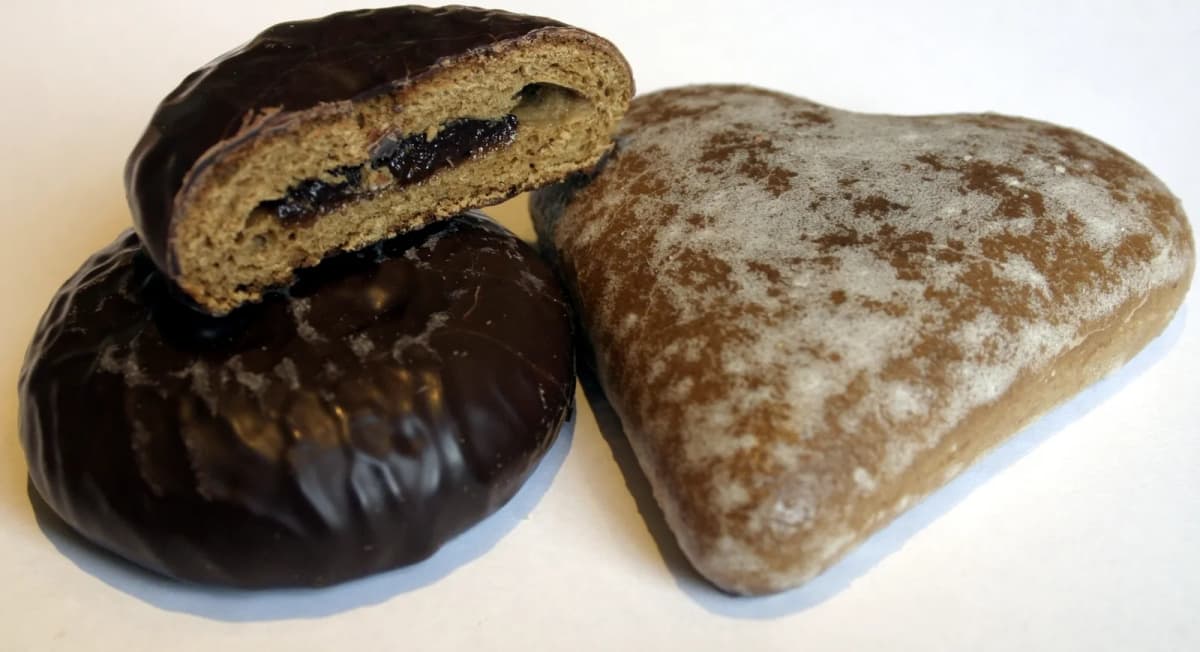
The northern city of Toruń has the most famous gingerbread tradition in Poland. The history of Toruń gingerbread goes back to the Middle Ages, with the first written record of gingerbread baking there dating from 1380. Toruń's best-known contribution to Polish cookies is the katarzynka (kah-tah-ZHIN-kah), plural katarzynki, a cookie made of six joined medallions.
Nobody knows who invented the shape, so two charming legends do the job instead. In one, a baker's daughter named Katarzyna couldn't find the moulds and pressed six round cookies together. In the other, a nun named Katarzyna saw six rounds fuse in the oven. Either way, the name stuck, and katarzynki are still sold in Toruń today. We'll look at Toruń's gingerbread history in more depth in a separate guide.
Faworki or Chruściki: Fried Angel Wings
Not all Polish cookies are baked. Faworki (fah-VOR-kee) are thin strips of dough, each with a slit in the middle that one end is pulled through to make a twist, then fried until crisp and blistered and buried under powdered sugar. In English they're often called "angel wings". They shatter when you bite them, and they leave powdered sugar on everything you own.
They have more than one name. The Wikipedia article on angel wings explains that faworki comes from the French faveur, the ribbons a lady once gave to a knight, while chruściki (khroosh-CHEE-kee) and chrust (khroost) come from the Polish word for brushwood, because a pile of them looks like a heap of twigs. Which name you use often depends on which part of Poland your family comes from.

Photo: Nowaja on Pixabay.
Faworki belong to karnawał (kar-NAH-vahw), the carnival season, and especially to Tłusty Czwartek (TWOOS-tih CHVAR-tek), Fat Thursday, the last Thursday before Lent. That's the same day Poles queue around the block for doughnuts, which our guide to pączki and Fat Thursday covers in detail. Faworki are the crunchy sidekick on that day: many bakeries sell both, and plenty of people buy both.
Rogaliki: Little Crescent Cookies
Rogaliki (roh-gah-LEE-kee) are small crescents, rolled up from a triangle of dough around a little filling, usually jam or powidła, sometimes nuts or poppy seed. The word is a diminutive of rogal (ROH-gahl), "crescent roll", which itself comes from róg (roog), "horn". Literally, then, rogaliki are "little horns".
There are two broad families. Bakery rogaliki are often made from a soft yeast dough and glazed, closer to a small sweet roll. Home-baked rogaliki are more often made from a tender shortcrust or cheese-enriched dough and finished with powdered sugar, which puts them firmly among Polish cookies. Both are loved, and both vanish quickly from any plate of Polish cookies.

Photo: Aw58, CC BY-SA 4.0, via Wikimedia Commons.
Kruche Ciasteczka and Other Everyday Polish Cookies
Plenty of Polish cookies have no festival attached at all. They're simply what's in the tin when guests drop by for tea. The backbone of homemade Polish cookies is ciasto kruche (CHAHS-toh KROO-heh), shortcrust dough. Kruchy means crumbly or short, and kruche ciasteczka (KROO-heh chahs-TECH-kah) are the buttery cut-out Polish cookies that turn up in every shape a cookie cutter allows.
A few other names you'll meet:
- Kocie języczki (KOH-cheh yen-ZICH-kee), "cats' tongues": thin, crisp, rounded butter biscuits a few centimetres long, named for their shape.
- Kokosanki (koh-koh-SAHN-kee): small coconut cookies, soft inside and golden at the edges, much like coconut macaroons.
- Bezy (BEH-zih), singular beza: meringues of whipped egg white and sugar, dried slowly at a low oven temperature until crisp.
- Ciasteczka owsiane (chahs-TECH-kah ov-SHAH-neh): oat cookies, a modern everyday favourite.
These are great words for practising Polish plurals. Notice that most of them already appear in the plural, because nobody ever eats just one.
Shop-Bought Classics: Delicje and Friends
Homemade baking gets the romance, but some of the most recognisable Polish cookies come in a packet. The best known is Delicje Szampańskie (deh-LEETS-yeh shahm-PAHN-skyeh), a round sponge biscuit topped with fruit jelly and a layer of chocolate, similar to a Jaffa Cake. They've been made in the town of Płońsk since the 1970s and belonged to the Wedel brand for years, though today they're made by LU Polska.
Packets of Delicje, boxes of chocolate-covered pierniki from Toruń and bags of kruche ciasteczka are standard items in Polish shops abroad, which makes them an easy taste of Poland if you can't bake. They're also a handy way to practise reading labels: look for words like nadzienie (nah-DZHYEH-nyeh), "filling", and czekolada (cheh-koh-LAH-dah), "chocolate".
What About "Polish Jelly Cookies"?
"Polish jelly cookies" is a phrase you'll mostly see in American recipe collections and family cookbooks, not in Poland. It usually refers to kolaczki or to round shortbread cookies with a dab of jam in the centre, the kind sometimes called thumbprints. There isn't one specific Polish cookie by that name, so if a relative's recipe card says "jelly cookies", look at the shape: folded squares mean kolaczki, round cookies with a jam dimple are a home-style shortcrust cookie.
In Polish, the jam itself would be dżem (jem), konfitura (kon-fee-TOO-rah) for jam with whole fruit pieces, or marmolada (mar-moh-LAH-dah). Despite the name, marmolada in Polish is a smooth fruit spread, not specifically the orange marmalade English speakers expect.
Polish Xmas Cookies and the Christmas Table
So where do Polish Xmas cookies fit into the holidays? Baking usually starts in early December, with pierniczki first because they need time to soften. Polish-language Wikipedia's history of the choinka (hoh-EEN-kah), the Christmas tree, notes that trees were traditionally decorated with pierniczki, nuts, small cakes and red apples. An iced gingerbread heart with a ribbon through it still makes a lovely ornament.
On Christmas Eve itself, Polish cookies share the table with heavier traditional cakes like makowiec (poppy seed roll), sernik and piernik. The main event is the meatless supper, which our guide to Wigilia, the Polish Christmas Eve explains dish by dish. For the bigger picture of the season, from Advent to the carols, see our overview of Polish Christmas traditions.
A plate of Polish Christmas cookies is also a social thing. Families share tins with relatives and neighbours, and a box of homemade Polish cookies is a perfectly normal gift for a host. If you're invited to a Polish home in December, bringing something sweet is always welcome.
Polish Cookies Vocabulary: Words to Know
Food words are some of the easiest Polish vocabulary to remember, because you learn them with your stomach. Here's a quick reference for Polish cookies and baking:
| Polish | Pronunciation | English |
|---|---|---|
| ciasteczka | chahs-TECH-kah | cookies |
| piec / upiec | pyets / OO-pyets | to bake (ongoing / completed) |
| mąka | MOHN-kah | flour |
| masło | MAH-swoh | butter |
| cukier | TSOO-kyer | sugar |
| miód | myoot | honey |
| jajko | YAI-koh | egg |
| foremka | foh-REM-kah | cookie cutter |
| blacha | BLAH-hah | baking tray |
| piekarnik | pyeh-KAR-neek | oven |
The verb pair piec / upiec is a nice example of Polish verb aspect: piekę ciasteczka (PYEH-keh) means "I'm baking cookies" right now, while upiekłam ciasteczka or upiekłem ciasteczka means "I baked the cookies" and they're done. For more dishes and table customs, our guide to Polish food culture is a good next stop.
And if you want to ask for something in a bakery, one phrase covers most situations: Poproszę te ciasteczka (poh-PROH-sheh teh chahs-TECH-kah), "I'd like these cookies, please". Point, smile, and you're done.
Frequently Asked Questions
What are the most popular Polish cookies? At Christmas, pierniczki (small honey gingerbread cookies) are the clear favourite in Poland. Faworki dominate carnival season and Fat Thursday. In Polish-American families, kolaczki are the best-known Polish cookies, especially in December.
How do you pronounce kolaczki? Say koh-WAHCH-kee. The Polish letter ł sounds like an English "w", and the stress falls on the second-to-last syllable, as in almost every Polish word.
Are kolaczki Polish or Czech? Both traditions share the same root word. In Poland, kołacz is a round festive yeast bread, while the Czech koláč is a yeast pastry with a fruit centre. The folded cream-cheese cookie called kolaczki is most strongly associated with Polish-American baking.
What's the difference between piernik and pierniczki? Piernik is a gingerbread cake, often baked in a loaf tin and layered with plum butter. Pierniczki are the small cut-out cookies made from a similar honey-and-spice dough.
Where can I buy Polish cookies outside Poland? Polish delis, and the Polish shelf in many supermarkets abroad, usually stock packaged Polish cookies such as Delicje and chocolate-covered pierniki. Homemade-style kolaczki are easiest to find at Polish-American bakeries in December, or in your own oven.
Are faworki and chruściki the same thing? Yes. They are two regional names, along with chrust, for the same crisp fried pastry dusted with powdered sugar.
Bake Your Way into Polish
Polish cookies are a lovely entry point into the language because the words come with stories: wheels and circles in kołaczki, peppery spices in pierniczki, knights' ribbons in faworki and little horns in rogaliki. Learn the name, say it out loud, and the next time you see that tray in a Polish cukiernia you won't just point, you'll ask.
To practise the ordering phrases you'd use at a bakery counter, try our lesson on food and drinks:
Food, Drinks and Ordering in PolishFeatured photo: Asya Vlasova on Pexels.