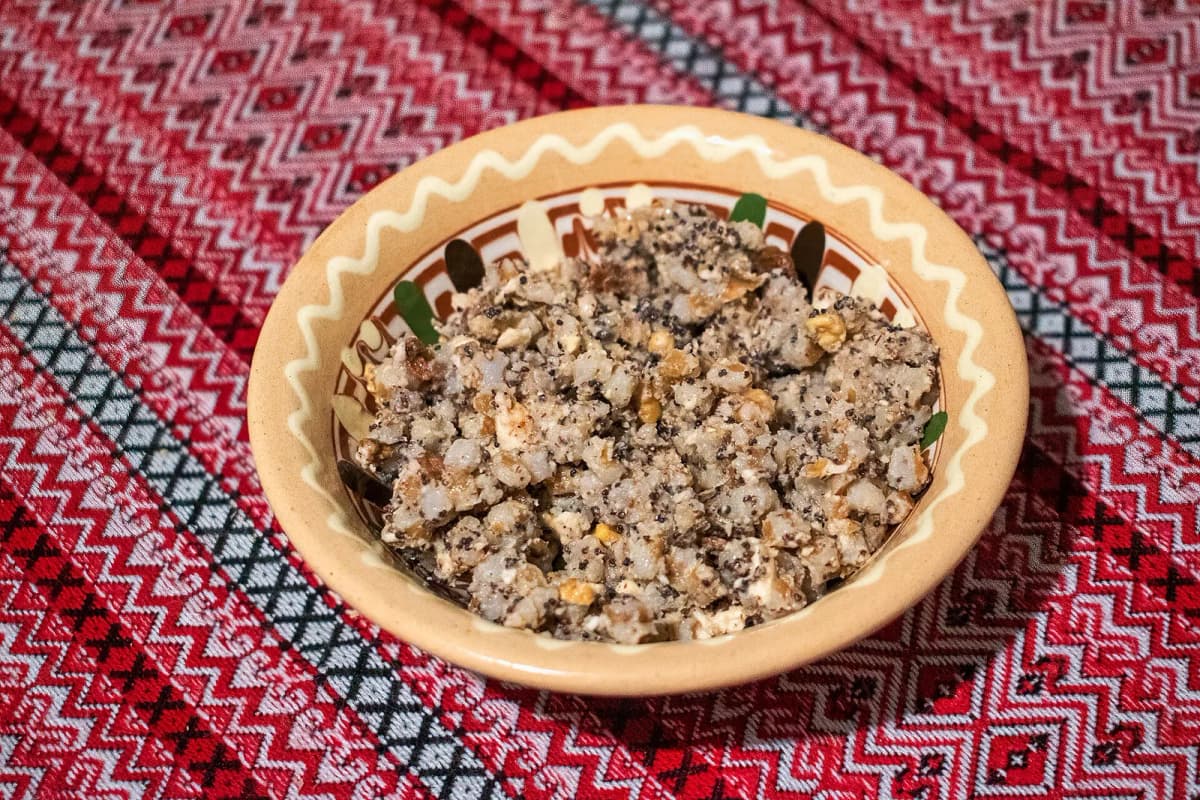
Kutia is a sweet Christmas Eve dish of boiled wheat berries, poppy seeds and honey, usually studded with walnuts, raisins and dried fruit. In Poland you will find it mainly on Wigilia tables in the east of the country, and it belongs to a wider family of grain dishes shared by Ukrainians, Lithuanians and Belarusians, who each have their own version and their own name for it.
If you grew up with kutia (pronounced KOO-tyah), it probably tastes of grandparents and childhood. If you have never tried it, think of a cool, chewy, nutty pudding that is closer to a sweet grain salad than to anything creamy. It is simple, ancient and surprisingly moreish.
This guide explains what goes into it, where in Poland people still make it, how it connects Polish, Ukrainian and Lithuanian Christmas traditions, and how to make a bowl yourself.
What Is Kutia Made Of?
At its heart, the dish has just three ingredients, each with a long history in Eastern European farming and ritual:
| Polish | Pronunciation | English | Role in the dish |
|---|---|---|---|
| pszenica | psheh-NEE-tsah | wheat | The base: whole wheat berries, soaked and boiled |
| mak | mahk | poppy seed | Scalded and ground into a dark, creamy paste |
| miód | myoot | honey | Sweetens and binds everything |
| orzechy | o-ZHEH-khih | nuts | Usually walnuts, sometimes hazelnuts or almonds |
| rodzynki | ro-DZIN-kee | raisins | Add sweetness and chew |
| bakalie | bah-KAH-lyeh | dried fruit and nuts | Figs, apricots, candied orange peel |
According to the Wikipedia article on kutia, the traditional Polish recipe uses wheat, poppy seeds ground in a makutra (mah-KOO-trah), a ribbed ceramic bowl, plus honey, raisins, walnuts or hazelnuts, almonds and vanilla. Some families stir in milk or sour cream, and some replace the wheat with rice or another grain.
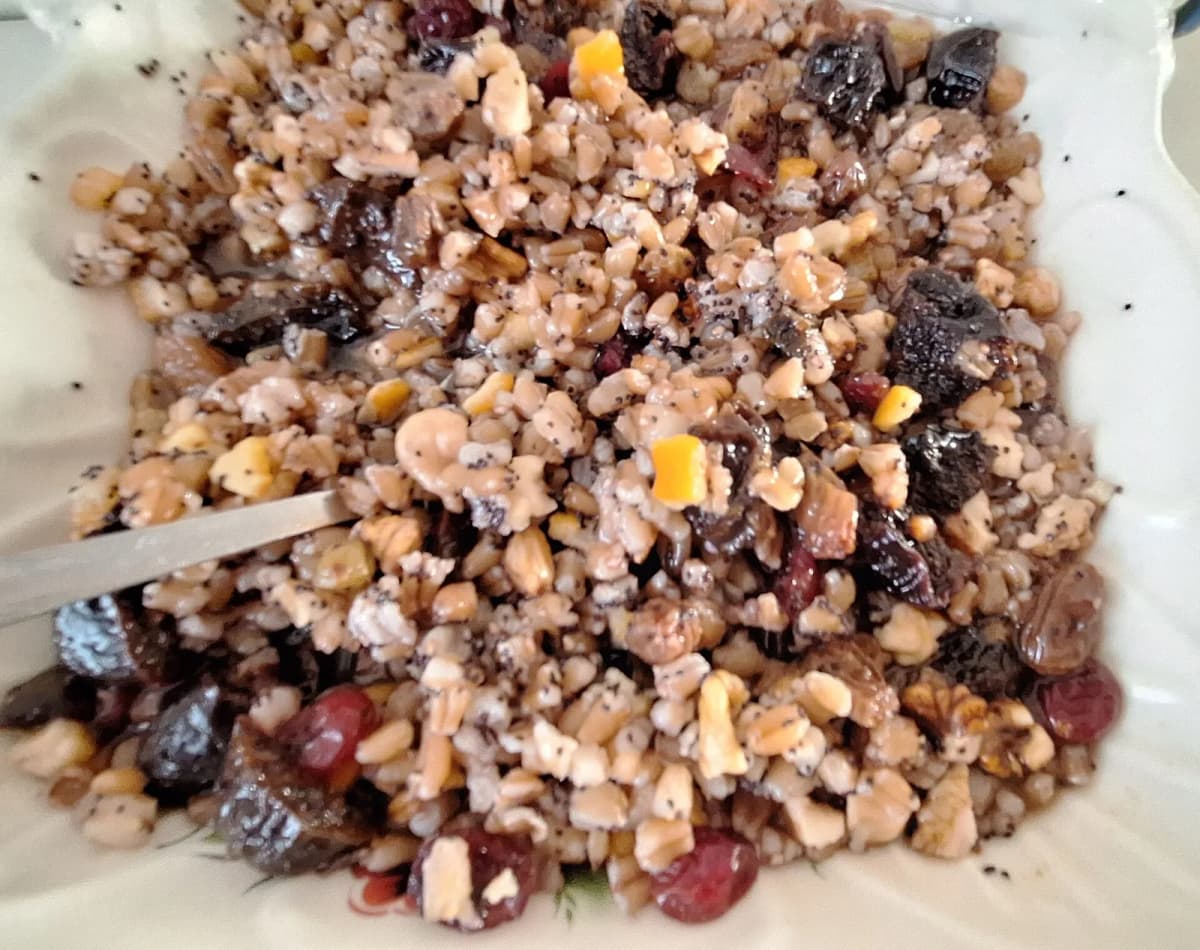
Photo: Rakoon, CC0, via Wikimedia Commons.
The texture surprises people. The wheat stays chewy, the poppy seed makes everything slightly creamy and grey-blue, and the honey gives a gentle sweetness rather than a sugary hit. It is served cold or at room temperature, in small portions, often as one of the first or last dishes of the evening.
Where Kutia Comes From
The word itself travelled a long way. Linguists trace the word to Greek, from kókkos, "grain", and Polish Wikipedia notes that it reached Polish through Ukrainian. Polish also has an older regional form, kucja (KOOTS-yah).
The dish is much older than the name. Grain, poppy and honey were basic foods in this part of Europe for centuries, and boiled wheat sweetened with honey appears in winter and memorial rituals across the region. Some scholars link the custom to pre-Christian Slavic beliefs about feeding the souls of ancestors at the darkest time of the year, a layer of meaning that still shows in some family customs today.
A Shared Dish Across Eastern Europe
It is fairest to describe it as a shared eastern tradition rather than the property of any one nation. Here is how it appears in the countries that keep it:
- Ukraine: кутя (kutia) is one of the two essential ritual dishes of Sviata Vecheria, the Holy Supper on Christmas Eve, and it is the first of the twelve dishes tasted.
- Lithuania: a related dish of boiled grains with honey water, kūčia, gave its name to Kūčios, the Lithuanian Christmas Eve supper itself.
- Belarus: куцця (kutsia) is eaten at Christmas and New Year, and also at memorial days and funeral meals, sometimes in a plainer version without honey.
- Poland: it appears on Wigilia tables mainly in the east, and in families with roots in the former eastern borderlands.
Similar dishes exist further south too, such as koliva in Greece and colivă in Romania, usually made for memorial services rather than Christmas. They share the same ancient idea: wheat as a symbol of life that returns after winter.
Kutia in Poland: The Eastern Borderlands Connection
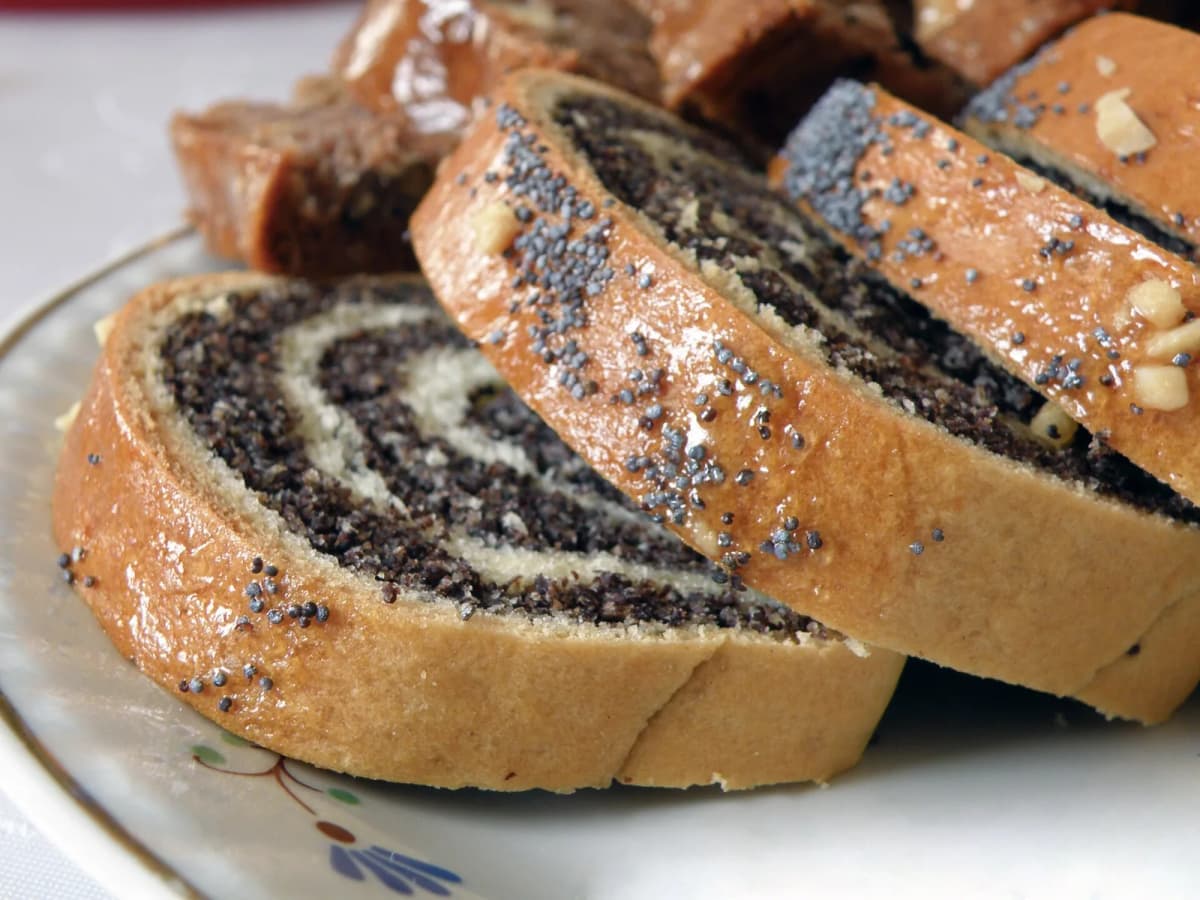
You will not find kutia on every Polish Christmas Eve table. In much of western and central Poland, poppy seed arrives at Wigilia in other forms, most often as a rolled poppy seed cake. The wheat and honey version is the eastern option.
Today it is made mainly in the Podlasie region around Białystok, the Lublin region, and the border districts of Podkarpacie, close to Belarus and Ukraine. It is also eaten all over Poland by descendants of families from the Kresy (KREH-sih), the former eastern borderlands that were part of Poland before the Second World War and now lie in Ukraine, Belarus and Lithuania.
After 1945 many of those families were resettled in western Poland, around Wrocław, Opole and the former German territories, and they brought their recipes with them. That is why a family in Silesia may serve it on 24 December while their neighbours have never made it: for them, the dish is a link to grandparents' homes in Lwów or Wilno.
Kutia on the Wigilia Table
In Polish homes that make it, the dish is one of the twelve meatless dishes of Wigilia, the Christmas Eve supper. Our guide to Wigilia and its twelve dishes shows where it fits in the whole meal, and our overview of Polish Christmas traditions covers the rest of the season around it. Families differ on timing: some eat it at the start, right after sharing the oplatek wafer, others serve it with the desserts alongside makowiec, the Polish poppy seed roll.
Some families also make it again for New Year's Eve, and in eastern Poland it has traditionally been served at wakes as well, a reminder of its old role in honouring the dead.
Kutia in Ukraine: Customs and Calendar
In Ukraine, it is not just one dish among many. It is the dish that opens the Holy Supper. Traditionally the head of the family takes the first spoonful, remembers departed relatives, and in some regions tosses a spoonful up towards the ceiling. Grains that stick were read as a sign of a good year: swarms of bees, healthy livestock, plenty of eggs.
The bowl may also stay on the table overnight with spoons left out for the souls of ancestors, and children sometimes carry a bowl to grandparents and godparents as a gift. Because 24 December is a fast day, the Ukrainian version is strictly Lenten, with no milk or eggs.
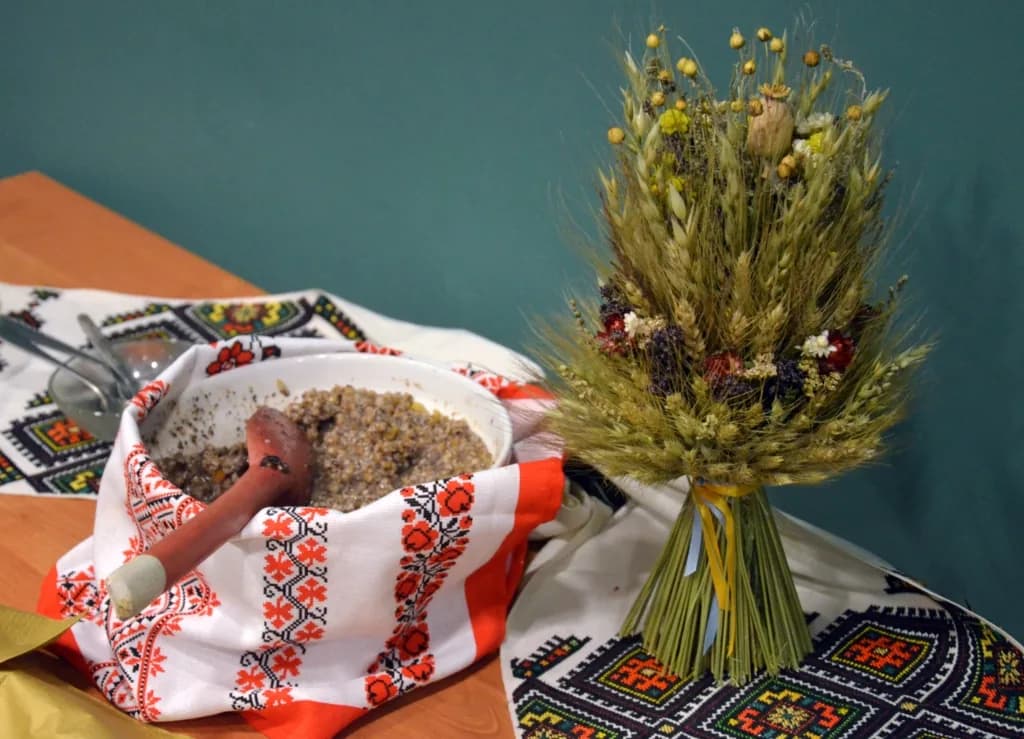
Photo: Janbies, CC BY-SA 4.0, via Wikimedia Commons.
The date has changed recently. For a long time most Ukrainians celebrated Christmas on 7 January, following the Julian calendar, with the Holy Supper on 6 January. In July 2023 Ukraine moved its official Christmas holiday to 25 December, after the Orthodox Church of Ukraine adopted a revised calendar, and the Ukrainian Greek Catholic Church made the same change. As a result, many Ukrainian families now share kutia on 24 December, the same evening as Polish Wigilia, while others, including many Ukrainian Orthodox communities abroad, still keep the January date.
The photo above, taken at a Ukrainian Orthodox Christmas celebration in Poland, shows kutia next to a didukh, a sheaf of wheat stalks that stands in the corner of the room during the holidays and also symbolises the ancestors.
Kutia in Lithuania and Belarus
The Wikipedia article on Kūčios describes the Lithuanian Christmas Eve supper as a meal of twelve dishes with a place set for family members who have died. In older times the grain dish called kūčia, boiled wheat, barley, peas or beans with honey water, was its centrepiece, and the first bites were offered to the spirits of ancestors. Lithuanian tables also feature kūčiukai, small hard biscuits served with poppy seed milk.
In Belarus, the dish has often been made with pearl barley or rice as well as wheat, and folk tradition calls it the favourite food of the winter spirit. The dish turns up at Christmas, New Year and on Dziady, the days for remembering the dead.
The details differ from country to country, but the shared core is striking: grain, poppy, honey, and a moment at the table set aside for the people who are no longer there.
How to Make Kutia at Home
It is easy to make, but it needs time, so start a day ahead. This version serves about eight people as one dish among many.
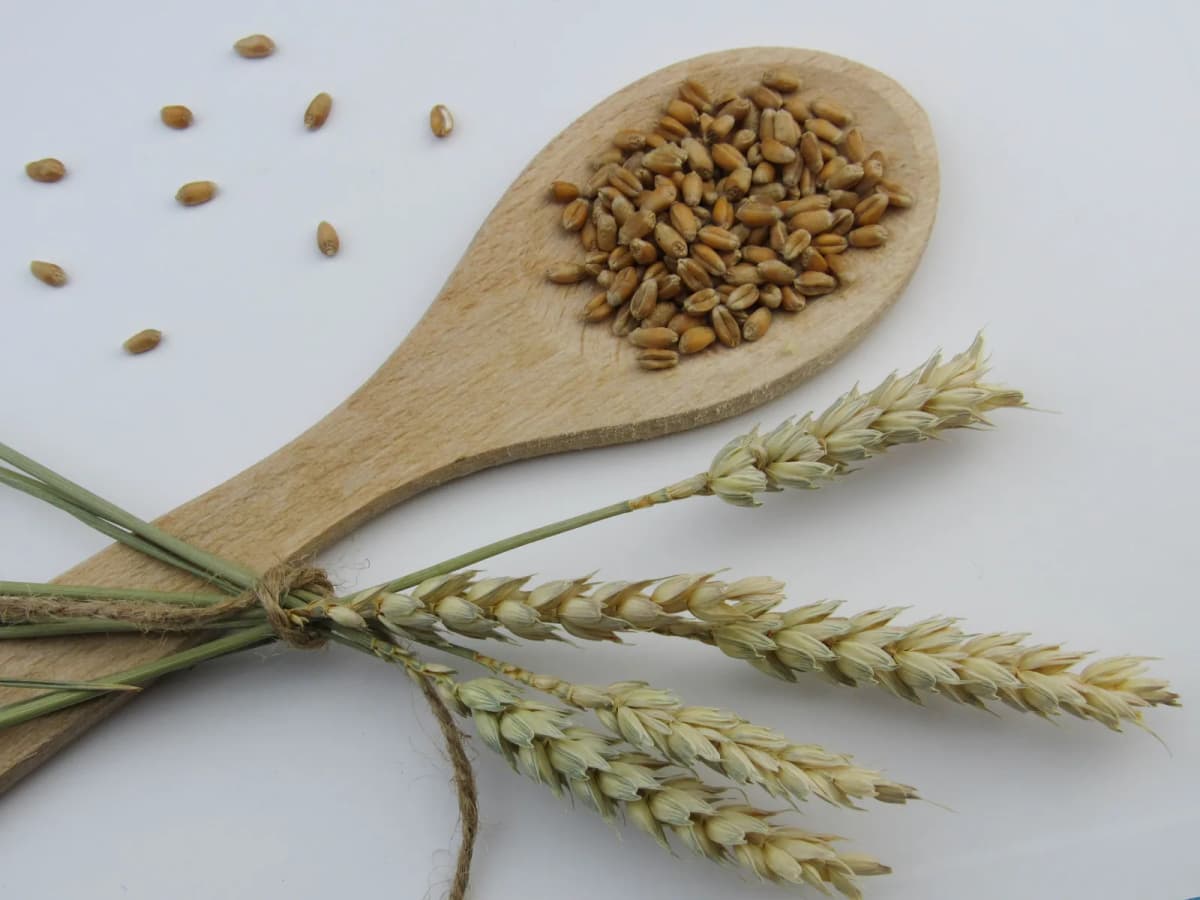
Photo: Karyna Panchenko on Pexels.
Ingredients
- 200 g whole wheat berries (in Poland sold as pszenica na kutię, "wheat for kutia")
- 150 g blue poppy seeds
- 4 to 5 tablespoons runny honey
- 70 g walnuts, roughly chopped
- 50 g raisins
- 50 g mixed dried fruit or candied orange peel, chopped
- A few almonds, a pinch of vanilla (optional)
Method
- Soak the wheat. Rinse the wheat berries and soak them overnight in plenty of cold water.
- Cook the wheat. Drain, cover with fresh water and simmer gently until the grains are tender but still chewy, usually one to two hours depending on the wheat. Drain and cool completely.
While the wheat cools, turn to the poppy seed and the fruit.
-
Prepare the poppy seed. Pour boiling water over the poppy seeds, leave for an hour or more, then drain well through a fine sieve or cloth.
-
Grind the poppy seed. Grind it two or three times in a food processor, spice grinder or a traditional makutra until it turns pale and creamy. Finally, bring everything together:
-
Soak the fruit. Cover the raisins and dried fruit with hot water for ten minutes, then drain.
-
Mix. Warm the honey with a tablespoon or two of hot water so it pours easily. Combine the wheat, poppy seed, fruit and nuts, then stir in the honey.
-
Rest. Chill for a few hours or overnight so the flavours come together. Taste and add more honey if needed.
Tips for Getting Kutia Right
Do not rush the wheat. Undercooked berries are the most common problem. Bite a few grains before draining: they should be soft all the way through, with just a little chew. If your wheat is old or very hard, it may need longer than you expect.
Grind the poppy seed properly. Whole poppy seeds stay gritty and taste dusty. Grinding them after scalding releases the oil and turns them creamy, which is what gives a good bowl its colour and smooth texture. A coffee or spice grinder works well in small batches.
Season at the end. Honey varies a lot in strength. Add most of it, let the mixture rest for an hour, then taste again. Cold dishes taste less sweet than warm ones, so check after chilling too.
Make it ahead. This is a perfect dish to prepare on 23 December, leaving the oven and stove free for fish, pierogi and soup on Christmas Eve itself.
Serve small portions. It is filling and rich, and on a twelve-dish table, two or three spoonfuls per person are plenty. Serve it in one big bowl in the middle of the table, or in small glass dishes so the layers of grain and poppy seed show.
Shortcuts and Variations
If you are short on time, use pęczak (PEN-chak), pearled wheat, which cooks in about half an hour, or a jar of ready-made poppy seed filling, masa makowa (MAH-sah mah-KOH-vah). The result is sweeter and less traditional, but still good.
Some Polish families add a splash of cream or a spoon of sour cream for a richer, looser result. Others keep it strictly Lenten, like the Ukrainian version, and use only grain, poppy, honey, fruit and nuts. Both are authentic in their own homes.
For a drink, the natural partner is kompot, the Polish fruit drink, especially the smoky kompot z suszu made from dried fruit, which appears on many of the same Christmas Eve tables.
Kutia Vocabulary for the Kitchen
If you are shopping for ingredients in Poland, or cooking with a Polish grandmother, these words will help:
| Polish | Pronunciation | English |
|---|---|---|
| kutia | KOO-tyah | kutia |
| pszenica na kutię | psheh-NEE-tsah nah KOO-tyeh | wheat for kutia |
| mak niebieski | mahk nyeh-BYES-kee | blue poppy seed |
| sparzyć mak | SPAH-zhich mahk | to scald the poppy seed |
| zmielić | ZMYEH-leech | to grind |
| miód | myoot | honey |
| orzechy włoskie | o-ZHEH-khih VWOS-kyeh | walnuts |
| Smacznego! | smahch-NEH-go | Enjoy your meal! |
Notice that kutia changes to kutię after "na": that is the accusative case at work. You will see the same change on food labels and in recipes everywhere.
Food, Drinks and OrderingFrequently Asked Questions
Is kutia Polish or Ukrainian? Both, and more. It is a shared dish of the region, eaten in Ukraine, Belarus, Lithuania and eastern Poland. Ukrainians, Belarusians and Lithuanians have their own names, recipes and customs, and in Poland it is mainly associated with the east and with families from the former borderlands.
What does kutia taste like? Mildly sweet, nutty and chewy, with the slightly earthy flavour of poppy seed and the floral sweetness of honey. It is served cold or at room temperature.
When is kutia eaten? Mainly on Christmas Eve. In some families it returns on New Year's Eve, and in parts of Eastern Europe it is also served at funerals and memorial days.
Can I make kutia with something other than wheat? Yes. Pearled wheat is the easiest substitute. Rice, pearl barley and other grains are used in some regions and families, especially in Belarus.
How long does kutia keep? Covered in the fridge, it keeps for about three days. Many cooks think it tastes better on the second day, once the honey has soaked in.
Kutia is one of those dishes that tells you where a family comes from. If someone in your Polish family makes it, ask where the recipe started: the answer often leads east, to a town now across the border and a story worth hearing. For more about the dishes that fill Polish holiday tables, our guide to Polish food culture is a good place to keep exploring.
Featured photo: Віщун, CC BY-SA 4.0, via Wikimedia Commons (kutia in a traditional Ukrainian bowl, 2023).