The Polish hussars were the heavy cavalry of the Polish-Lithuanian Commonwealth, and for about a century and a half they were among the most feared horsemen in Europe. In Polish they are called husaria (hoo-SAR-yah), and a single hussar is a husarz (HOO-sash). Most people know them for one striking detail: the tall feathered wings that rose behind some riders, which is why English speakers often call them the winged hussars.
The wings are where the legend starts, but they are also where it gets muddled. Online you will read that the wings whistled in the wind to terrify enemy horses, that they stopped Tatar lassos, or that they were only worn on parade. Historians still argue about it. This guide sets out what the sources actually say about Polish hussar wings, the armour and weapons, and the three battles that made the Polish hussars famous: Kircholm in 1605, Klushino in 1610 and Vienna in 1683.
Along the way you will pick up the Polish words for lance, sabre and wings, and you will find out why a Swedish heavy metal band wrote a song about a 17th-century cavalry charge. If you have ever watched a reenactment and wondered what the fuss is about, this is the place to start.
Who Were the Polish Hussars?
The Polish hussars did not start out heavy, and they did not start out Polish. The first hussars in Poland were light horsemen of Serbian origin who came via Hungary around 1500. According to the Wikipedia overview of the Polish hussars, the name itself comes from a Serbian word, gusar, meaning roughly "wanderer" or "brawler".
Over the 16th century the formation changed. Under King Stefan Batory, who reigned from 1576 to 1586, the Polish hussars became a heavy shock cavalry recruited from the nobility (szlachta, SHLAKH-tah), armed with long lances and partial plate armour. Their golden age began with the Battle of Lubiszew in 1577 and lasted until the end of the 17th century.
How a hussar unit worked
The basic unit was the chorągiew (ho-RON-gyef), a "banner" or company. Inside it, a nobleman called a towarzysz (toh-VAH-zhish, "companion") served with his own small retinue of armed retainers, the pocztowi (poch-TOH-vee), whom he equipped and paid himself. That made service in the Polish hussars extremely expensive, which is part of why the formation carried such prestige.
| Polish term | Pronunciation | Meaning |
|---|---|---|
| husaria | hoo-SAR-yah | the hussar cavalry as a whole |
| husarz | HOO-sash | one hussar |
| towarzysz | toh-VAH-zhish | a noble "companion", the full member of a unit |
| pocztowy | poch-TOH-vih | a retainer serving under a towarzysz |
| chorągiew | ho-RON-gyef | a banner, the basic company |
| rotmistrz | ROT-meestsh | the captain of a banner |
Polish Hussar Wings: Why Did They Wear Them?
Ask "why did the Polish hussars wear wings?" and you will get a confident answer from almost every website. The honest answer is that nobody knows for certain, and the reasons may have changed over time. Here are the main theories, with the strengths and weaknesses of each.
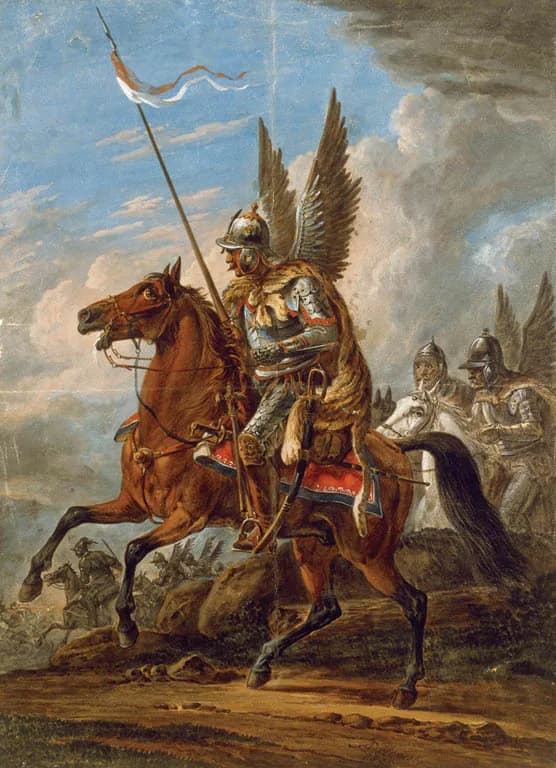
Painting: Aleksander Orłowski, 1810s, public domain, via Wikimedia Commons.
Theory 1: noise to frighten horses
This is the most popular explanation: feathers rattling in the wind made a whistling or rustling noise that panicked enemy horses. It is a great story, but sceptics have a strong point. In a full charge, with hundreds of horses' hooves, armour and battle cries, a few feathers would be hard to hear at all. Most writers who still support the "frightening" idea now focus on what the wings looked like, not how they sounded.
Theory 2: protection against lassos
Tatar horsemen, a frequent enemy on the Commonwealth's southern frontier, used lassos to pull riders out of the saddle. A tall frame of wood and feathers behind the rider could make that harder. This explanation appears in many sources, and it fits the frontier where the Polish hussars spent much of their time.
Theory 3: protection from sabre cuts
A related idea is that the wooden frame gave some protection to the back and neck against a slashing blow from behind. Richard Brzezinski, author of a well-known Osprey study of the Polish winged hussar, lists this alongside the lasso theory and the idea that wings worked like a kind of campaign medal.
Theory 4: looking magnificent
The simplest explanation may be the strongest. Polish nobles loved display, and wings, feathers and animal skins made a rider look bigger, wealthier and more frightening. Contemporary writers describe the visual shock of a winged charge, and the 18th-century writer Jędrzej Kitowicz called the wings a strangely beautiful sight.
Were the wings worn in battle?
This is the real debate. Brzezinski writes that wings were taken on campaign but that it is "far from certain" they were worn in battle. Polish historians point out that early wings were often fixed to the saddle rather than the back, that not every hussar wore them, and that many museum armours had wings added in the 19th century. The famous image of a rider with two tall wings on his back owes a lot to 19th-century painters such as Józef Brandt and Juliusz Kossak.
So the fair summary is this: the Polish hussars did use wings, the style and placement changed over time, and the most likely purpose was visual and psychological. Anyone who tells you the single "true" reason is selling a neater story than the evidence allows.
Polish Hussar Armor and Weapons
Polish hussar armor was lighter than the full plate of a medieval knight. A typical outfit for a towarzysz in the late 16th and early 17th century included a breastplate and backplate, a gorget for the throat, arm defences and a helmet. The total weighed around 15 kg, according to common estimates, so riders could still move quickly.
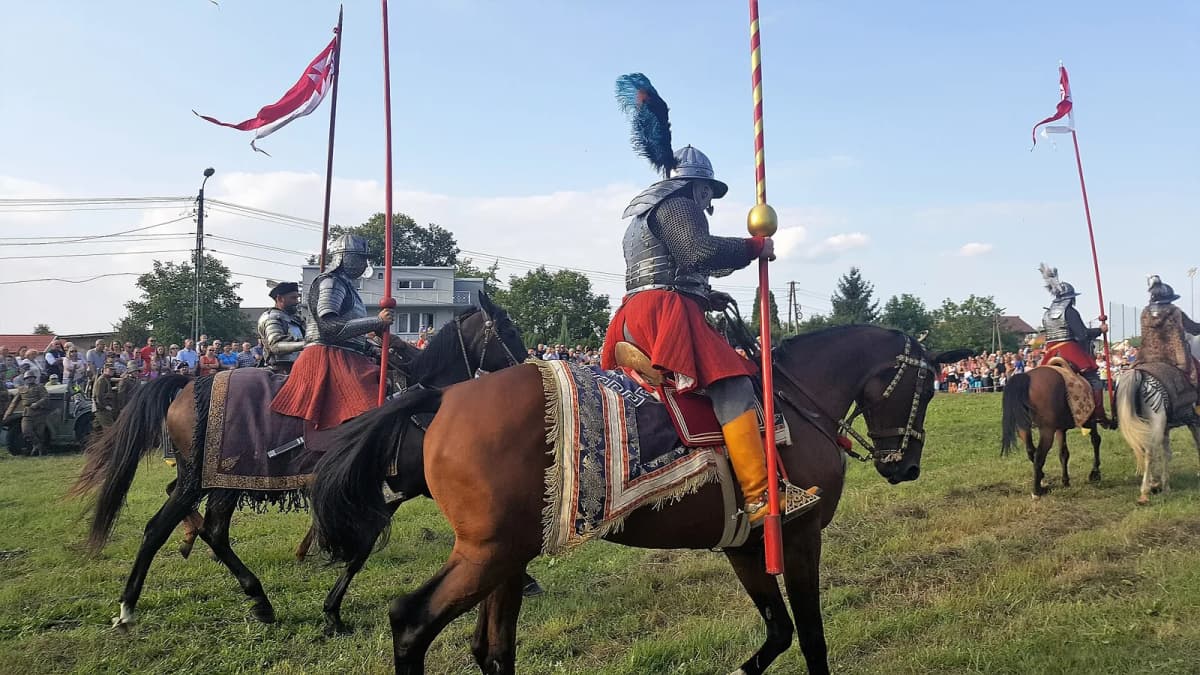
Photo: DentArt, CC BY-SA 4.0, via Wikimedia Commons.
The helmet and the skins
The classic hussar helmet is the szyszak (SHI-shak), with a neck guard of overlapping plates and a nose bar. Officers in the time of King Jan III Sobieski sometimes wore karacena (kah-rah-TSEH-nah), a showy scale armour. Over the shoulder, a wealthy towarzysz often draped a leopard skin, while wolf, bear and lynx pelts also appear.
The lance
The hussar's main weapon was the kopia (KOP-yah), a lance usually given as 4.5 to 6.2 metres long. It was hollow and made of light wood, so it was long enough to reach enemy pikemen before their pikes reached the horse, yet light enough to handle. It often broke on impact, and spare lances were brought along on wagons. A long pennant, the proporzec (pro-POH-zhets), fluttered below the tip.
Swords and firearms
Each rider carried more than one blade:
- koncerz (KON-tsesh): a long, stiff stabbing sword, up to about 1.5 m, used after the lance broke
- pałasz (PAH-wash): a heavy straight broadsword
- szabla (SHAH-blah): the curved sabre, worn on the left side
- pistols in saddle holsters, and later a carbine for the retainers
The Polish hussar sabre
The szabla husarska (SHAH-blah hoo-SAR-skah), the Polish hussar sabre, appeared around 1630. It had an almost fully closed hilt to protect the hand and a small thumb ring that gave the rider more control for powerful cuts from the saddle. Blades averaged about 85 cm. It became one of the most admired Polish weapons and stayed in use, in various forms, well into the 19th century.
The Battle of Kircholm, 1605
Kircholm is the battle that best shows what the Polish hussars could do. It was fought on 27 September 1605 near Kircholm, today Salaspils in Latvia, about 18 km from Riga, during the Polish-Swedish war. King Charles IX of Sweden was besieging Riga, and the Lithuanian commander Jan Karol Chodkiewicz came to relieve it.
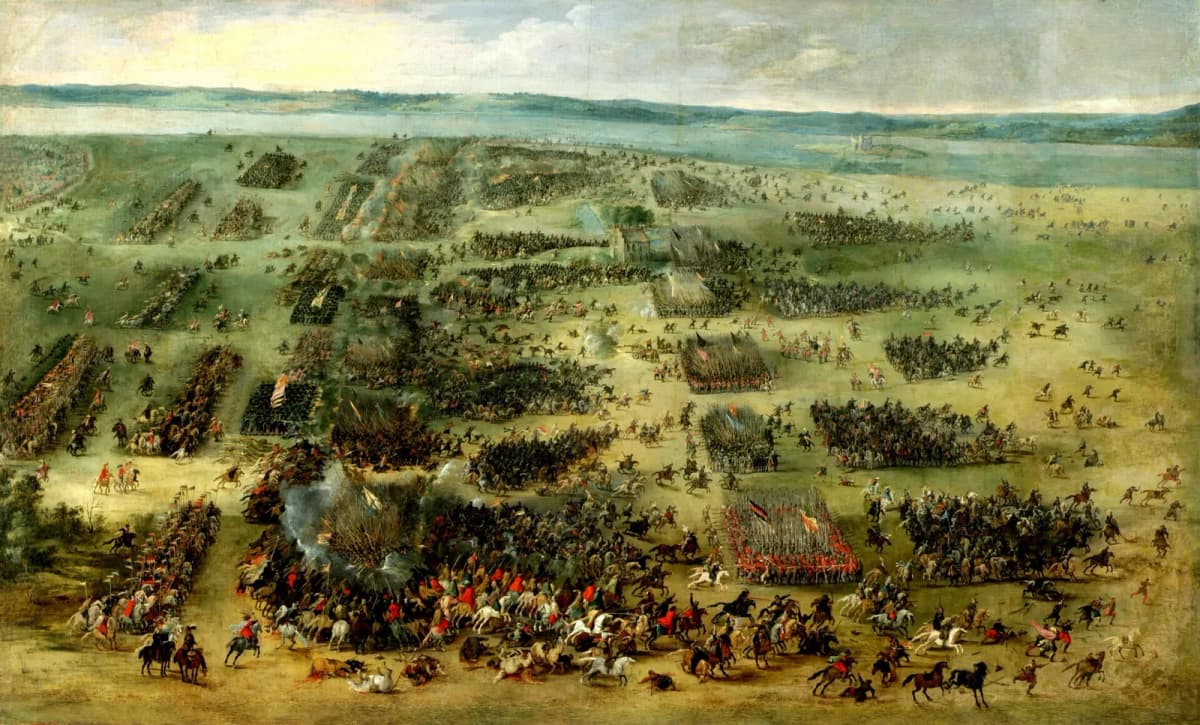
Painting: Pieter Snayers, 1620s, public domain, via Wikimedia Commons.
The numbers look impossible. The Swedish army had about 10,868 men and 11 guns. Chodkiewicz had about 3,600 men, roughly 2,600 of them cavalry, and 5 guns. After hours of manoeuvring, Chodkiewicz lured the Swedes off their strong position, and the Polish hussars struck the flanks. Within about half an hour the Swedish cavalry broke and the infantry was exposed.
Swedish losses are usually given at several thousand killed, with estimates up to around 8,000 killed, captured or scattered. The Commonwealth lost roughly 100 dead and 200 wounded. Kircholm became the textbook example of a hussar charge, and the Flemish painter Pieter Snayers recorded it on canvas within a few decades.
The Battle of Klushino, 1610
Five years later came an even bigger upset. On 4 July 1610, at Klushino (Polish Kłuszyn, KWOO-shin) near Smolensk, Hetman Stanisław Żółkiewski faced a Russian army under Prince Dmitry Shuisky, supported by mercenaries under the Swedish general Jacob De la Gardie.
Żółkiewski had about 6,500 to 6,800 men, of whom around 5,500 were hussars. The opposing army was several times larger; estimates vary a lot, with figures of up to about 30,000 Russians plus some 5,000 mercenaries. The Polish hussars charged repeatedly, regrouping between attacks, until the Russian and mercenary forces collapsed.
The results were dramatic. Żółkiewski went on to enter Moscow, and the boyars there offered the Russian throne to the Polish prince Władysław Vasa. Casualty figures for Klushino are much disputed, so be careful with any single number you see online.
The Charge at Vienna, 1683
The most famous moment for the Polish hussars came on 12 September 1683, outside Vienna. The Ottoman army under Grand Vizier Kara Mustafa had been besieging the city for two months. A relief army of Polish, Imperial and German troops arrived, under the overall command of the Polish king Jan III Sobieski (yan TSHEH-chee so-BYES-kee).
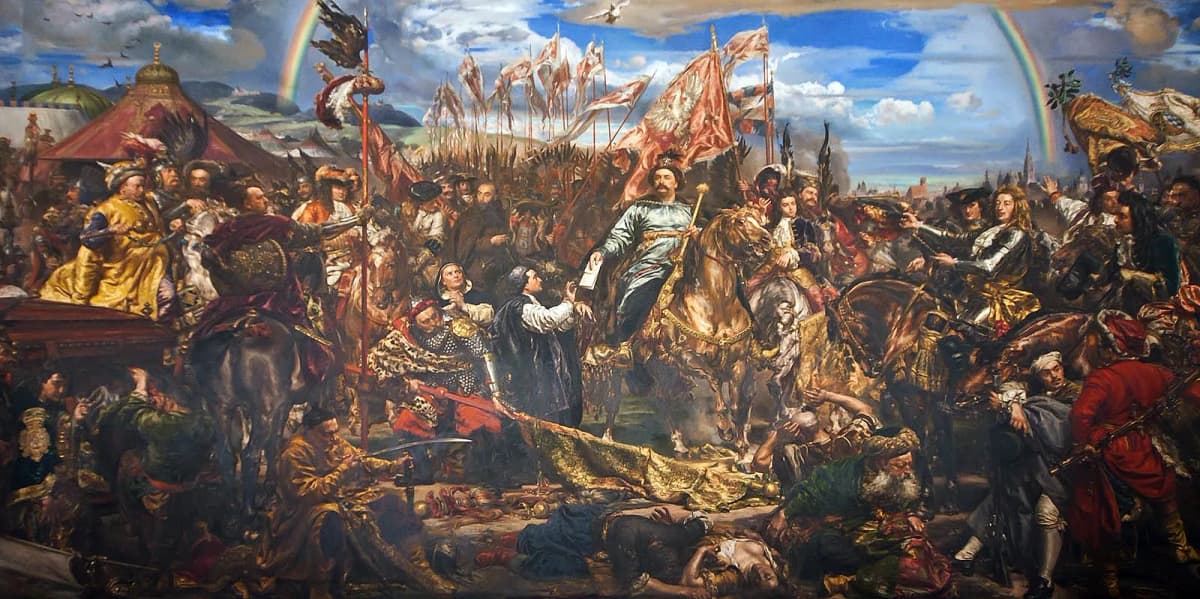
Painting: Jan Matejko, 1883, public domain, via Wikimedia Commons.
The battle ran all day. Late in the afternoon, around 6 pm, Sobieski launched a cavalry attack in four groups, three Polish and one Imperial. About 18,000 horsemen rode down from the hills, with around 3,000 Polish hussars at the front. It is often called the largest cavalry charge in history. The Ottoman lines broke, the camp was overrun, and the siege was over.
The Battle of Vienna is the reason the winged hussars are known far beyond Poland. Sobieski is traditionally quoted as saying Venimus, vidimus, Deus vicit, "We came, we saw, God conquered". In Polish the event is called odsiecz wiedeńska (OT-shech vyeh-DEN-skah), "the relief of Vienna", and every Polish schoolchild learns it.
| Battle | Date | Commonwealth force | Opponent | Result |
|---|---|---|---|---|
| Kircholm | 27 Sep 1605 | about 3,600 | about 10,868 Swedes | decisive victory |
| Klushino | 4 Jul 1610 | about 6,500 to 6,800 | several times larger Russian and mercenary army | decisive victory |
| Vienna | 12 Sep 1683 | part of a relief army of 70,000 to 80,000 | Ottoman army besieging Vienna | siege lifted |
The End of the Winged Hussars
The very things that made Polish hussars so effective also made them hard to sustain. Horses and equipment were extremely expensive, and the long wars of the 17th century drained the Commonwealth. As infantry firearms improved, a charge with lances became riskier and less useful.
The last major battle the Polish hussars fought was at Kliszów in 1702. After that they became mainly a ceremonial formation, and in 1776 the Sejm disbanded them, passing their role to the lancers known as ułani (oo-WAH-nee). Within twenty years the Commonwealth itself had been partitioned out of existence. Our article on how Polish survived 123 years without a country picks up the story from there.
Winged Hussars in Pop Culture
For many people outside Poland, the first contact with the Polish hussars is not a history book but a song. The Swedish power metal band Sabaton released "Winged Hussars" on their album The Last Stand on 19 August 2016. The song tells the story of the Polish hussars at the Battle of Vienna, and it has become a staple of their concerts. There is a certain irony in a Swedish band celebrating the cavalry that crushed a Swedish army at Kircholm, which fans love to point out.
Hussars also turn up in Polish painting, film and fantasy. Józef Brandt's 19th-century battle scenes shaped how people imagine them, and you can see echoes of Polish history and folklore in the world of The Witcher, as our article on the Polish origins of The Witcher explains. Today, reenactment groups across Poland ride in full hussar kit at historical festivals and military parades, often with white-and-red pennants that echo the Polish flag.
Hussars in the Polish anthem's world
Polish patriotic culture from the 18th and 19th centuries looked back on the hussar era as a time of military glory. The national anthem mentions another 17th-century commander, Stefan Czarniecki, and the same longing for past victories runs through it. Our guide to the Polish national anthem explains the historical names in its verses.
Useful Polish Words for Hussar Fans
If you visit the Polish Army Museum in Warsaw or a reenactment, these words will help you follow along.
| Polish | Pronunciation | English |
|---|---|---|
| skrzydła | SKSHID-wah | wings |
| skrzydło | SKSHID-woh | a wing |
| pióra | PYOO-rah | feathers |
| kopia | KOP-yah | lance |
| szabla | SHAH-blah | sabre |
| zbroja | ZBROY-ah | armour |
| koń | koyn | horse |
| szarża | SHAR-zhah | charge (of cavalry) |
| bitwa | BEET-vah | battle |
| zwycięstwo | zvih-CHENS-tvoh | victory |
A phrase you might hear: Husaria ruszyła do szarży (hoo-SAR-yah roo-SHIH-wah do SHAR-zhih), "The hussars set off on the charge." Notice how szarża changes to szarży after do: that is the genitive case at work. If you want to understand why Polish nouns change like this, the genitive lesson is a good next step.
The Genitive CaseFamous Commanders of the Polish Hussars
A few names come up again and again in the story of the Polish hussars, and you will see them on Polish street signs, monuments and banknotes:
- Jan Karol Chodkiewicz (yan KAH-rol hod-KYEH-veech): victor of Kircholm in 1605.
- Stanisław Żółkiewski (stah-NEE-swaf zhoow-KYEF-skee): victor of Klushino in 1610.
- Jan III Sobieski: king of Poland from 1674 and commander at Vienna in 1683.
Sobieski in particular is a national hero, and he appears in many lists of famous Polish people. His palace at Wilanów in Warsaw is one of the best places to get a feel for the world the Polish hussars came from.
Frequently Asked Questions
Why did Polish hussars have wings? Historians don't agree. The main theories are psychological effect and display, protection against Tatar lassos, protection from sabre cuts, and noise to scare horses. The noise theory is the weakest; display and intimidation are the most widely accepted.
Did the winged hussars wear the wings in battle? Some did, at least in some periods, but not every hussar wore them and their placement changed over time. Early wings were often fixed to the saddle. Many tall twin wings in museums were added later.
How long was a hussar lance? Usually 4.5 to 6.2 metres. It was hollow and light, designed to reach enemy pikemen first and often to break on impact.
What was the biggest victory of the Polish hussars? Kircholm (1605) and Klushino (1610) were the most lopsided, but Vienna (1683) is the most famous, with around 3,000 Polish hussars leading a charge of about 18,000 cavalry.
When were the Polish hussars disbanded? In 1776, by decision of the Sejm. Their last major battle was Kliszów in 1702.
What song is "Winged Hussars"? A song by the Swedish band Sabaton from the album The Last Stand (2016), about the Polish hussars at the Battle of Vienna.
The Polish hussars only rode for about two centuries, but they still shape how Poles see their own history. Learn the word husaria, picture a forest of lances with white-and-red pennants, and you have one of the most vivid images in Polish culture.
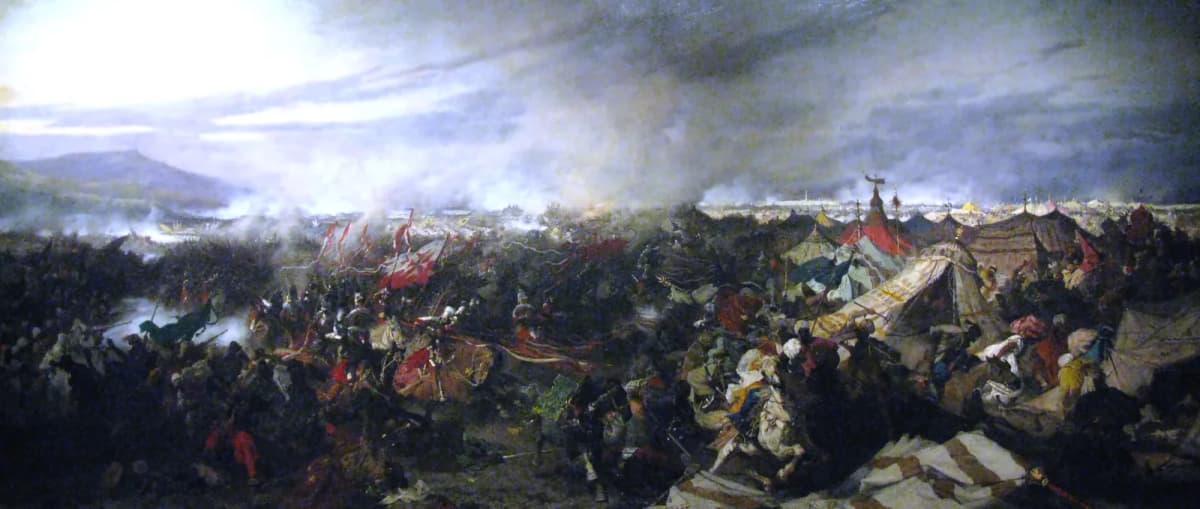
Featured image: Józef Brandt, The Battle of Vienna (1863), public domain, via Wikimedia Commons.