Polish Christmas traditions do not fit into one day. They start with candlelit church services at the beginning of Advent, build to a meatless supper on 24 December, and only really wind down after the Feast of the Three Kings on 6 January, with some families keeping the tree up until early February. If you have Polish roots, a Polish partner, or a trip planned for December, knowing the shape of the whole season makes everything else make sense.
This guide walks through Polish Christmas traditions in the order they happen, from Advent to Epiphany. Along the way you will pick up the Polish words people actually use, from Wigilia (vee-GEE-lyah) to kolęda (ko-LEN-dah), with simple pronunciation hints so you can say them out loud.
One quick note: Christmas Eve gets its own detailed guide on PolishPal, so here we give you the essentials and point you there for the full twelve-dish story.
Polish Christmas Traditions at a Glance
Christmas in Poland is called Boże Narodzenie (BOH-zheh nah-ro-DZEH-nyeh), literally "God's Birth", but in everyday speech most people simply say Święta (SHFYEN-tah), "the holidays". Ask a Polish friend about their plans and you will hear "Gdzie spędzasz Święta?" (gjeh SPEN-dzash SHFYEN-tah), "Where are you spending the holidays?"
Polish Christmas traditions follow a clear rhythm. Advent is quiet and expectant. Christmas Eve is the emotional peak. Christmas Day and the day after are for rest and family visits. Then the carolling season runs on into January. Here is the outline:
| Date | Polish name | What happens |
|---|---|---|
| Four Sundays before Christmas | Adwent | Advent: roraty masses, Advent wreaths, preparation |
| 6 December | Mikołajki | St. Nicholas Day: small gifts for children |
| 24 December | Wigilia | Christmas Eve supper, opłatek, presents |
| Night of 24/25 December | Pasterka | Midnight Mass |
| 25 December | Boże Narodzenie | Christmas Day, quiet family day |
| 26 December | Drugi dzień świąt | Second Day of Christmas, visiting relatives |
| 6 January | Trzech Króli | Epiphany: chalk on doors, Three Kings parades |
| 2 February | Matki Boskiej Gromnicznej | Candlemas, the traditional end of the season |
In 2026, Christmas Day falls on a Friday, so Advent begins on Sunday 29 November.
Advent and Roraty: The Season Starts in the Dark
Many Polish Christmas traditions begin in church long before anyone thinks about presents. Adwent (AD-vent) is the four weeks of preparation before Christmas, and its most distinctive custom is roraty (ro-RAH-tih), special masses in honour of the Virgin Mary held on weekdays throughout Advent.
According to the Polish Wikipedia entry on roraty, these masses were traditionally said before sunrise, though many parishes now hold them in the evening so children can come. Kids walk in procession carrying lampiony (lam-PYO-nih), handmade lanterns, into a church with the lights switched off, so the only glow comes from the lanterns and a special candle, the roratka, which stands by the altar only during Advent. The name comes from the Latin opening words "Rorate caeli", "drop down dew, you heavens".

Photo: David Bartus on Pexels.
At home, Advent is a time of baking, cleaning and making decorations, the quieter Polish Christmas traditions that happen out of sight. Many families also have a wieniec adwentowy (VYEH-nyets ad-ven-TOH-vih), an Advent wreath, and light one more candle each Sunday.
Late November also brings a fun warm-up: on the eve of St. Andrew's Day, young people play fortune-telling games, pouring hot wax into water to read their future. Andrzejki is not a church feast, but it belongs to the same run of Polish Christmas traditions in spirit: it is the last big party before the quieter weeks of Advent.
Mikołajki: St. Nicholas Day on 6 December
On 6 December Polish children wake up hoping to find small presents under their pillow or in a shoe left out the night before. Mikołajki (mee-ko-WAI-kee) celebrates St. Nicholas, Święty Mikołaj (SHFYEN-tih mee-KO-wigh), and in many homes it is the unofficial start of the festive season.
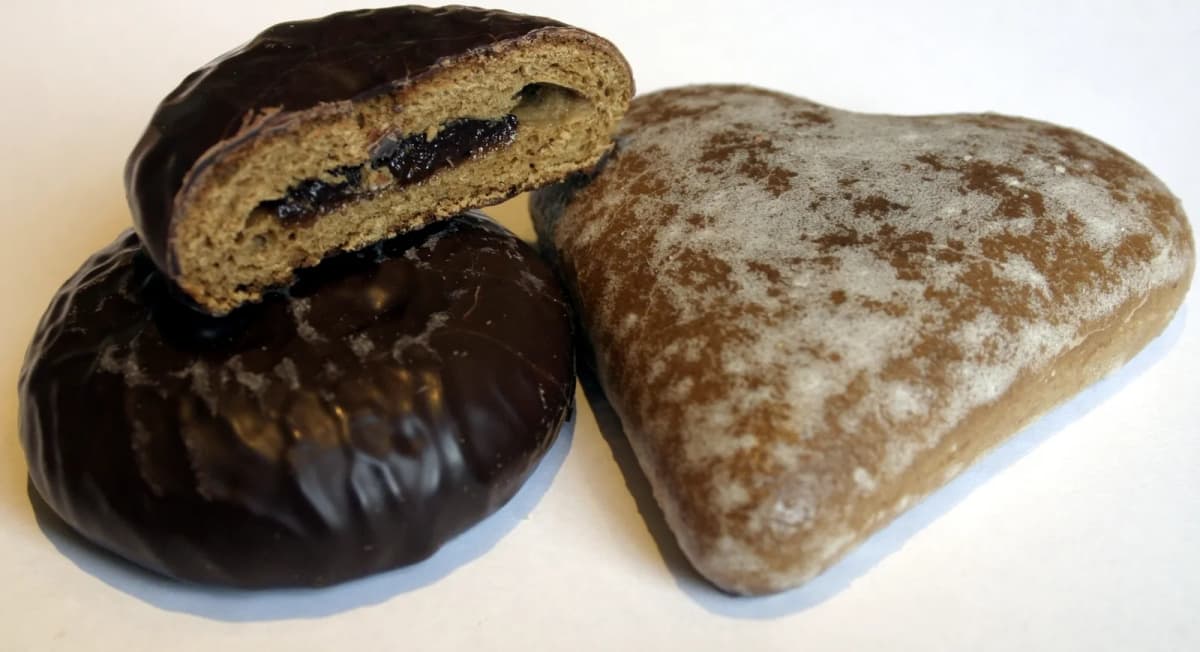
The gifts are usually modest: sweets, a book, a small toy, perhaps a piernik (PYER-neek), gingerbread. Children who misbehaved traditionally get a rózga (ROOZ-gah), a bundle of twigs, as a warning, though these days it is more of a joke. Schools and offices often swap small presents on the same day.
Who Brings the Presents on Christmas Eve?
This is where Polish Christmas customs get regional, and where Polish Christmas traditions differ most from town to town. In much of the country the presents under the tree on 24 December come from Święty Mikołaj. In Wielkopolska around Poznań, Kashubia, Kujawy and parts of the north, though, the gift bringer is traditionally the Gwiazdor (GVYAHZ-dor), a bearded figure in a fur coat whose name comes from gwiazda, "star". Elsewhere, children are told that presents come with the Gwiazdka (GVYAHZD-kah), "the little star", which is also a common word for Christmas Eve itself.
Wigilia: Christmas Eve in Poland
If you remember only one thing about Polish Christmas traditions, remember that the big night is the 24th, not the 25th. Christmas Eve in Poland, Wigilia, is the most important evening of the year for many families, and since 2025 it has also been a statutory day off work, so people have the whole day to cook and travel home.

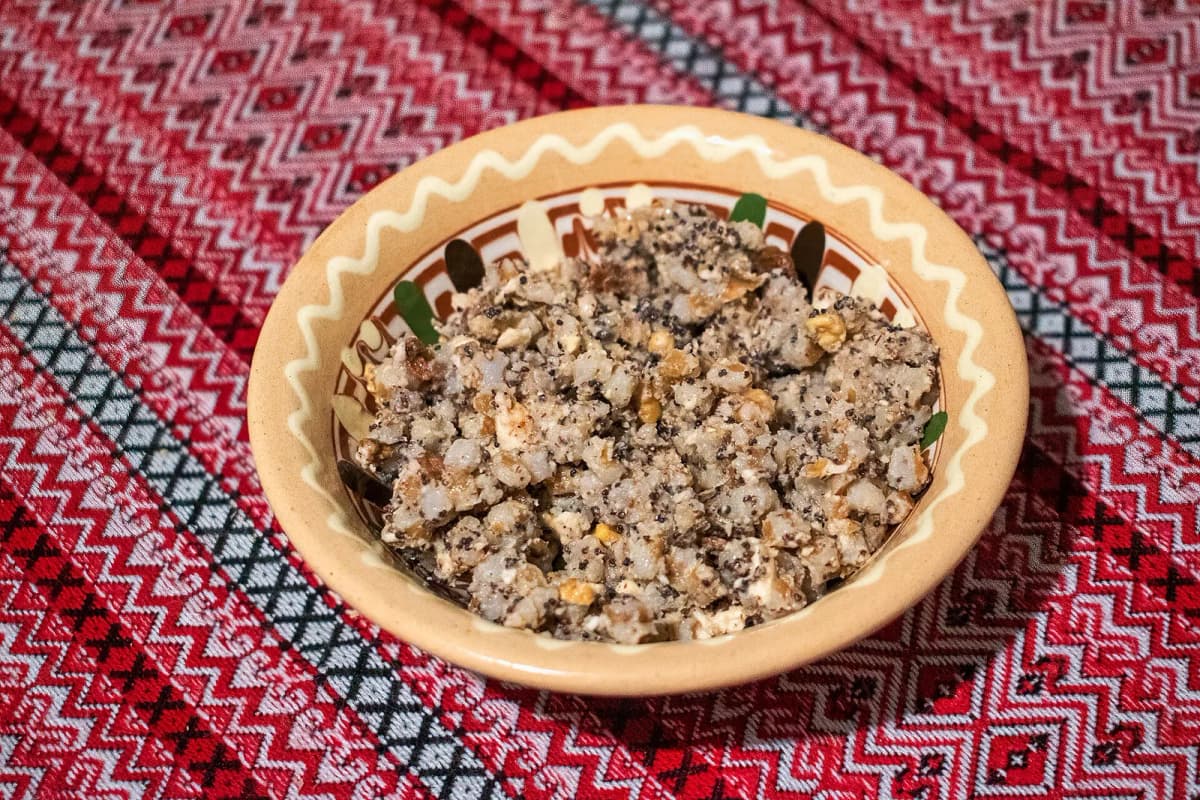
Photo: Diabetes, public domain, via Wikimedia Commons.
The essentials, in the order they happen:
- Pierwsza gwiazdka (PYERV-shah GVYAHZD-kah): children watch the sky, and supper starts when the first star appears, in memory of the Star of Bethlehem.
- Opłatek (oh-PWAH-tek): before eating, everyone breaks and shares a thin wafer, exchanging personal wishes for the year ahead.
- Sianko (SHAN-ko): a little hay under the white tablecloth recalls the manger.
- Wolne miejsce (VOL-neh MYAYS-tseh): an extra place is set for an unexpected guest or a remembered relative.
- Twelve meatless dishes: barszcz with tiny dumplings, carp, herring, pierogi, poppy seed cake and dried fruit compote are the classics.
Presents are opened after supper, often while singing carols around the choinka (ho-EEN-kah), the Christmas tree. For the full menu, the symbolism of the number twelve and regional differences, read our complete guide to Wigilia, the Polish Christmas Eve supper.
Pasterka: Midnight Mass
Late on Christmas Eve many families wrap up warmly and walk to church for Pasterka (pas-TER-kah), the Midnight Mass. The name comes from pasterz, "shepherd", because the mass recalls the shepherds who came to the manger. Churches are packed, and it is often the first time that season people sing carols together in public.
Even for Poles who rarely go to church, Pasterka is one of the Polish Christmas traditions they keep as a family habit. If you are a guest, going along is a lovely way to experience Polish Christmas traditions from the inside, and nobody will expect you to know the words. You will hear the carols again and again until early February, so they become familiar fast.
Carols and Carollers: Musical Polish Christmas Traditions
Polish carols, kolędy (ko-LEN-dih), are among the richest Polish Christmas traditions, and families sing them at home rather than just hearing them in shops. The best known is "Bóg się rodzi" (book sheh RO-jee), "God Is Born", written by the poet Franciszek Karpiński in 1792. Others every Polish child knows include "Wśród nocnej ciszy" ("In the Silence of the Night") and the lullaby carol "Lulajże, Jezuniu".
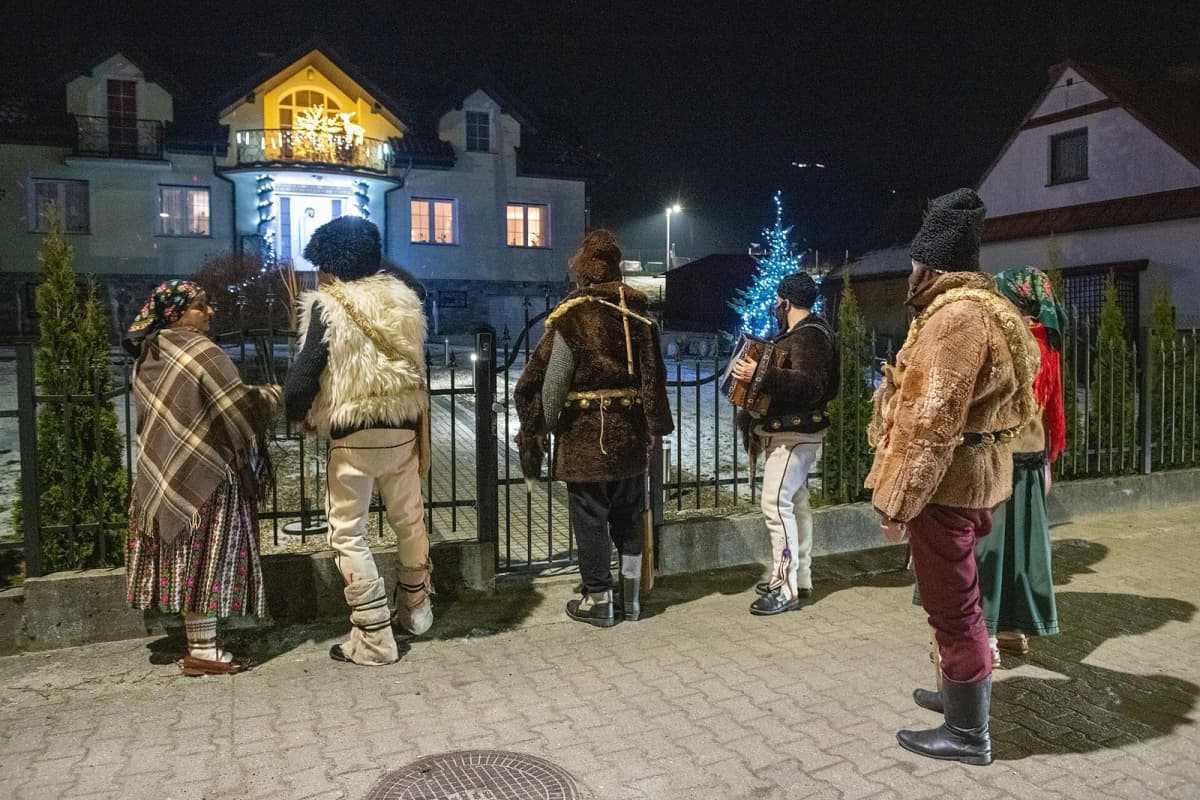
The word kolęda also means a visit. Kolędnicy (ko-len-DNEE-tsih) are carollers who go from house to house between Christmas and Epiphany, singing in exchange for treats or small donations. In villages, especially in the mountains, groups dress up as characters: a star bearer, an angel, a devil, Death, King Herod, and the turoń (TOO-roñ), a shaggy horned beast that snaps its jaws and chases people for laughs.

Photo: Robert Garstka / Regionalny Instytut Kultury w Katowicach, CC BY 4.0, via Wikimedia Commons.
Some of these masked figures, and the Polish Christmas traditions around them, come from a much older layer of village belief, the same world of spirits and creatures described in our guide to Polish folklore creatures. Children also perform jasełka (yah-SEW-kah), nativity plays, at school and in parish halls.
The Kraków Nativity Scenes
Kraków adds its own twist with the szopka krakowska, a glittering nativity scene built to look like the city's churches and towers. Every December, makers bring them to the Main Market Square for a competition, and the tradition is now on UNESCO's intangible heritage list. Read the full story in our guide to the Kraków nativity scene.
The Christmas Tree and the Older Podłaźniczka
The choinka is now in nearly every Polish home. Traditionally it was decorated just before Wigilia, though many families now put it up earlier in December. Many Polish families still hang glass baubles, bombki (BOMB-kee), alongside homemade straw and paper ornaments, and some leave the tree up until 2 February.
Before the Christmas tree became common, one of the Polish Christmas traditions in southern homes was the podłaźniczka (pod-wah-ZHNEECH-kah): the top of a fir or spruce hung upside down from the ceiling beam, often above the Christmas Eve table, and decorated with apples, nuts, sweets, tissue paper and straw ornaments. It was meant to bring prosperity to the household and was most common in Podhale and the Beskid mountains.

Painting: Włodzimierz Tetmajer, "Podłaźniczka" (1900), public domain, via Wikimedia Commons.
If you want to see glittering decorations in bulk, the Polish Christmas markets in Kraków, Wrocław and Gdańsk sell handmade bombki, straw stars and gingerbread from late November onwards.
Christmas Day and the Second Day of Christmas
After the intensity of Wigilia, 25 December is calm, and the Polish Christmas traditions of the day are mostly about rest. Christmas Day is for sleeping in, going to church, eating leftovers and seeing close family. Shops are closed. Hearty dishes come back now that the meat-free rule of Christmas Eve is over, and bigos, the slow-cooked hunter's stew, is a favourite because it can be reheated without effort. Our guide to bigos and how Poles cook it explains why it tastes better on the third day.
The 26th, drugi dzień świąt (DROO-gee jen SHFYONT), the Second Day of Christmas, is also a public holiday. It is St. Stephen's Day, and it is traditionally the day for visiting the wider family, so expect another long lunch.
Trzech Króli: Epiphany and Chalk on the Door
The last of the big Polish Christmas traditions falls in the new year. On 6 January, Trzech Króli (tshekh KROO-lee), the Feast of the Three Kings, families take blessed chalk home from church and write the year and the letters K+M+B (or C+M+B) above the front door. The letters are read as the names of the kings, Kacper, Melchior and Baltazar, or as the Latin "Christus mansionem benedicat", "May Christ bless this house".
Epiphany became a public holiday again in 2011, for the first time since 1960, and many towns now hold colourful Orszak Trzech Króli (OR-shak tshekh KROO-lee) parades, with children in paper crowns walking behind the three kings. Warsaw's 2010 parade drew around 10,000 people, and the idea has spread across the country since then.
Even after Epiphany, some homes keep the tree and the nativity scene up until Matki Boskiej Gromnicznej, Candlemas on 2 February, the traditional close of the Christmas season. Then it is straight into carnival and, before long, the run-up to Easter.
Poland at Christmas: Tips for Guests and Visitors
Spending the holidays with a Polish family, or visiting Poland at Christmas, is easier when you know a few unwritten rules. None of them are strict, and hosts are usually delighted that a foreign guest wants to take part in their Polish Christmas traditions at all.
Plan around the closures. Shops close on 24, 25 and 26 December, and public transport runs on reduced holiday timetables. Restaurants that stay open on Christmas Eve are rare outside hotels, so if you are travelling on your own, buy food on the 23rd.
Taste a little of everything. At Wigilia hosts are pleased when guests try every dish on the table, even if only a spoonful. Nobody minds if you skip the herring a second time, but a small taste of each one is a kind gesture.
Have a wish ready for the opłatek. When someone offers you their wafer, break off a small piece, let them break a piece of yours, and exchange a short wish. "Zdrowia i szczęścia" (ZDRO-vyah ee SHCHEN-shchah), "health and happiness", works with anyone.
Bring something small. Flowers, a box of chocolates or a bottle for the host are normal. If you know the family keeps Christmas Eve meatless, do not bring a meat dish to share.
Expect a long evening. Supper, presents, carols and perhaps Pasterka can take you well past midnight. Pace yourself: there are twelve dishes, and dessert comes last.
Polish Christmas Customs: Useful Vocabulary
Learning the words is the easiest way into Polish Christmas traditions, because almost every custom has its own name.
Here are the key words from this guide in one place. If you learn just five, choose Wigilia, opłatek, choinka, kolęda and Wesołych Świąt.
| Polish | Pronunciation | English |
|---|---|---|
| Boże Narodzenie | BOH-zheh nah-ro-DZEH-nyeh | Christmas |
| Święta | SHFYEN-tah | the holidays |
| Wigilia | vee-GEE-lyah | Christmas Eve (supper) |
| opłatek | oh-PWAH-tek | Christmas wafer |
| choinka | ho-EEN-kah | Christmas tree |
| bombka | BOMB-kah | bauble |
| kolęda | ko-LEN-dah | Christmas carol |
| Pasterka | pas-TER-kah | Midnight Mass |
| prezent | PREH-zent | present |
| Wesołych Świąt! | veh-SO-wih shfyont | Merry Christmas! |
To answer a Christmas greeting, say "Wzajemnie!" (vzah-YEM-nyeh), "Same to you!" Our guide to saying merry Christmas in Polish has longer wishes for cards and messages.
Frequently Asked Questions
What is the most important of the Polish Christmas traditions? For most families it is Wigilia, the Christmas Eve supper on 24 December, and especially the sharing of the opłatek wafer before the meal.
Do Poles open presents on Christmas Eve or Christmas Day? On Christmas Eve, after supper. Children also get small gifts on 6 December for St. Nicholas Day.
Is Christmas Eve a public holiday in Poland? Yes. Since 2025, 24 December has been a statutory day off work, joining 25 and 26 December. Shops are closed on all three days.
When does Christmas end in Poland? Officially many people see 6 January, Epiphany, as the end, but traditionally the season runs until Candlemas on 2 February, and carolling and nativity scenes can last that long.
Why is there hay under the tablecloth? It recalls the manger in Bethlehem. Some families also pull out a strand after supper as a light-hearted fortune-telling game.
Polish Christmas traditions are generous to newcomers: nobody expects a guest to know every rule, but a few Polish words, a shared piece of opłatek and a willingness to sing along go a very long way. If you want a broader look at the year, the Wikipedia overview of Christmas in Poland is a good starting point, and our beginner lesson below will help you talk about your own family over the holiday table.
Family and PossessivesFeatured photo: Robert Garstka / Regionalny Instytut Kultury w Katowicach, CC BY 4.0, via Wikimedia Commons (carollers in Szczyrk, 2024).