The oplatek is a thin white wafer that Polish families break and share on Christmas Eve, just before the first bite of supper. Spelled opłatek in Polish (oh-PWAH-tek, often written oplatek in English), it looks almost exactly like a communion host, only larger and stamped with a nativity scene. It has no taste to speak of, and yet for many Poles it is the most important moment of the whole holiday.
The reason is what happens while you hold it. Each person walks around the table, breaks off a piece of someone else's wafer, and offers a personal wish for the year ahead: health for a grandparent, luck with exams for a teenager, a quiet word of reconciliation for a sibling. It can take twenty minutes and it can make people cry.
This guide explains what the oplatek is made of, where the custom comes from, how to share it step by step, and exactly what to say in Polish when it is your turn. It also covers where to buy one if you live outside Poland.
What Is Oplatek?
An oplatek is an unleavened wafer made only of wheat flour and water, baked very thin between hot metal plates engraved with Christmas pictures. The result is a brittle, paper-white sheet, usually rectangular and about the size of a postcard, with a raised image of the Holy Family, the manger or the Star of Bethlehem pressed into it.

Photo: Diego Delso, CC BY-SA 3.0, via Wikimedia Commons.
The recipe is the same as the altar bread used at Catholic Mass, which is why English speakers often describe the Polish Christmas wafer as "a big communion wafer". The difference is important, though: the oplatek is blessed but not consecrated. It is not a sacrament, and you do not need to be Catholic, or even religious, to share it. In Polish homes non-believers, guests and children all take part.
The plural is opłatki (oh-PWAHT-kee), and you will see "oplatki" on parish notices and shop labels abroad. A packet usually holds several wafers, enough for a family table with a spare for a card.
Where the Polish Christmas Wafer Comes From
The idea of sharing blessed bread is much older than Polish Christmas. In the early Church, Christians exchanged bread that had been blessed but not consecrated, called eulogia, as a sign of friendship and unity, and sent pieces to the sick and to absent relatives. According to the Wikipedia article on the Christmas wafer, the Polish custom grows from that early Christian practice.
By the 17th century the oplatek had become part of the culture of the Polish nobility, the szlachta (SHLAKH-tah), and from there it spread across the Polish-Lithuanian Commonwealth and into ordinary homes. In the 19th century, when Poland had been partitioned by its neighbours and no longer existed on the map, families often added one more wish while breaking the wafer: that Poland would be free again.
Wafers were traditionally baked in monasteries and parishes, and many Polish churches still supply them to their parishioners before Christmas. Today most oplatki are produced commercially and sold in packets, but the parish connection remains strong, especially for families abroad.
How Many Poles Share the Oplatek Today?
Almost all of them. A 2023 survey by the Polish public opinion centre CBOS, reported by Notes from Poland, found that 97 percent of Poles share the oplatek at Wigilia. That puts the Polish wafer Christmas tradition on a par with decorating the tree (96 percent) and ahead of the empty place setting, which 83 percent still keep.
Those numbers say a lot. Sharing the oplatek is something almost every Polish household does, whether or not the family goes to church. For many it has become a family ritual first and a religious one second, a moment when everyone at the table stops, looks at each other and says something kind out loud.
How to Share Oplatek, Step by Step
The ritual happens on 24 December at Wigilia (vee-GEE-lyah), the Christmas Eve supper, after the first star appears and before anyone eats. If you have never been to one, our guide to Wigilia, the Polish Christmas Eve supper explains the whole evening. Here is the oplatek part, in order:
-
Gather standing up. Everyone stands around the table, which is set with a white cloth and often a plate of wafers in the middle.
-
The host begins. Traditionally the oldest person or the head of the family says a few words or a short prayer and breaks the first wafer.
-
Take your own piece. Each person holds a wafer or a large piece of one. Then comes the part that matters most:
-
Go to each person in turn. Face someone, offer them your wafer, and let them break off a small corner. You break a corner off theirs.
-
Say your wish. While breaking, you each give a short personal wish, then usually hug or kiss on the cheek.
-
Eat the pieces. The small corners you collect are eaten as you go.
-
Move on. Repeat with every person at the table, including children and guests, then sit down for supper.
In a big family this takes a while, and that is the point. The oplatek gives everyone a moment alone with each relative, which on a busy holiday may be the only one they get.
If You Are Hosting
Hosting the oplatek for the first time, perhaps for a Polish partner's family or for friends abroad, is simpler than it sounds. Buy enough wafers for everyone to hold one, or plan to break large sheets into halves. Lay them on a plate on the white tablecloth, ideally with a little hay underneath, and keep the plate where people can reach it easily.
When everyone is standing, say a sentence or two of welcome. It can be a prayer, a thank you for being together, or a word for anyone missing this year. Then break the first piece with the oldest guest and let the room take over. Keep a spare wafer or two in the packet: someone always drops a corner.
Etiquette Tips for First-Timers
Do not worry about doing it wrong. Take a small piece, not a large chunk, so the wafer lasts for everyone. Look people in the eye. Keep your wish short and personal rather than reciting something long. If you do not speak Polish, a wish in English with a warm "Wesołych Świąt" at the end is perfectly welcome.
If someone has been ill, has lost a family member, or is going through a hard time, it is common to tailor the wish quietly to them. And if there has been tension in the family, sharing the oplatek is traditionally the moment to forgive and start again.

Photo: Alicja on Pixabay.
What to Say: Oplatek Wishes in Polish
Most wishes are built from a short list of nouns, and the grammar is simpler than it looks. The verb życzyć (ZHIH-chich), "to wish", takes the genitive case, so the things you wish are in the genitive: zdrowie (health) becomes zdrowia, szczęście (happiness) becomes szczęścia. In practice people often skip the verb altogether and just say the nouns.
| Polish | Pronunciation | English |
|---|---|---|
| Zdrowia, szczęścia, pomyślności! | ZDRO-vyah, SHCHEN-shchah, po-mihsh-L-NOSH-chee | Health, happiness, prosperity! |
| Wszystkiego najlepszego! | fshist-KYEH-go nai-lep-SHEH-go | All the best! |
| Spełnienia marzeń! | speh-WNYEH-nyah MAH-zhen | May your dreams come true! |
| Dużo miłości! | DOO-zho mee-WOSH-chee | Lots of love! |
| Sukcesów w pracy | sook-TSEH-soof f PRAH-tsih | Success at work |
| Powodzenia na studiach | po-vo-DZEH-nyah nah STOO-dyakh | Good luck with your studies |
| Żebyśmy się spotkali za rok | zheh-BISH-mih sheh spot-KAH-lee zah rok | May we all meet again in a year |
| Wesołych Świąt! | veh-SO-wih shfyont | Merry Christmas! |
A typical full wish sounds like this: "Życzę ci zdrowia, szczęścia i spełnienia marzeń" (ZHIH-cheh chee ZDRO-vyah, SHCHEN-shchah ee speh-WNYEH-nyah MAH-zhen), "I wish you health, happiness and that your dreams come true." Use ci (chee) for one person you know well, and Panu (PAH-noo) or Pani (PAH-nee) for an older man or woman you address formally.
How to Answer
The simplest reply is Dziękuję, nawzajem! (jen-KOO-yeh, nav-ZAH-yem), "Thank you, same to you!", or Wzajemnie! (vzah-YEM-nyeh). Then add a wish of your own. If you would like more greetings for cards and messages, our guide to saying merry Christmas in Polish has a longer list.
If the grammar of these wishes caught your eye, the genitive case is behind almost all of them. It is also the case Poles use for birthday and name day wishes, so learning it pays off all year.
Genitive Case: Grammar ReferenceColoured Wafers, Ornaments and Wafers for Animals
White is not the only colour. In many rural regions families also used coloured wafers, which were given to the farm animals on Christmas Eve. The custom came from a folk belief that animals, which had stood by the manger in Bethlehem, should share in the joy of Christmas too.
Wafer dough was also used for decorations. In the early 19th century, families, especially in southern and eastern Poland, began cutting and gluing coloured wafer sheets into delicate hanging ornaments called światy (SHFYAH-tih), "worlds": spheres, stars and many-sided shapes hung from the ceiling, often on the old upside-down fir top called a podłaźniczka. They were meant to bring harmony and good fortune to the house.

Photo: Maire, CC BY-SA 4.0, via Wikimedia Commons.
In Silesia there is also the radośnik (rah-DOSH-neek), an oplatek spread with honey and given to children so their new year would be sweet. Customs like these, together with hay under the tablecloth and carolling, are covered in our overview of Polish Christmas traditions from Advent to Epiphany.
Oplatek Beyond the Family Table
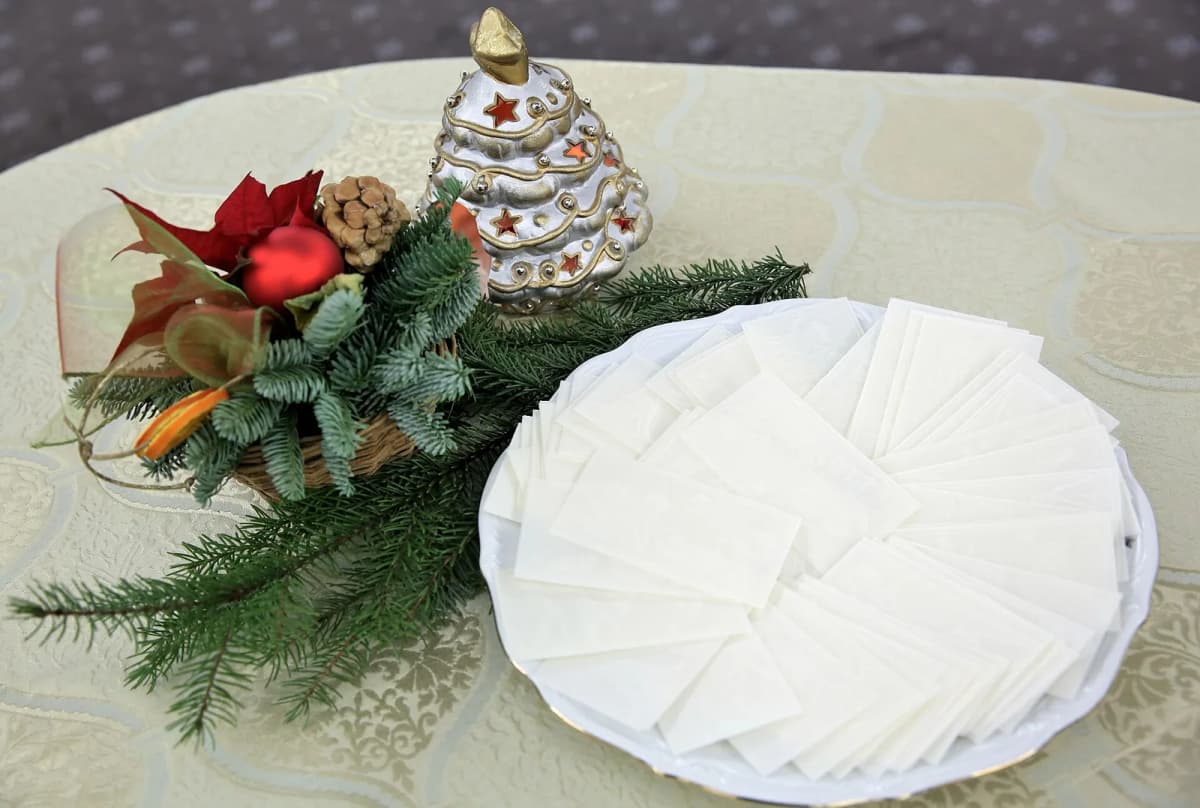
The oplatek is not only for Christmas Eve. Throughout December, Polish workplaces, schools, universities, parishes, clubs and even the Senate hold spotkania opłatkowe (spot-KAH-nyah oh-pwaht-KO-veh), "wafer gatherings", where colleagues break a wafer together and exchange wishes before everyone goes home for the holidays. The featured photo at the top of this article shows a plate of wafers ready for one of these meetings.
The custom also travels by post. A Polish Christmas wafer is so light and flat that families tuck one inside a Christmas card for relatives abroad, so the person who cannot come home can still break it at their own table on 24 December.
Shared With Neighbours
Poland is not the only country with this custom. In Lithuania the Christmas wafer is called kalėdaitis, and it is shared at Kūčios, the Lithuanian Christmas Eve supper, with each diner given a wafer by the head of the family. In Slovakia it is the oblátka, and the tradition is also found in Moravia. The details differ, but the idea of breaking bread together before the Christmas Eve meal is the same.
Where to Buy Oplatek Outside Poland
If you live abroad and want to keep the tradition, you have three good options:
- Polish Catholic parishes. Many Polish and Slavic parishes in the US, UK, Canada and Australia sell or give out oplatki during Advent, usually from the parish office or after Mass, in return for a small donation. Check the parish bulletin or website from late November.
- Polish delis and grocery shops. Shops serving Polish communities usually stock packets of oplatek in December, alongside other Christmas foods.
- Online. Polish shops and parish gift stores sell wafers by post, including gluten-free versions for anyone who cannot eat wheat.

Photo: Kgbo, CC BY-SA 4.0, via Wikimedia Commons.
Wafers keep well because they are completely dry, so buy early. If you are visiting Poland in December, you will also find them in supermarkets and at stalls at the Polish Christmas markets, which makes them an easy, meaningful souvenir to take home.
Searching online for a "Christmas Polish wafer" will also bring up sweet layered wafer biscuits. Those are a different product: the oplatek is a single plain sheet with no filling or sugar.
Frequently Asked Questions
What does oplatek taste like? Very little. It is plain flour and water, so it tastes like a dry, crisp communion wafer. The flavour is not the point; the sharing is.
Do you have to be Catholic to share oplatek? No. The wafer is blessed but not consecrated, so anyone at the table can take part, including guests of other faiths or none.
When do you share the oplatek? On Christmas Eve, 24 December, standing around the table just before supper begins. Workplaces and schools hold their own wafer gatherings during December.
What do you say when sharing oplatek? A short personal wish, such as "Zdrowia, szczęścia, pomyślności!" (health, happiness, prosperity). The reply is "Dziękuję, nawzajem!" followed by your own wish.
What happens to leftover oplatek? Some families keep a piece for absent relatives, post it in a Christmas card, or give it to pets, echoing the old custom of sharing wafers with farm animals.
The oplatek costs almost nothing and takes no cooking, which may be why it has survived when so much else about Christmas has changed. A paper-thin wafer, a few honest words, and a hug: if you are spending Christmas with a Polish family this year, that is the moment to be ready for. For the bigger picture of the Polish festive calendar, our guide to Polish holidays and traditions is a good next read.
Featured photo: Michał Józefaciuk, CC BY-SA 3.0 PL, via Wikimedia Commons (wafers prepared for an opłatek meeting at the Polish Senate).