The Wroclaw gnomes are the strangest thing you will ever stumble over in a Polish city — literally. Walk down almost any street in Wrocław and you will eventually trip over a knee-high bronze figure doing something absurd: reading a newspaper, climbing a lamppost, hiding in a mailbox, or dozing off on a bench. There are more than a thousand of them now, scattered across the city like a scavenger hunt nobody officially organized. But the Wroclaw gnomes did not start as tourist bait. They started as a joke aimed squarely at a communist government that could not figure out how to arrest a cartoon dwarf.
That contradiction — a whimsical street decoration with a genuinely subversive political origin — is what makes the Wroclaw gnomes worth understanding, not just photographing. Behind every one of the more than a thousand krasnale (Polish for "dwarfs" or "gnomes," and cousins of the same Polish folklore creatures that fill the country's older legends) is a city that once used absurdity as a weapon against a regime that took itself very, very seriously.
What Are the Wroclaw Gnomes, Exactly?
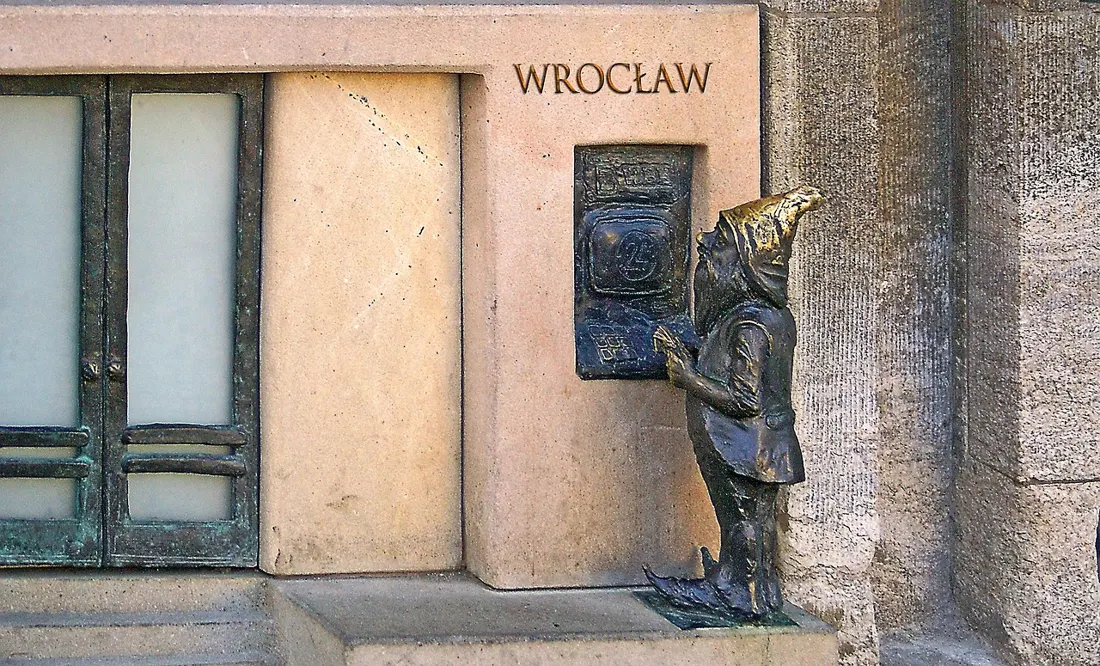
The Wroclaw gnomes, called krasnale in Polish, are small bronze statues installed on streets, in doorways, on window ledges, and occasionally in genuinely unexpected places throughout Wrocław, a city in southwestern Poland. Each figure stands roughly 15 to 30 centimeters tall, and each one has its own name, backstory, and personality — a firefighter gnome outside a fire station, a blind gnome reading Braille outside a foundation for the visually impaired, a banker gnome guarding a bank entrance.
The official count, tracked by the city's own tourism office, now sits at well over a thousand registered dwarfs, making Wrocław home to one of the largest public sculpture collections of its kind anywhere in the world. New gnomes are still added every year, sponsored by local businesses, institutions, and even private citizens who apply through the city for permission to install one.
Unlike most public art installations, the Wrocław gnomes were never planned as a single coordinated project. They grew organically over two decades, starting from a single bronze statue and multiplying into a citywide phenomenon that now has its own official map, its own festival, its own gift shop merchandise, and — because this is still Poland — a story rooted in resisting authoritarian rule.
Born as an Act of Rebellion: The Orange Alternative
To understand why Wrocław, of all Polish cities, ended up covered in gnomes, you have to go back to the early 1980s and a strange, brilliant protest movement called Pomarańczowa Alternatywa — the Orange Alternative.
Poland in the early 1980s was under martial law. Solidarity, the independent trade union that had briefly cracked open Polish civil society, had been driven underground. The streets of Wrocław were covered in anti-government graffiti, and the militia's standard response was to paint over every slogan with a slap of gray or white paint the moment it appeared. It was a losing game for both sides — dissidents wrote faster than the paint could dry, and the state kept erasing.
Waldemar Fydrych, an art history student at the University of Wrocław who went by the self-appointed rank "Major," saw an opportunity in those blank patches of fresh paint. Instead of writing another slogan the militia would simply paint over again, Fydrych and his growing circle of followers started painting small, cartoonish dwarfs directly onto the censored patches. A dwarf could not be prosecuted as anti-state propaganda. There was no law against a gnome. The authorities were left with an impossible choice: leave the absurd little painted figures up, or send police to formally arrest a wall drawing of a smiling dwarf.
The Orange Alternative escalated from there into full street theater. Fydrych and his followers staged deliberately ridiculous public "happenings" — handing out toilet paper during shortages, celebrating fictional Soviet holidays, dressing hundreds of participants as gnomes and elves.
The movement's absolute peak came on International Children's Day, June 1, 1988, when thousands of people marched through Wrocław wearing orange, cone-shaped dwarf hats and chanting "freedom for the dwarfs" while riot police stood by, visibly unsure how to respond to a crowd they could not credibly accuse of sedition. Historians now count that march, alongside the Solidarity strikes in Gdańsk, among the events that helped crack the foundations of communist rule in Poland less than eighteen months before the system collapsed entirely. Long before anyone called them the Wroclaw gnomes, these painted dwarfs were doing genuinely dangerous political work disguised as a children's joke.
From Political Prank to Bronze Icon
For more than a decade after communism fell in 1989, the dwarf remained mostly a memory — a story Wrocław residents told about the strange years of martial law, not something you could see on the street. That changed in 2001, when the city commissioned a single bronze statue on Świdnicka Street to formally commemorate the Orange Alternative movement. That first statue, nicknamed Papa Krasnal ("Papa Dwarf"), still stands there today: a small bronze figure that quietly kicked off one of the most distinctive urban art traditions in Europe.
Local sculptor Tomasz Moczek took the concept and ran with it. A handful more dwarfs appeared in 2005, each with its own design and installed with the city's blessing at a specific, meaningful location. What began as a handful of commemorative statues turned into a full civic tradition: businesses started sponsoring their own gnomes, cultural institutions commissioned dwarfs tied to their mission, and ordinary Wrocław residents began submitting proposals for new ones through the city's official process.
By the 2010s, the Wroclaw gnomes had become genuinely self-sustaining as a phenomenon, growing far beyond anything the city planning office could have designed on purpose. The pace has not slowed. Wrocław's tourism office now runs an official searchable directory of registered dwarfs, complete with addresses, photographs, and short biographies for each one, and the city holds an annual Dwarf Festival every September, complete with a parade, a juggler, stilt-walkers, and a brass band marching the gnomes' own streets in their honor.
Krasnale Wroclawskie: Meet a Few of the Most Famous Wroclaw Gnomes
Part of what makes hunting for krasnale wroclawskie so addictive is that each one tells a small story, and together they sketch a strange, funny portrait of the city itself.
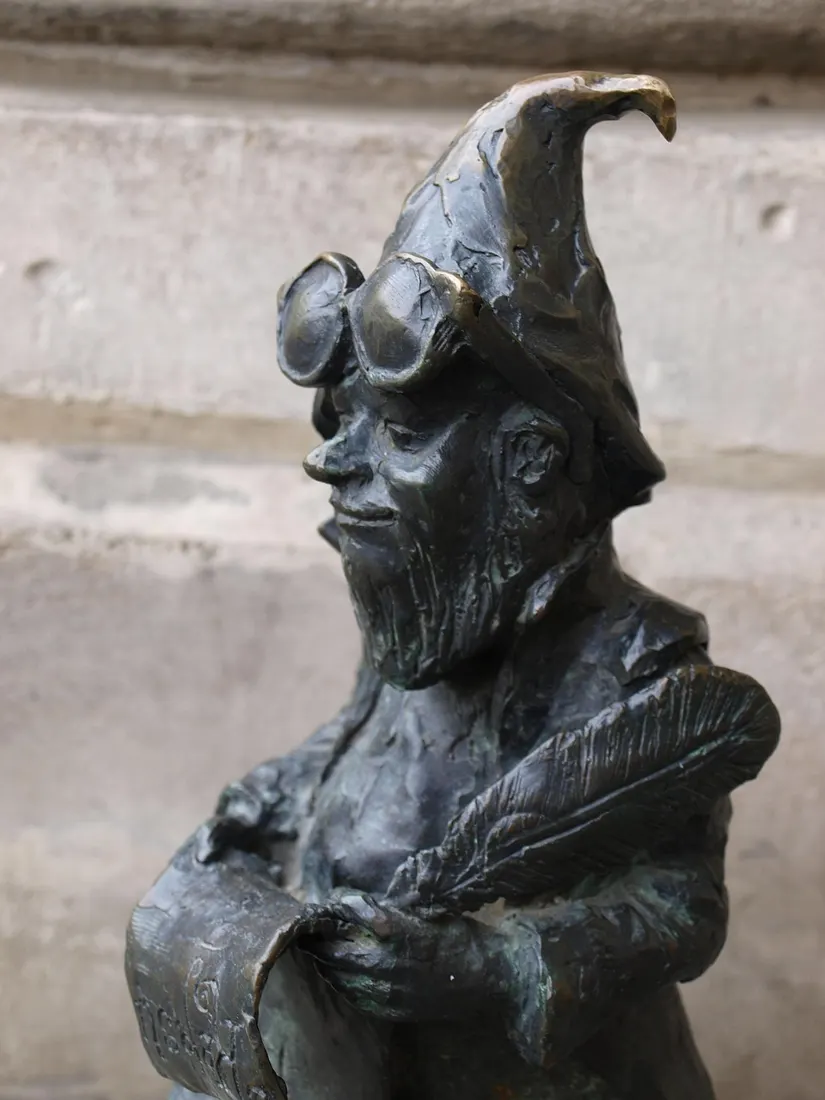
WrocLovek, a punning mashup of "Wrocław" and the Polish word for "person" (człowiek), is the single most duplicated dwarf design in the city — installed dozens of times in different poses across different neighborhoods, effectively acting as the unofficial mascot of the entire collection. Papa Krasnal, the original 2001 statue on Świdnicka Street, remains the most photographed simply because it is the one everybody's guidebook mentions first.
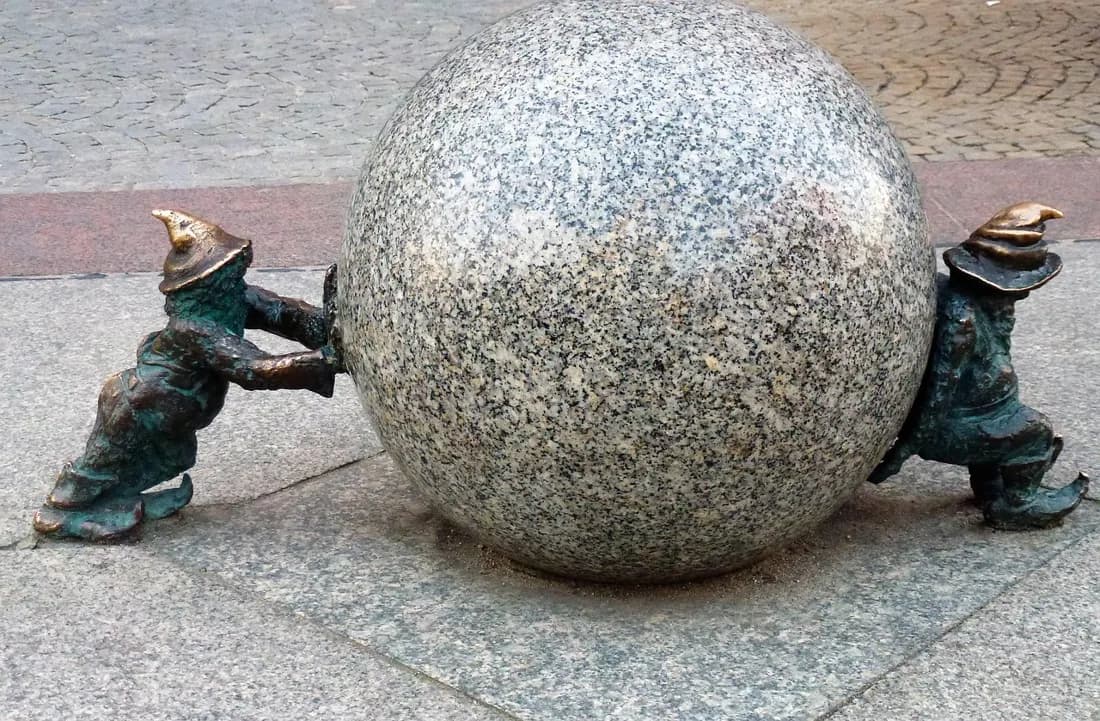
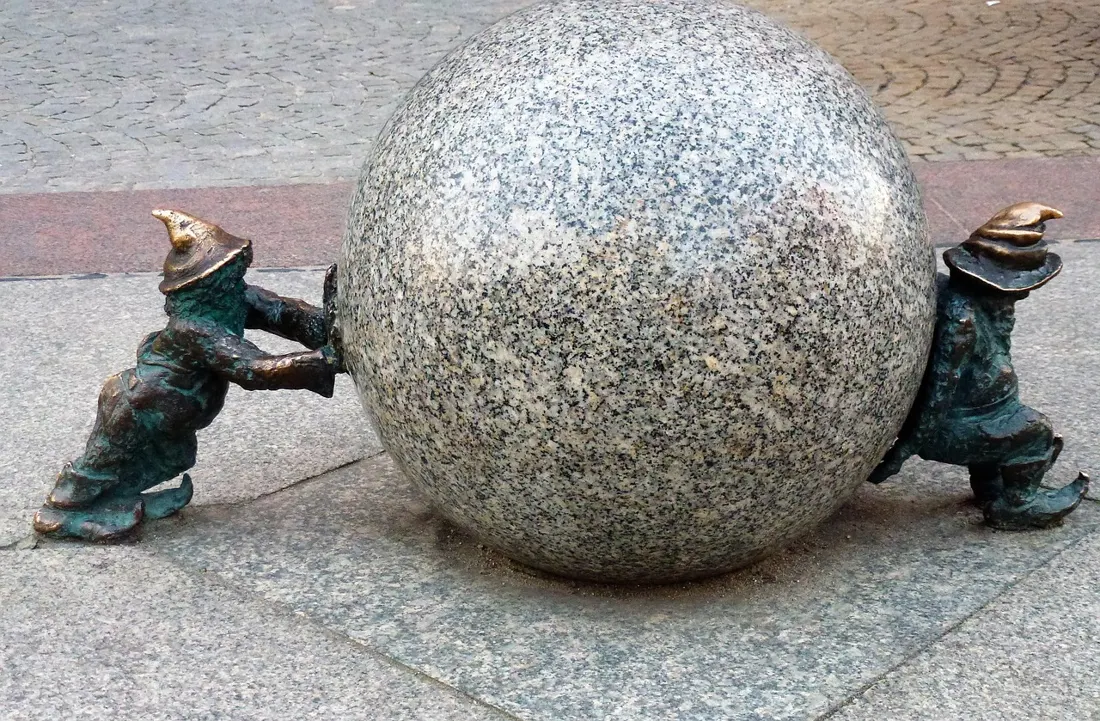
Some gnomes exist specifically to make a point. The Krasnale Tolerancji — the Dwarfs of Tolerance — are a small cluster of figures installed to raise awareness of disability and inclusion, including one gnome reading a book in Braille outside a foundation that supports blind residents. Other dwarfs are purely occupational in-jokes: a gnome dressed as a firefighter outside a fire station, one in a banker's suit outside a bank branch, and a set of "pool dwarfs" lounging near a public swimming pool. A cluster called Krasnale Syzyfki — the Sisyphus Dwarfs — depicts a group of tiny figures endlessly pushing a boulder, a wry nod to the Greek myth planted in the middle of a very Polish city.
None of this would work as public art anywhere else quite the way it works in Wrocław, because the joke only lands if you already know the punchline: that these charming little statues descend directly from a movement that used cartoon dwarfs to make a totalitarian government look ridiculous.
How to Hunt for Gnomes in Wrocław Today
Finding all of the Wroclaw gnomes is, by design, functionally impossible — new ones are added constantly, and even locals do not claim to have seen them all. But hunting down a meaningful cluster of them in an afternoon is one of the most genuinely fun things to do in the city, and it costs nothing.
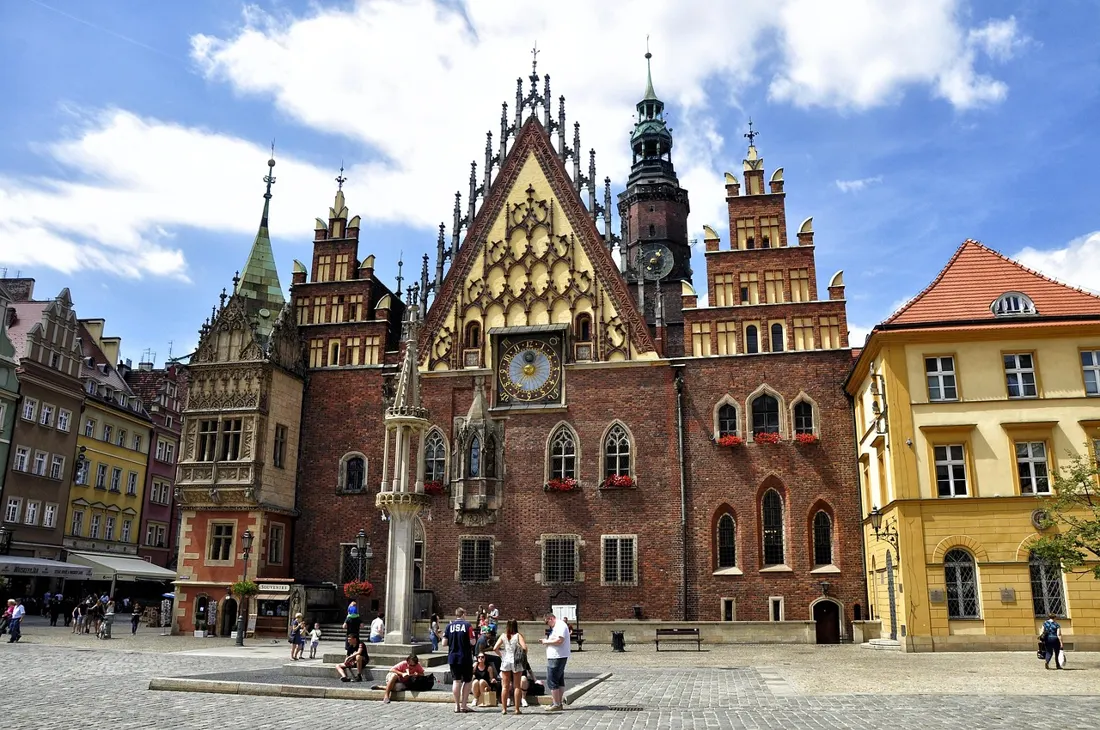
The city's official tourism site maintains a searchable Dwarf Directory with a full interactive map, filterable by district, along with the name, short story, and exact location of every registered dwarf. Most visitors start in the Old Town around Rynek (the Market Square) and Świdnicka Street, where Papa Krasnal still stands and where gnome density is highest, then branch out toward the university quarter and Ostrów Tumski, the city's cathedral island, where quieter, more obscure Wroclaw gnomes tend to hide in doorways and window ledges.
Souvenir shops throughout the Old Town sell paper maps of the routes for visitors who would rather not stare at a phone screen all day, and several tourist information points sell small gnome figurines and sweets branded with the dwarfs' likeness. If your visit happens to line up with September, the annual Dwarf Festival adds a parade and live performances to the usual scavenger hunt, turning the whole city center into something closer to a street party than a walking tour.
Why a Gnome Became Poland's Unlikely Symbol of Freedom
What makes the Wroclaw gnomes worth more than a photo stop is the layer underneath the cuteness. Poland spent much of the twentieth century under regimes that punished dissent seriously and often violently, and the country's most enduring symbols of resistance tend to reflect that gravity — the black-and-red Solidarity logo, the crosses at Gdańsk's shipyard gates, the underground press. The Orange Alternative took a completely different approach: instead of confronting state power head-on, it made state power look absurd for taking a children's cartoon character seriously as a threat.
That strategy of using folklore-adjacent, faintly ridiculous imagery to outmaneuver a serious opponent is not unique to the Wroclaw gnomes. Poland has a long tradition of encoding real historical weight into figures that look, on the surface, like they belong in a children's book — much like the fire-breathing dragon statue that still guards Kraków's Wawel Hill, whose legend was reshaped and retold across centuries by people using folklore to process real history. Wrocław's krasnale simply compressed that same instinct into a much shorter timeline: a joke painted on a wall in 1982 became a nationally recognized symbol of peaceful resistance within less than a decade, and a beloved civic tradition within two.
If you are trying to understand how Polish identity survived some of the harshest chapters of the twentieth century — including a 123-year stretch when Poland did not exist as a country on any map at all — the Wroclaw gnomes are a small but genuinely useful case study. They are proof that a culture can resist erasure not only through open confrontation, but through absurdity, humor, and a refusal to be taken too seriously by the people trying hardest to control it.
Anyone weighing a longer stay in the city, whether for language study or simply because Wrocław keeps showing up on lists of the best cities in Poland for expats, will find the Wroclaw gnomes are one of the fastest ways to strike up a conversation with a local — everyone in Wrocław has a favorite gnome, and most are happy to argue about which one is best.
Frequently Asked Questions About the Wroclaw Gnomes
How many Wroclaw gnomes are there? The official count maintained by the city's tourism office is now well over a thousand registered Wroclaw gnomes, and the number grows every year as new ones are sponsored and installed. No single list is ever fully complete for long.
Why does Wrocław have gnomes everywhere? The Wroclaw gnomes tradition began as a tribute to the Orange Alternative, an absurdist anti-communist protest movement of the 1980s that used painted dwarf graffiti to mock the authorities. The city installed its first commemorative bronze dwarf, Papa Krasnal, in 2001, and the collection grew from there into a full civic phenomenon.
What was the Orange Alternative? The Orange Alternative (Pomarańczowa Alternatywa) was a peaceful protest movement led by Waldemar "Major" Fydrych in Wrocław during the 1980s. Rather than confronting the communist government directly, it staged absurdist public theater — including painting dwarfs over censored anti-government graffiti — to make the regime's crackdowns look ridiculous.
Where is the first Wroclaw gnome statue? The first official bronze Wroclaw gnome, Papa Krasnal, stands on Świdnicka Street in the city center. It was installed in 2001 specifically to commemorate the Orange Alternative movement.
What does krasnale mean in Polish? Krasnale (singular: krasnal) is the Polish word for garden gnomes or dwarfs — the same folkloric creatures found in traditional Central European folklore, long before Wrocław adopted them as the Wroclaw gnomes and turned them into a civic symbol.
Are the Wroclaw gnomes free to visit? Yes. The Wroclaw gnomes are public sculptures installed on open streets and squares throughout the city, and there is no charge to see them. The only cost is time — and possibly a paper map from a souvenir shop.
Is there an app or map for finding the Wroclaw gnomes? Wrocław's official tourism website hosts a searchable Dwarf Directory with an interactive map, filterable by district, showing each registered gnome's name, story, and exact location. Printed maps are also widely available in Old Town souvenir shops.
What is the most famous Wroclaw gnome? Papa Krasnal, the original 2001 statue on Świdnicka Street, is the most historically significant. WrocLovek, a pun-named design installed in dozens of locations across the city, is the most frequently spotted of all the Wroclaw gnomes.
Is there a gnome festival in Wrocław? Yes. The city holds an annual Dwarf Festival every September, featuring a parade with jugglers, stilt-walkers, and a brass band, celebrating the Wroclaw gnomes as a civic tradition in their own right.
Can I sponsor my own gnome in Wrocław? Businesses, institutions, and private individuals can apply through the city for permission to install a new Wroclaw gnome at a specific location, which is part of why the collection keeps growing year over year.
Do other Polish cities have gnome statues too? Some cities have installed a handful of gnomes inspired by Wrocław's example, but none come close to the scale or cultural depth of the original Wroclaw gnomes collection, which remains tied specifically to the city's Orange Alternative history.
When did the Wroclaw gnomes tradition start? The visual tradition dates to the early 1980s, when Orange Alternative activists began painting dwarfs over censored political graffiti. The bronze statue tradition specifically began in 2001 with the installation of Papa Krasnal.
Why did the government not just remove the painted dwarfs? A cartoon dwarf painted on a wall was not illegal under any existing statute, which is exactly why the Orange Alternative chose the image. Painting over a dwarf, or arresting someone for drawing one, made the authorities look absurdly heavy-handed rather than authoritative.
What should I look for when gnome-hunting in Wrocław? Start around the Market Square and Świdnicka Street, where dwarf density is highest and Papa Krasnal still stands, then branch out toward the university quarter and Ostrów Tumski for quieter, more obscure finds tucked into doorways and window ledges.
Wrocław's gnomes are easy to dismiss as a cute photo opportunity — and plenty of visitors do exactly that, snapping a picture of WrocLovek and moving on without a second thought. But scratch the surface of even one krasnal and you find a city that once turned a children's cartoon into a functioning weapon against a regime with tanks and secret police, and won. That is worth a second look the next time you catch yourself stepping over a tiny bronze dwarf reading a newspaper on a Wrocław sidewalk.