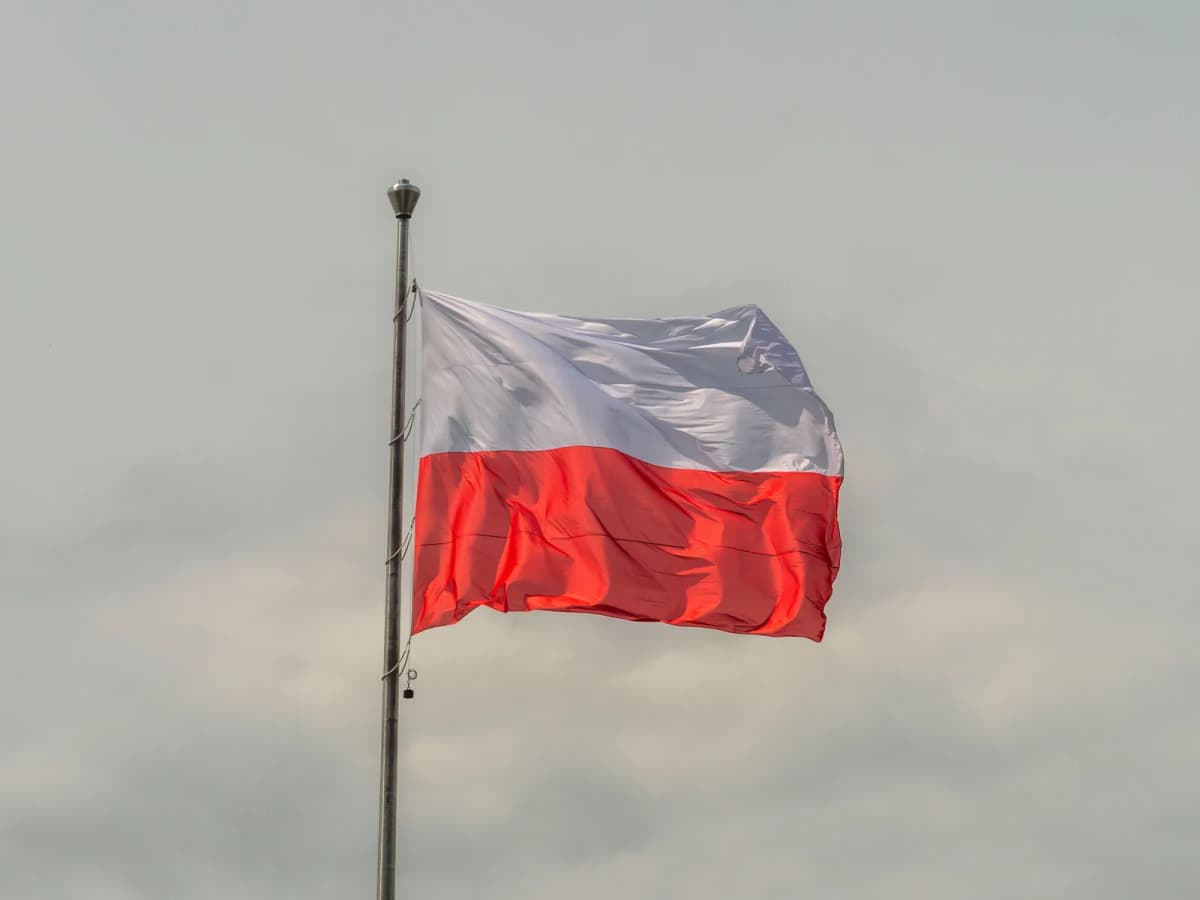
The Polish flag is one of the simplest flags in the world: two horizontal stripes of equal width, white on top and red below. In Polish it is called flaga Polski (FLAH-gah POL-skee) or, more affectionately, biało-czerwona (BYAH-woh cher-VOH-nah), "the white-and-red". There is no star, no stripe pattern and no motto. Just two colours that every Pole recognises from a hundred metres away.
Simple does not mean shallow, though. Those two colours come from medieval heraldry, they were fixed in law in 1919, their exact shades are written down as scientific colour coordinates, and the flag has its own day in the calendar on 2 May. There is also an official version with the white eagle on it, plus a famous mix-up: turn the Polish flag upside down and you get something very close to the flags of Indonesia and Monaco.
This guide covers the meaning and history of the Polish flag, what the current law actually says, how to hang it correctly, and the handful of Polish words you need to talk about it. If you are learning Polish or exploring your family's roots, it is a small topic that opens a surprisingly big door into Polish history.
The Polish Flag at a Glance
Before the history, here are the basic facts, taken from the current consolidated text of the 1980 act on Poland's national symbols.
| Polish name | flaga państwowa Rzeczypospolitej Polskiej (state flag of the Republic of Poland) |
| Everyday name | biało-czerwona, flaga Polski, polska flaga |
| Design | Two horizontal stripes of equal width: white on top, red on the bottom |
| Proportions | 5:8 (height to length) |
| Official version with arms | The same flag with the coat of arms in the middle of the white stripe |
| Legal basis | Act of 31 January 1980 on the coat of arms, colours and anthem; Article 28 of the 1997 Constitution |
| Flag Day | 2 May (Dzień Flagi) |
The Constitution keeps it short. Article 28 says the colours of the Republic of Poland are white and red, and the 1980 act fills in the details: the order of the stripes, the proportions, the exact shades and who flies which version.
Polish Flag Meaning: Where the Colours Come From
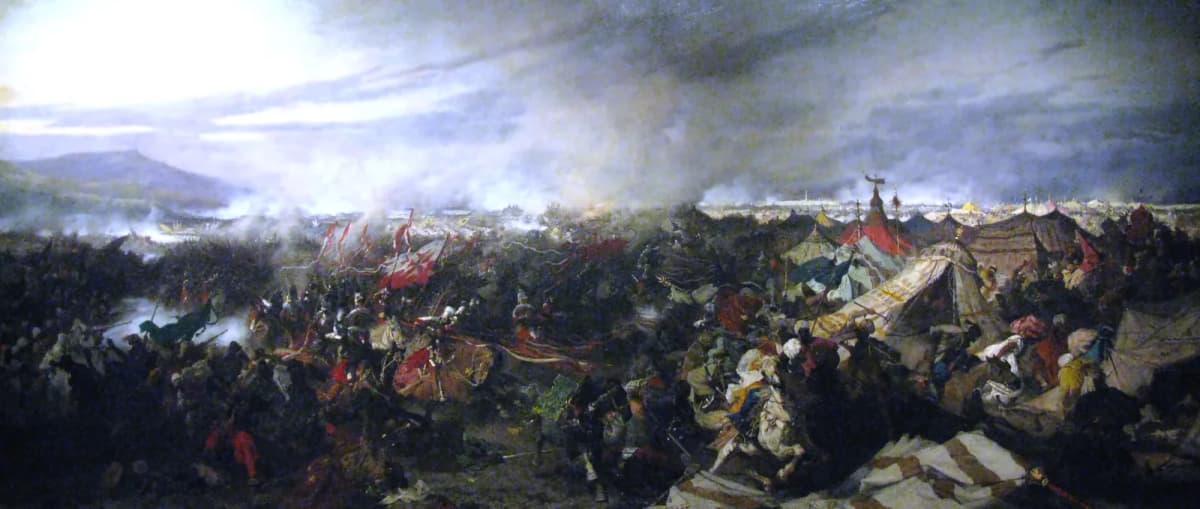
The honest answer to "what does the Polish flag mean" is that the colours were not invented to symbolise abstract ideas. They are heraldic. They come straight from the old coats of arms of the Polish-Lithuanian state.
Poland's coat of arms, the Orzeł Biały (OH-zhew BYAH-wih, "White Eagle"), shows a white eagle on a red shield. The arms of the Grand Duchy of Lithuania, the Pogoń (POH-gon, "the Pursuer"), show a white knight on a white horse, again on a red shield. When the two states shared a ruler and later formed the Polish-Lithuanian Commonwealth, white on red was the common colour scheme of both. The Wikipedia article on the flag of Poland traces this heraldic link in detail. The national colours simply take the colour of the charge (white) and the colour of the field (red).
That is also why white sits on top. In heraldry the colour of the main figure is treated as more important than the background, so the white of the eagle comes first and the red of the shield comes second.
Popular meanings you will hear
Over time, Poles have layered extra meanings onto the two colours, and you will hear them in schools and speeches. White is often linked to purity, peace or the Christian faith, and red to the blood shed for independence. These are poetic interpretations rather than anything written in law, but they are part of how many Poles feel about the Polish flag, especially on days of remembrance.
Crimson, then vermilion
For centuries the traditional Polish red was a deep crimson, called karmazyn (kar-MAH-zin) in Polish. A presidential decree of 13 December 1927 changed the official shade to a brighter vermilion, and that brighter red is what you see on the Polish flag today.
Polish Flag History: From Royal Banners to the 1980 Law
The white-and-red combination is old, but the bicolour Polish flag as a legal symbol is younger than many people expect. Here is the short version of the Polish flag history, step by step.
| Year | What happened |
|---|---|
| Middle Ages | White eagle on red appears on royal banners and seals |
| 3 May 1792 | White-and-red cockades worn in Warsaw on the first anniversary of the Constitution of 3 May 1791 |
| 7 February 1831 | During the November Uprising, the Sejm adopts white and red as the national cockade |
| 1 August 1919 | The Sejm of reborn Poland makes the white-and-red bicolour the national flag |
| 13 December 1927 | Presidential decree sets the red as vermilion |
| 7 December 1955 | Communist-era decree keeps the same colours |
| 31 January 1980 | Current act on the coat of arms, colours and anthem is passed |
| 1990 | Amendments after the fall of communism; the crown returns to the eagle |
| 20 February 2004 | Amendment creates Flag Day on 2 May |
Cockades before flags
During the partitions, when Poland had no state of its own, the colours lived on in small, wearable form. White-and-red cockades (kokarda, koh-KAR-dah) were pinned to hats and coats at patriotic events. The 1831 resolution of the Sejm during the November Uprising is often treated as the first official decision on Polish national colours. Our article on how Polish survived 123 years without a country explains why symbols like these mattered so much when there was no state to back them.
1919: the flag of independent Poland
After Poland regained independence in November 1918, the new parliament wrote the national symbols into law. The act of 1 August 1919 established the white-and-red bicolour as the Polish flag. The story of that rebirth, and why 11 November is the big date, is in our guide to Polish Independence Day.

Photo: Polish Army, 2 May 1945, public domain, via Wikimedia Commons.
1945 and 1980
On 2 May 1945, soldiers of the First Polish Army raised the white-and-red flag on the Victory Column (Siegessäule) in Berlin, the moment captured in the photo above. That date would later become one of the reasons Flag Day falls on 2 May.
The law that governs the Polish flag today is the Act of 31 January 1980 on the Coat of Arms, Colours and Anthem of the Republic of Poland and on State Seals. It has been amended many times, most recently in force from 1 January 2025, and the Speaker of the Sejm published a consolidated text in March 2025. You can read the official consolidated text of the act on the Sejm's legal database. It is short and, if you read some Polish, surprisingly readable.
What the Law Says About the Polish Flag Today
Article 4 of the act describes the colours: white and red, in two horizontal parallel stripes of the same width, the upper one white and the lower one red. Article 6 then defines the state flag as a rectangular piece of cloth in those colours, placed on a mast.
The exact colours of the Polish flag
Here is a detail most flag websites skip. The law does not define the colour of the Polish flag with a paint code or a hex value. Annex 2 gives scientific colour coordinates in the CIE colour space, plus how far a real flag is allowed to drift from them.
| Colour | x | y | Y (lightness) | Allowed difference (ΔE) |
|---|---|---|---|---|
| White (biała) | 0.315 | 0.320 | 82.0 | 4.0 |
| Red (czerwona) | 0.570 | 0.305 | 16.0 | 8.0 |
Screen colours (RGB or hex values) that you see online are conversions of these numbers, so you will find slightly different versions. If you are printing a flag or designing something official, go back to the annex rather than trusting a random colour picker.
Proportions
Annex 3 sets the proportions at 5:8, so a flag 100 cm tall should be 160 cm long. On the version with the coat of arms, the arms are two-fifths of the flag's height and sit in the middle of the white stripe.
Everyone may fly it
Article 5 says that everyone has the right to use the colours of the Republic of Poland, especially to mark ceremonies, holidays and other events, as long as they are treated with respect. Article 7 lists the buildings where the flag must fly (the Sejm, the Senate, the President, the government, local councils during sessions) and recommends that people also fly it on homes and businesses on national holidays.
The Polish Flag With the Eagle
Search for "Polish flag with eagle" and you will see the white-and-red flag with the red shield and crowned white eagle in the centre of the white stripe. This is not a fan design. It is an official state flag, defined in Article 6 of the 1980 act, but it has a specific job.

Image: Aotearoa and others, public domain, via Wikimedia Commons.
According to Article 8, the flag with the coat of arms is raised by:
- Polish embassies, consulates and other official missions abroad, and the heads of those missions on their residences and vehicles
- civilian airports and airfields
- civilian passenger aircraft on flights abroad
- harbour master's offices in ports
Under Article 9, Polish sea-going ships also fly it as their ensign (bandera, ban-DEH-rah). In other words, the eagle version is mainly used where Poland represents itself abroad or at its borders. At home, on a balcony on 3 May, the plain white-and-red Polish flag is the normal choice.
In practice you will see the eagle flag at sports events and in the diaspora, especially in the United States, where many Polish-American families fly it because it cannot be confused with any other country's flag. That brings us to the famous mix-up.
What the eagle looks like
The official description in Article 2 reads like a little vocabulary lesson: a white eagle with a golden crown on its head turned to the right, wings spread, with a golden beak and talons, on a red shield. The crown disappeared from the eagle during the communist period and was restored in 1990, which is why you sometimes see older crownless eagles on vintage badges and coins.
Upside Down Polish Flag: Indonesia, Monaco and Common Mix-ups
Flip the Polish flag upside down and you get red over white. That is almost exactly the flag of Indonesia and the flag of Monaco. The difference is the order of the colours and the proportions:
| Flag | Top | Bottom | Proportions |
|---|---|---|---|
| Poland | White | Red | 5:8 |
| Indonesia | Red | White | 2:3 |
| Monaco | Red | White | 4:5 |
Monaco's red and white come from the colours of the House of Grimaldi, and its flag was adopted on 4 April 1881. So none of these countries copied the others. They simply arrived at the same two colours from different heraldic and historical roots.

Photo: Deden R on Pexels.
Why the upside down Polish flag keeps happening
The upside down Polish flag is a surprisingly common error. It shows up on souvenir stalls, in graphics for sports broadcasts and at diaspora events, usually because someone grabbed the wrong flag icon or hung a vertical banner the wrong way round. Most Poles will spot it instantly, and some will feel genuinely uncomfortable, a bit like seeing your own name misspelled on a certificate.
The simple rule to remember: white always goes up. If the stripes run vertically, the law has a rule for that too, which we cover next.
How to Hang the Polish Flag Correctly
The 1980 act and long-standing practice give a few clear rules. These are worth knowing if you fly a Polish flag at home, at a parish event or at a Polish school abroad.
- Horizontal: white on top, red on the bottom.
- Vertical: Article 4 says the white stripe goes on the left, as seen from the front.
- Mourning: when the President declares national mourning (żałoba narodowa, zhah-WOH-bah nah-roh-DOH-vah), the flag is lowered to half-mast (Article 11).
- Respect: Article 15 says the colours must be displayed in a way that gives them due honour and respect.
Damaging or publicly insulting the flag is treated seriously. Article 137 of the Polish Penal Code covers anyone who publicly insults, destroys, damages or removes a state symbol such as the flag, with penalties that can include a fine or up to a year in prison. This is general information rather than legal advice, but the practical lesson is easy: treat the Polish flag the way you would treat a family heirloom.
Flags on products
Article 16 adds a rule that surprises many visitors: the official symbols may not be placed on goods for sale, but stylised or artistically reworked versions of the coat of arms or colours are allowed. That is why souvenir shops are full of creative white-and-red designs rather than exact copies of the state flag with arms.
Flag Day: Why 2 May?
Since 2004, 2 May has been Dzień Flagi Rzeczypospolitej Polskiej (jen FLAH-gee zheh-chpos-poh-LEE-tey POL-skyey), Flag Day of the Republic of Poland. It was created by an amendment to the 1980 act dated 20 February 2004, which added a one-line Article 6a: "The day of 2 May is established as the Day of the Flag of the Republic of Poland."

Photo: Zygmunt Put, CC BY-SA 4.0, via Wikimedia Commons.
Several reasons are usually given for the date:
- It sits between two other holidays, 1 May (Labour Day) and 3 May (Constitution Day), so flags go up for a long weekend that Poles call majówka (mah-YOOF-kah).
- On 2 May 1945, Polish soldiers raised the white-and-red flag in Berlin.
- The same day is also the Day of Polonia and Poles Abroad, celebrating the diaspora.
One practical note: Flag Day is a state holiday, but 2 May is not a public day off work. Many people take it as leave to stretch the majówka. You will find more on the rest of the calendar in our guide to Polish holidays and traditions.
Other big flag days
The Polish flag goes up everywhere on 3 May and on 11 November, Independence Day. It is also flown during commemorations such as the anniversary of the Warsaw Uprising on 1 August. On these days the anthem is played too, and our guide to the Polish national anthem explains what the words mean and how to behave while it plays.
How to Say the Colours of the Polish Flag in Polish
Talking about the colour of the Polish flag is a perfect mini-lesson in Polish adjectives, because the colour words change their endings to match the noun.
| English | Polish | Pronunciation |
|---|---|---|
| white | biały / biała / białe | BYAH-wih / BYAH-wah / BYAH-weh |
| red | czerwony / czerwona / czerwone | cher-VOH-nih / cher-VOH-nah / cher-VOH-neh |
| white-and-red | biało-czerwony | BYAH-woh cher-VOH-nih |
| flag | flaga (feminine) | FLAH-gah |
| national colours | barwy narodowe | BAR-vih nah-roh-DOH-veh |
| coat of arms, emblem | godło | GOD-woh |
| eagle | orzeł | OH-zhew |
| flagpole, mast | maszt | mahsht |
Because flaga is feminine, you say flaga jest biało-czerwona (the flag is white and red). Notice that in the compound biało-czerwona only the last part changes; the first part stays as biało. And the order matters: Poles always say biało-czerwona, never "czerwono-biała", which matches the order of the stripes.
Useful phrases
- Polska flaga ma dwa kolory: biały i czerwony. The Polish flag has two colours: white and red.
- Wywieszamy flagę na majówkę. We hang out the flag for the May long weekend.
- Biało-Czerwoni wygrali! The White-and-Reds won! (a common nickname for Polish national sports teams)
If you want more colour vocabulary, our full guide to colors in Polish covers every shade and the gender endings in detail. And to see how adjectives like czerwona agree with masculine, feminine and neuter nouns, this lesson is the natural next step:
Nominative Case and Noun GenderPolish Flag Etiquette for Visitors and the Diaspora
If you are visiting Poland on a national holiday, you will see the Polish flag on balconies, trams and shop windows. A few tips help you join in respectfully:
- Small flags are welcome. Waving a small paper or fabric flag at a parade on 3 May or 11 November is completely normal.
- Don't let it touch the ground. This is not written as a fine in the law, but it is a widely shared sign of respect.
- Check the order before posting. If you share a photo or use a flag icon online, make sure white is on top. Comment sections can be unforgiving about the upside down Polish flag.
- Take it down when it is worn out. A faded, torn flag hanging all year sends the opposite message from the one intended.
For Polish families abroad, the Polish flag often sits next to the flag of the new home country. In that case, local flag rules usually decide which flag takes the place of honour, so it is worth checking the custom where you live.
Frequently Asked Questions
What are the colours of the Polish flag? White and red, in two horizontal stripes of equal width, with white on top. The shades are defined by CIE colour coordinates in Annex 2 of the 1980 act.
What does the Polish flag mean? The colours come from heraldry: the white eagle on a red shield of Poland and the white knight on a red shield of Lithuania. Popular readings link white to peace or purity and red to the blood of those who fought for independence.
Is the Polish flag the same as Indonesia's? No. Indonesia's flag is red over white with proportions 2:3; the Polish flag is white over red with proportions 5:8. Monaco's flag is also red over white, at 4:5.
Can anyone fly the Polish flag with the eagle? The law reserves the flag with the coat of arms for embassies and consulates, civil airports, aircraft on foreign flights, harbour offices and ships at sea. In practice many people use it at sports events and in the diaspora, but at home the plain white-and-red flag is the standard.
When is Polish Flag Day? On 2 May, since 2004. It is a state holiday but not a day off work.
How do I hang the Polish flag vertically? With the white stripe on the left as you look at it from the front.
Two stripes, two words, biało-czerwona, and behind them eight centuries of history. Next time you see the Polish flag on a balcony in May, you will know where the colours come from, why white is on top, and exactly how to say it in Polish.
Featured photo: SHOX ART on Pexels.