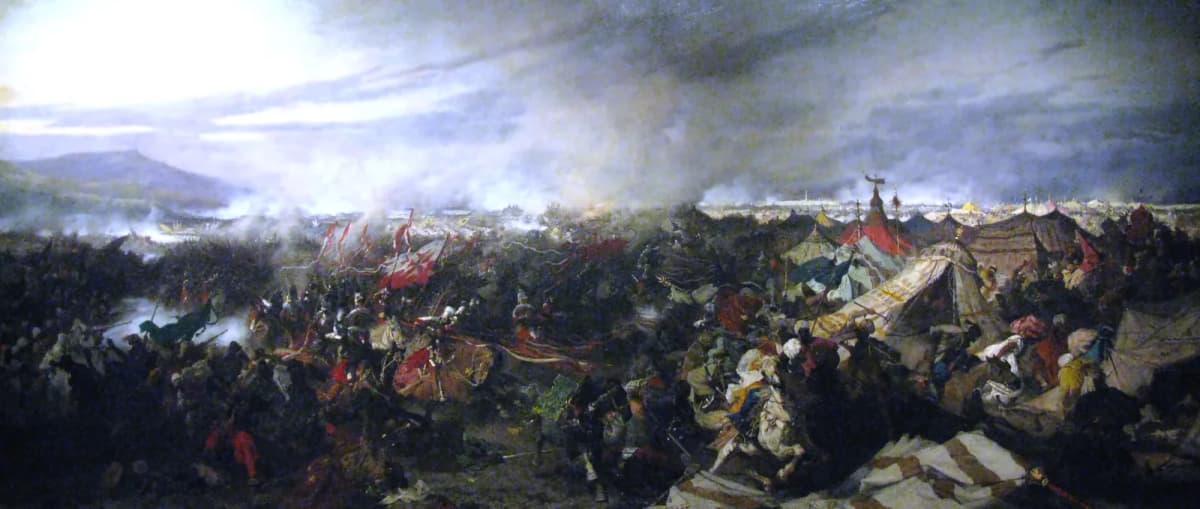
The Polish national anthem is Mazurek Dąbrowskiego (mah-ZOO-rek dom-brof-SKYEH-go), known in English as Dąbrowski's Mazurka or, after its famous first line, "Poland Is Not Yet Lost". It is a marching song written in Italy in 1797, set to a lively folk dance rhythm, and it is one of the few national anthems whose opening words admit that the country might have disappeared.
That opening line is the key to the whole song. When Józef Wybicki wrote it, Poland had just been wiped off the map by its neighbours. The Polish national anthem is not a hymn to a powerful state; it is a promise that the nation survives as long as its people do.
This guide gives you the full official lyrics of the Polish national anthem, a line-by-line English translation, the grammar behind the old-fashioned verb forms, a pronunciation guide for the first verse, and the story of how a soldiers' song from Reggio Emilia became the anthem of a whole country.
What Is the Polish National Anthem?
The Polish national anthem is a four-verse song with a refrain, officially titled Mazurek Dąbrowskiego. The name comes from two things: the mazurek, a Polish folk dance in triple time, and General Jan Henryk Dąbrowski, the commander the song addresses in its refrain.
It became the official Polish national anthem on 26 February 1927, during the interwar Second Republic. The history of Poland Is Not Yet Lost on Wikipedia collects the main sources if you want to dig deeper. Today its status sits in the highest law of the land: Article 28 of the 1997 Constitution states plainly, Hymnem Rzeczypospolitej Polskiej jest Mazurek Dąbrowskiego ("The anthem of the Republic of Poland is Dąbrowski's Mazurka").
The details live in a separate statute, the 1980 Act on the Emblem, Colours and Anthem of the Republic of Poland. Its annexes contain the official text and the official sheet music, so there is exactly one legally correct version of the words. That is the version you will find below.
| Polish name | Mazurek Dąbrowskiego |
| English names | Dąbrowski's Mazurka, Poland Is Not Yet Lost |
| Lyrics | Józef Wybicki, July 1797 |
| Music | Anonymous, based on a folk mazurka |
| Official since | 26 February 1927 |
| Verses | 4 verses + refrain (the manuscript had 6) |
Polish National Anthem Lyrics in Full
Here are the official Polish national anthem lyrics exactly as they appear in the annex to the 1980 act. Each verse is followed by the refrain Marsz, marsz, Dąbrowski. In practice, at most public events only the first verse and refrain are sung, but every Pole has at least heard the other three.
Verse 1 Jeszcze Polska nie zginęła, Kiedy my żyjemy. Co nam obca przemoc wzięła, Szablą odbierzemy.
Refrain Marsz, marsz, Dąbrowski, Z ziemi włoskiej do Polski. Za twoim przewodem Złączym się z narodem.
Verse 2 Przejdziem Wisłę, przejdziem Wartę, Będziem Polakami. Dał nam przykład Bonaparte, Jak zwyciężać mamy.
Verse 3 Jak Czarniecki do Poznania Po szwedzkim zaborze, Dla ojczyzny ratowania Wrócim się przez morze.
Verse 4 Już tam ojciec do swej Basi Mówi zapłakany – Słuchaj jeno, pono nasi Biją w tarabany.
The text is more than two hundred years old and in the public domain, so you are free to print it, sing it and use it in class.
The Polish National Anthem in English: Line by Line
Poetic translations of the Polish national anthem exist, but they bend the meaning to fit a rhyme. For learners, a literal translation is far more useful, because you can see which Polish word does which job.
Verse 1: "Poland has not yet perished"
| Polish | Literal English |
|---|---|
| Jeszcze Polska nie zginęła, | Poland has not yet perished, |
| Kiedy my żyjemy. | While we are alive. |
| Co nam obca przemoc wzięła, | What foreign force has taken from us, |
| Szablą odbierzemy. | We shall take back with the sabre. |
The refrain: "March, march, Dąbrowski"
| Polish | Literal English |
|---|---|
| Marsz, marsz, Dąbrowski, | March, march, Dąbrowski, |
| Z ziemi włoskiej do Polski. | From the Italian land to Poland. |
| Za twoim przewodem | Under your leadership |
| Złączym się z narodem. | We shall unite with the nation. |
Verse 2: the Vistula, the Warta and Bonaparte
| Polish | Literal English |
|---|---|
| Przejdziem Wisłę, przejdziem Wartę, | We'll cross the Vistula, we'll cross the Warta, |
| Będziem Polakami. | We shall be Poles. |
| Dał nam przykład Bonaparte, | Bonaparte has given us the example |
| Jak zwyciężać mamy. | Of how we are to win. |
The Vistula (Wisła) and the Warta are Poland's two great rivers. Crossing them meant marching home and taking the country back.
Verse 3: Czarniecki's return
| Polish | Literal English |
|---|---|
| Jak Czarniecki do Poznania | As Czarniecki [returned] to Poznań |
| Po szwedzkim zaborze, | After the Swedish seizure, |
| Dla ojczyzny ratowania | To save the homeland |
| Wrócim się przez morze. | We shall return across the sea. |
Stefan Czarniecki was a 17th-century commander during the Swedish invasion of Poland known as the Deluge. He fought the Swedes as far away as Denmark and came back by sea, which made him the perfect model for soldiers stranded in Italy.
Verse 4: a father and his Basia
| Polish | Literal English |
|---|---|
| Już tam ojciec do swej Basi | Already a father, to his Basia, |
| Mówi zapłakany – | Says, in tears – |
| Słuchaj jeno, pono nasi | "Just listen, it seems our boys |
| Biją w tarabany. | Are beating the drums." |
Basia is a pet form of Barbara. She and the tearful father stand for everyone left at home, listening for the drums (tarabany) of the army coming back.
"Poland Is Not Yet Lost": What the First Line Really Means
Jeszcze Polska nie zginęła is often translated as "Poland is not yet lost", but the verb is stronger than that. Zginąć means "to perish" or "to be killed". The line is a flat contradiction of the political reality of 1797: everyone else said Poland was dead, and the song answers "not yet".
The grammar repays a closer look. Zginęła is the past tense, and its ending -ła is feminine because Polska is a feminine noun. If you want a refresher on why Polish nouns carry gender, our guide to understanding Polish gender explains it from scratch.
The second line, kiedy my żyjemy, uses kiedy (normally "when") in the sense of "as long as". Put together, the Polish national anthem opens with a condition: the nation lives as long as Poles live. That idea, that a nation can exist without a state, is exactly what kept Polish identity going through 123 years of partitions. Our article on how Polish survived 123 years without a country tells that wider story.
Interestingly, Wybicki's own manuscript did not say zginęła at all. It opened Jeszcze Polska nie umarła, "Poland has not yet died". The wording shifted to zginęła in later printings, and that is the form the law fixed.

Old Polish in the Anthem: Grammar Notes for Learners
The Polish national anthem was written in late 18th-century Polish, and a few forms will look odd to anyone who has studied the modern language. None of them are mistakes; they are just older.
Shortened "we" verbs: przejdziem, będziem, złączym, wrócim
Modern Polish verbs in the first person plural end in -my: przejdziemy (we will cross), będziemy (we will be), złączymy się (we will unite), wrócimy (we will return). The anthem uses the older short forms without the final -y, which fit the rhythm of the march.
If you see przejdziem in the anthem, read it as przejdziemy. You would never say będziem in a shop today, but every Polish schoolchild knows it from this song.
Szablą: the instrumental case
Szablą odbierzemy means "we will take it back with the sabre". The ending -ą on szabla marks the instrumental case, which Polish uses for the tool you do something with, just as English uses "with". You will meet exactly this ending in everyday phrases like piszę długopisem (I write with a pen).
Polish Instrumental Case — Grammar ReferenceZ ziemi włoskiej: genitive after "z"
Z ziemi włoskiej do Polski uses the genitive twice: after z (from) and after do (to). Ziemia becomes ziemi and Polska becomes Polski. Learners often notice that do Polski is the phrase on every airport sign for flights to Poland, and the anthem is a handy way to remember it.
Jeno and pono: words you won't hear today
The last verse has two archaic words. Jeno means "only" or "just" (modern tylko), and pono means "reportedly" or "it seems" (modern podobno). Both are long gone from everyday speech, which is part of why verse 4 sounds so old-fashioned to Polish ears.
Written in Italy: Wybicki, Dąbrowski and the 1797 Legions
The Polish national anthem was born far from Poland. After the third partition in 1795, Russia, Prussia and Austria divided what was left of the Polish-Lithuanian Commonwealth between them. Many Polish officers went abroad, and in 1797 General Jan Henryk Dąbrowski formed the Polish Legions in Italy to fight alongside Napoleon Bonaparte's French armies.
Their hope was simple: help Napoleon defeat Austria, then march home with French backing. The poet and politician Józef Wybicki, a close friend of Dąbrowski, wrote a song for them in July 1797 in Reggio nell'Emilia, then part of the Cisalpine Republic. He called it Pieśń Legionów Polskich we Włoszech, the Song of the Polish Legions in Italy.

The song spread quickly among the soldiers, then among Poles at home. The original manuscript had six verses plus the refrain; one of the dropped verses ended with a call to Kościuszko, the hero of the 1794 uprising. The four verses we sing today were fixed when the Polish national anthem was made official in 1927.
Wybicki was born in 1747 in Będomin, a village in Pomerania, south of Gdańsk. His family manor there is now the Museum of the National Anthem (Muzeum Hymnu Narodowego), the only museum in Poland devoted to a single song. It is worth a detour if you are travelling around Kashubia.

Why the Melody Is a Mazurka
Nobody knows who composed the tune. It is an anonymous melody built on the rhythm of the mazurek, a folk dance from Mazovia in triple time with a characteristic kick on the second or third beat. For a while the music was credited to the composer Michał Kleofas Ogiński, but that attribution was later disproved.
The dance gave the anthem its name and its unusual feel. Most national anthems are slow and solemn; the Polish national anthem has a bounce to it, because it started life as a song soldiers sang on the march. The official version used today was arranged by the composer Kazimierz Sikorski.
The mazurka also became one of Poland's great gifts to classical music. Fryderyk Chopin wrote dozens of them, turning a village dance into concert pieces. If you are curious about that side of the story, read our guide to Fryderyk Chopin and Poland.
Is Poland Mentioned in the Italian Anthem?
Yes, and the link is unique in the world. The Polish national anthem mentions Italy in its refrain (z ziemi włoskiej do Polski), and the Italian anthem returns the favour.
The Italian anthem, Il Canto degli Italiani, was written by Goffredo Mameli in 1847. Its fifth verse describes the Austrian eagle losing its feathers and says it drank "the blood of Italy" and, together with the Cossack, "the blood of Poland": il sangue d'Italia, il sangue polacco, bevé col Cosacco. Both peoples were then without a state of their own and under foreign rule, and Mameli saw them as fellow sufferers.
Few countries mention each other in their anthems, and Poland and Italy do so in both directions. Italians who visit Poland are often delighted to hear the word włoskiej (Italian) every time the anthem is played.
The Polish Anthem's Cousins: Ukraine and "Hey, Slavs"
The Polish national anthem inspired other nations in the 19th century. The Ukrainian anthem opens Shche ne vmerla Ukrainy, "Ukraine has not yet perished", a line written in 1862 that clearly echoes Jeszcze Polska nie zginęła.
The melody travelled too. The Slovak song "Hey, Slovaks" (1834), later known across the region as "Hey, Slavs", was sung to a slowed-down version of the Polish tune. As "Hey, Slavs" it later served as the anthem of Yugoslavia, so for decades two countries had anthems with almost the same melody.
How Poles Behave When the Anthem Plays
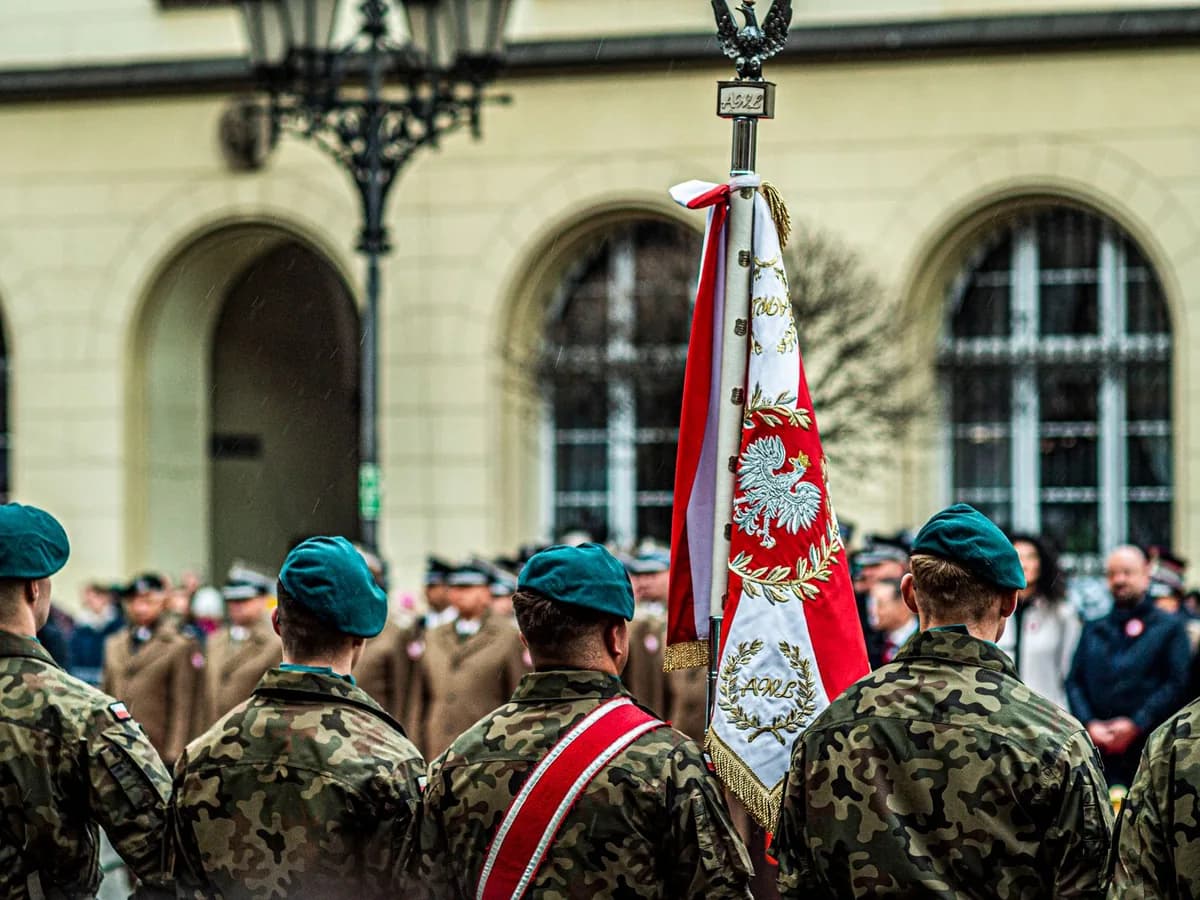
The 1980 act sets out how to behave when the Polish national anthem is performed. Article 14 asks everyone present to keep a serious and calm manner and to stand in a respectful posture. Men in civilian clothes take off their hats, people in uniform with headgear salute, and flag parties dip their banners.
In practice, that means:
- Stand up as soon as the anthem starts, even if you are watching a match at a stadium.
- Take your hat off if you are a man in civilian clothes.
- Stay still and quiet until the last note. Chatting or walking around is seen as rude.
- Don't clap or cheer in the middle; applause, if any, comes at the end of the ceremony.
The same law requires the anthem to be performed "in a way that ensures it due honour and respect" (Article 15). Pop remixes and parodies are therefore controversial in Poland, and politicians regularly argue about them.

When You'll Hear the Polish National Anthem
You'll hear the Polish national anthem at state ceremonies, military parades, school celebrations and every international match the national football or volleyball team plays. It is also part of the two big patriotic holidays: Constitution Day on 3 May and Independence Day on 11 November.
On 11 November in particular, many Poles join a nationwide singing of the anthem at noon. Our guide to Polish Independence Day explains how that works, along with the rest of the day's traditions.
Literature has its own famous performance. In the final book of Adam Mickiewicz's epic Pan Tadeusz, the old dulcimer player Jankiel gives a concert that tells the story of Poland in music, and he ends with the Dąbrowski Mazurka in front of the general himself. If you want to know more about that poem, see our article on Adam Mickiewicz and Pan Tadeusz.
How to Pronounce the First Verse and Refrain
Singing along is the best way to learn the Polish national anthem. These English-friendly spellings use capital letters for the stressed syllable. Remember that ł sounds like English "w", ż and rz sound like the "s" in "pleasure", and ą before b or p sounds like "om".
| Polish | Say it like |
|---|---|
| Jeszcze Polska nie zginęła, | YESH-cheh POL-skah nyeh zgee-NEH-wah |
| Kiedy my żyjemy. | KYEH-dih mih zhih-YEH-mih |
| Co nam obca przemoc wzięła, | tso nahm OB-tsah PSHEH-mots VZHYEH-wah |
| Szablą odbierzemy. | SHAH-blohn od-byeh-ZHEH-mih |
| Marsz, marsz, Dąbrowski, | marsh, marsh, dom-BROF-skee |
| Z ziemi włoskiej do Polski. | z ZHYEH-mee VWOS-kyey doh POL-skee |
| Za twoim przewodem | zah TFOH-eem psheh-VOH-dem |
| Złączym się z narodem. | ZWON-chim shyeh z nah-ROH-dem |
Two sounds trip learners up. The ę in zginęła and wzięła is not nasal before ł; it sounds like a plain "e". And przemoc starts with prz, which is a "p" followed straight away by the "sh" sound. Our guide to mastering Polish pronunciation covers both in detail, and the phonetics lesson lets you practise each sound on its own.
Polish Phonetics & PronunciationUseful Vocabulary From the Polish National Anthem
| Polish | English | Note |
|---|---|---|
| hymn | anthem | hymn narodowy = national anthem |
| zginąć | to perish | past tense zginęła (feminine) |
| żyć | to live | żyjemy = we live |
| przemoc | force, violence | obca przemoc = foreign force |
| szabla | sabre | instrumental szablą |
| ziemia | land, earth | z ziemi włoskiej = from Italian land |
| naród | nation | z narodem = with the nation |
| ojczyzna | homeland | from ojciec (father) |
| przykład | example | dać przykład = to set an example |
| zwyciężać | to win, to prevail | zwycięstwo = victory |
| bęben / taraban | drum | taraban is the old word |
Scenario: Noon on 11 November
You're spending Independence Day with your Polish friend Ola in Kraków. At a few minutes to twelve, people on the market square start to gather and fall quiet.
Ola: Za chwilę hymn. Śpiewasz z nami? (The anthem is in a moment. Are you singing with us?)
You: Znam tylko pierwszą zwrotkę. (I only know the first verse.)
Ola: Wystarczy! Wszyscy i tak śpiewają tylko pierwszą. (That's enough! Everyone only sings the first one anyway.)
You: A refren? "Marsz, marsz, Dąbrowski"? (And the refrain? "March, march, Dąbrowski"?)
Ola: Dokładnie. I zdejmij czapkę. (Exactly. And take your hat off.)
Notice zwrotka (verse) and refren (refrain): the two words you need to talk about any song in Polish.
Frequently Asked Questions
What is the Polish national anthem called?
The Polish national anthem is called Mazurek Dąbrowskiego, which means Dąbrowski's Mazurka. In English it is also known by its first line, "Poland Is Not Yet Lost" (Jeszcze Polska nie zginęła). Its original title was Pieśń Legionów Polskich we Włoszech, the Song of the Polish Legions in Italy.
What does "Jeszcze Polska nie zginęła" mean?
It means "Poland has not yet perished". The next line, kiedy my żyjemy, completes the thought: Poland lives on as long as Poles are alive. It was written in 1797, two years after Poland disappeared from the map in the third partition.
Who wrote the Polish national anthem?
The lyrics were written by Józef Wybicki in July 1797 in Reggio nell'Emilia, Italy, for the Polish Legions of General Jan Henryk Dąbrowski. The melody is anonymous and based on a folk mazurka.
Why does the Polish national anthem mention Italy and Napoleon?
Because it was written in Italy for Polish soldiers fighting alongside Napoleon Bonaparte's armies. They hoped that after defeating Austria they would march home and restore Poland, so the refrain calls on Dąbrowski to lead them "from the Italian land to Poland" and verse 2 holds up Bonaparte as an example.
Is Poland mentioned in the Italian anthem?
Yes. The fifth verse of the Italian anthem, Il Canto degli Italiani, says the Austrian eagle drank "the blood of Poland" together with the Cossack. Poland and Italy are a rare case of two countries naming each other in their national anthems.
How many verses does the Polish national anthem have?
The official Polish national anthem has four verses, each followed by the refrain Marsz, marsz, Dąbrowski. Wybicki's original manuscript had six. At most events only the first verse and the refrain are sung.
Do you have to stand for the Polish national anthem?
Yes. Under the 1980 act on the national symbols, everyone present should stand respectfully, men in civilian clothes should remove their hats, and people in uniform salute. Standing quietly and taking your hat off is all a visitor needs to do.
Learning the Polish national anthem is one of the quickest ways to connect with Polish history: eight short lines carry the partitions, the Napoleonic wars and two centuries of hope. Start with the first verse and refrain, sing along on 11 November, and you'll understand why Poles still stand a little straighter when it plays.